


How to Check a California Roofer’s License and Review Red Flags

A license number is only the starting point. To verify a California roofer, review the contractor’s CSLB record and confirm the active C-39 Roofing classification; according to the Contractors State License Board, roofing work should be covered by this classification. Knowing how to check a roofer's license in California through the CSLB also means reviewing license status, bond and insurance details, and any citations or disciplinary actions on record.
Before hiring a roofer, it makes sense to look beyond a name and license number. This guide explains how to check the CSLB record, understand its status and classification, and review any citation or complaint history. You’ll learn which details to compare with the proposal and what may need closer attention. These checks give you clearer information as you consider roof repair or replacement in San Diego, La Jolla, San Marcos, Encinitas, or Carlsbad.
Table of Contents
How can I verify a roofing contractor’s license in California?
To learn how to check a roofer's license in California using the CSLB, look up the contractor’s record before hiring. Review its status, business details, roofing classification, bond, and workers’ compensation information.
Search by License Number or Business NameEnter the contractor license number or business name in the CSLB lookup. California contractor license numbers contain 4 to 8 digits. For a name search, try distinctive business-name words without an initial “The” or “A.” Compare the result with the proposal. If several contractors appear, use the license number to distinguish the correct record from similar business names.
Confirm License Status and Business DetailsOpen the matching record and review its status, expiration date, legal business name, and physical business address. Compare these details with the proposal and business paperwork. If the name or address differs, confirm that the record belongs to the roofer offering the work, not a similarly named business. A license number alone does not establish that the record matches the contractor.
Verify the C-39 Roofing ClassificationLook at the classifications listed on the record, not just the license number. According to the Contractors State License Board, a contractor doing roofing work in California should hold an active C-39 Roofing classification. A general contractor may perform roofing as part of a larger project, but C-39 is the specific roofing classification to look for when the proposed work is roofing.
Check Bond and Workers’ CompensationReview the record’s bond and workers’ compensation details. According to the Contractors State License Board, most California contractors carry a $25,000 contractor's bond. California requires contractors with employees to have active workers’ compensation. Check whether the record shows current coverage or an exemption for zero employees. This second step in how to check a roofer's license in California using the CSLB helps you review protections alongside license details.
California generally requires an active contractor license for work costing $1,000 or more, work requiring a permit, or work involving employees. A suspended contractor cannot legally take a job requiring a permit, involving employees, or totaling $1,000 or more.
Permit requirements depend on the project and location. Check with the building department for the property’s city or county to find out which requirements apply to the planned roofing work.
Reviewing citations and disciplinary history
If a CSLB record shows a citation or disciplinary action, review the entry before deciding whether to hire. Check its status and context, and contact the Contractors State License Board if you need clarification.
Read the complaint disclosure and disciplinary history in the contractor’s CSLB record rather than relying only on a verbal explanation. Note whether each entry is open, resolved, or associated with a recorded disciplinary action. A complaint is a reason to examine the details, not a conclusion about the contractor’s work. Keep the record handy as you review the proposal and business name.
Assess each citation individually. A resolved citation does not automatically disqualify a California roofing contractor, while multiple open complaints warrant careful attention. Look for the recorded outcome and whether an entry remains unresolved. An old, resolved matter and several open complaints are not equivalent, so use the record’s status to decide what needs further review.
Compare the record’s disciplinary history with the work being discussed. Confirm the contractor’s active license status and 39 roofing classification, then note any discipline shown alongside those details. If the record raises questions about workers or compensation coverage, review those entries separately instead of assuming a citation explains the insurance status. A clean-looking detail in one part of the record doesn’t replace reviewing the rest.
If the roofer is unlicensed or the CSLB record has concerning entries, don’t sign or proceed until you understand the issue. Save the license number, record details, proposal, and related messages; contact the CSLB at 800-321-2752 with specific questions. For homeowners continuing to plan roof work, review roofing options once the licensing concerns are addressed.
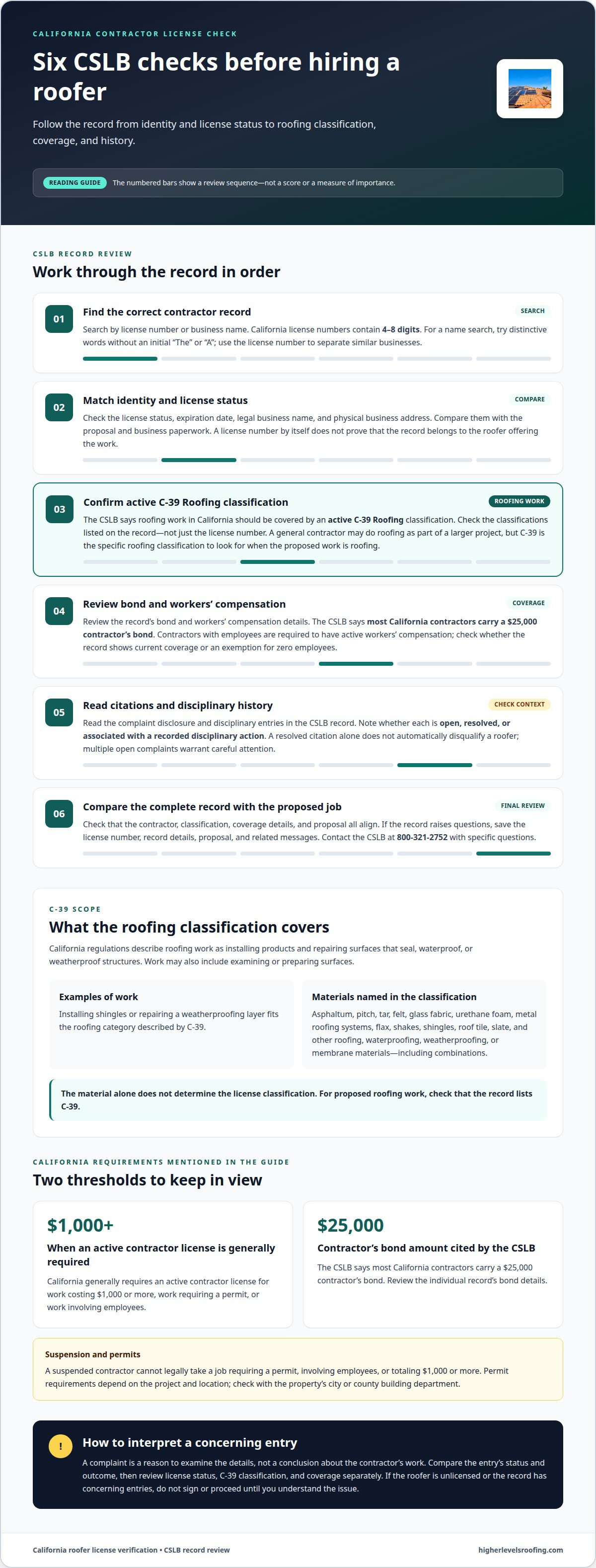
C-39 specialty roofing license classification
Open the Contractors State License Board record and inspect its classifications. For roofing work, look for an active C-39 Roofing classification, not simply a license number. A California contractor’s license can cover different trades, so the listed classification matters. Match the record to the contractor and proposed roofing work before relying on the credential.
Compare the proposed job with C-39’s roofing scope. California regulations define roofing work as installing products and repairing surfaces that seal, waterproof, and weatherproof structures. The work may also include examining or preparing surfaces. For example, installing shingles or repairing a weatherproofing layer fits the roofing category described by this classification.
Consider the materials named in the classification. C-39 work includes asphaltum, pitch, tar, felt, glass fabric, urethane foam, metal roofing systems, flax, shakes, shingles, roof tile, slate, and other roofing, waterproofing, weatherproofing, or membrane materials, including combinations. If a proposal names roof tile or shingles, check that the record lists C-39 rather than assuming the material determines the license classification.
Use the classification’s legal references to understand what the record identifies. California’s roofing contractor classification appears in Title 16, Division 8, Article 3 of the California Code of Regulations. Its stated authority cites Sections 7008 and 7059, with Sections 7058 and 7059 referenced in the Business and Professions Code. These identifiers help distinguish C-39 from unrelated classifications.
Read the record with project scope in mind. Some California general contractors with a B license can legally perform roofing as part of a larger project. That differs from checking for a roofing specialty classification on a contractor focused on roofing work. C-39 licensure is described as requiring at least four years of hands-on roofing experience. Verify the active classification and compare it with the work described in the proposal.
How to verify a California roofer’s license status, expiration date, and business name?
Search the CSLB record using the contractor’s license number or business name. If a name search returns no match, try its distinctive words without an initial “The” or “A.” For a name containing a first and last name, enter the last name first. For initials, try versions with and without spaces. These adjustments can help you find the intended California contractor record.
Review both the license status and expiration date on the matching record. They are separate details, so do not rely only on a printed license number. If the date has passed or the status is not active, pause before signing. Compare the record with the proposal date and planned start of work.
Match the record’s legal business name with the name on the estimate, contract, and payment instructions. A similar name may belong to a different licensee. Check the spelling and business identifiers, then compare the listed physical address with the contractor’s paperwork. If the business uses initials, search with and without spaces so you do not miss a matching entry.
Save the matching CSLB record with the proposal so you can refer to the same license details during project discussions. If the status, expiration date, business name, or address differs from the paperwork, resolve the discrepancy before proceeding. For a planned tile roof project, discuss your roofing project with a roofing professional.
Higher Levels Roofing: Roof Repair Services
Higher Levels Roofing provides roof repair services for damage or wear that calls for a closer look at your roof. For replacement, its roofing options include asphalt shingles, flat concrete tile, and concrete S tile. Matching the work to the existing roof and your project’s needs helps make the next step clear.
After reviewing a contractor’s CSLB record and identifying the work your roof needs, Higher Levels Roofing can help with repairs, replacements, and roofing installations. Share the issue you’ve noticed or the roof type you’re considering to focus the conversation on the relevant work. Contact Higher Levels Roofing to discuss your roofing project.
Make your next roofing decision with confidence
Knowing how to check a roofer’s license in California using the CSLB gives you a sound starting point. Next, turn what you’ve learned into a clear plan for your roof, whether you need a repair or are considering a new material. The right direction depends on the roof’s condition, your priorities, and the work your property needs.
Higher Levels Roofing offers asphalt shingle roofing, flat concrete tile roofing, and concrete S tile roofing. Each option brings a distinct material and appearance to a project. A conversation about your roof can help identify the roofing type and work that fit your plans, without rushing your decision.
Contact Higher Levels Roofing to discuss your roofing project and take a considered next step for your home.
Frequently Asked Questions
How to look up a California roofer’s license on the CSLB website?
Search the CSLB contractor lookup by license number or business name, then open the matching record. Make sure the result belongs to the roofer named on your estimate, not simply a business with a similar name. If two listings look alike, use the license number on the proposal to distinguish them, then review the details for that specific record.
What information do you need to search the CSLB contractor license database?
A contractor’s license number or business name is useful for a CSLB database search. License numbers contain 4 to 8 digits. If you only have a name, try distinctive words from the business name; names that include a person’s first and last name may also be searched with the last name first. Keep the estimate nearby so you can compare the result with the contractor information you received.
Which CSLB license classification is required for roofing work in California?
Look for an active C-39 Roofing classification for roofing work in California. The classification covers roofing activities such as installing roofing products and repairing surfaces that seal, waterproof, and weatherproof structures. A proposal for shingle installation or roof-tile work should be considered alongside the roofer’s listed classification. A general contractor’s other classification may apply to roofing as part of a larger project, so assess the project scope too.
How to check a roofer’s bond, workers’ compensation insurance, and liability coverage with CSLB?
Use the CSLB record to review the contractor’s bond and workers’ compensation information. A license lookup does not prove that the contractor has liability insurance. Review insurance documentation separately and check that it identifies the business involved in your project. Keeping the CSLB record and insurance paperwork together helps distinguish license information from coverage details.
How to verify a roofer’s license number on a bid, contract, or advertisement?
Compare the license number printed on the written proposal or advertisement with the number in the CSLB record. California law, under §7030.5, requires licensed contractors to display their license number on written advertising and proposals. Check that the number leads to the same business name shown on your paperwork. If a contract, bid, and advertisement show different numbers, clarify which licensee is responsible before signing.
How to check CSLB complaints, disciplinary actions, and license history for a roofer?
Read the roofer’s complaint disclosure and disciplinary entries in the CSLB record, including each listed outcome. A complaint and a disciplinary action are not interchangeable: check what the record says happened and whether an entry is open or resolved. A resolved citation does not automatically disqualify a contractor, while multiple open complaints deserve careful attention. Keep the record handy if you need to ask the CSLB about an entry.
Comments