


Cost of Tile Roof San Diego: 2026 Pricing Guide & Saving Strategies

The most expensive roof you can buy in San Diego today is often the one that needs replacing every fifteen years. While the initial cost of tile roof San Diego projects is higher than basic asphalt, these systems are designed to protect your home for a lifetime. It's completely normal to feel overwhelmed by the high upfront investment or confused by the technical differences between clay and concrete. You want a home that reflects our beautiful local architecture, but you also need to account for the 2026 Title 24 energy standards and fire safety codes without any hidden financial surprises.
We're here to provide the professional assurance you need to move forward with confidence. This guide offers a transparent breakdown of current roofing expenses, helping you understand everything from structural reinforcement to the latest "cool roof" technology. You'll discover how to compare material durability and learn about the "lift and reset" method that can save you thousands. By the end of this article, you'll have a clear, methodical plan to achieve a stunning, energy-efficient roof that serves as a permanent contribution to your property's value.
Table of Contents
Average Cost of Tile Roof Replacement in San Diego (2026)
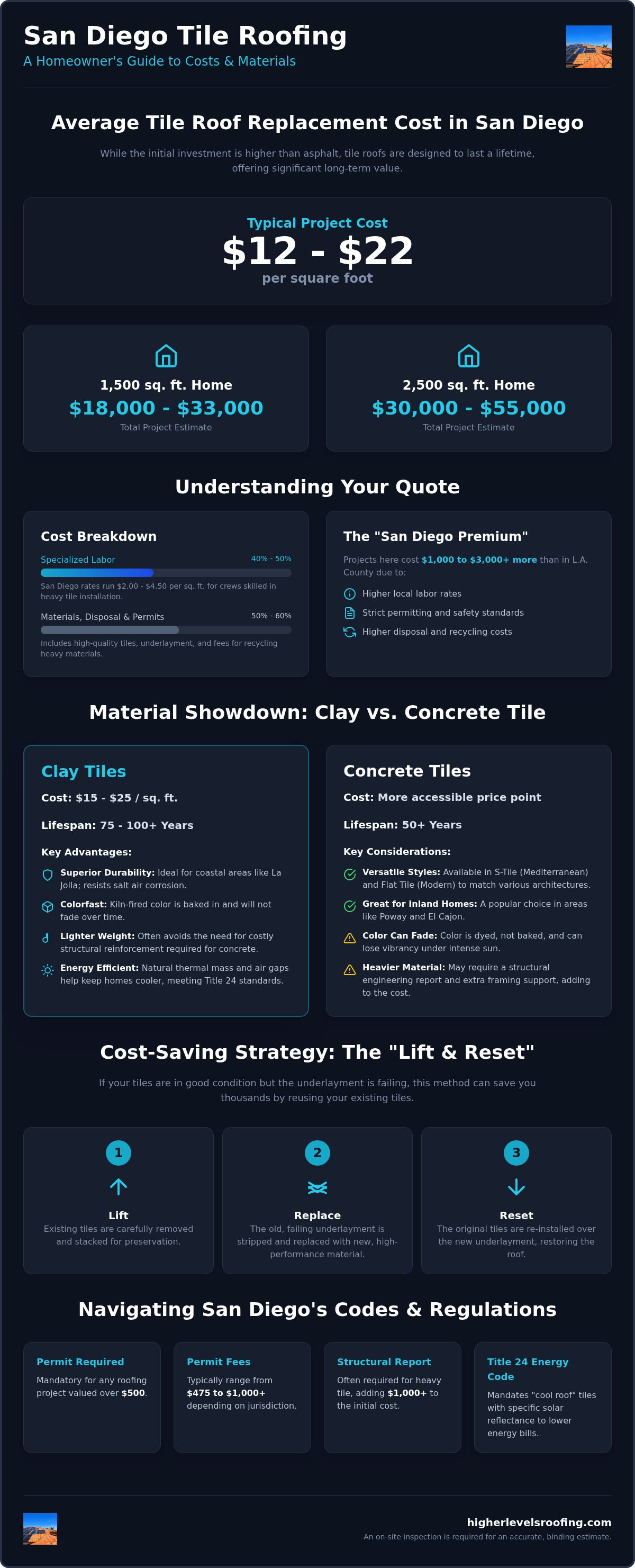
Investing in a new roof is one of the most significant decisions you'll make for your home. In our local market, the typical cost of tile roof San Diego homeowners should expect ranges between $12 and $22 per square foot. While this represents a higher initial investment than asphalt shingles, it's a choice rooted in longevity and local style. A tile system often costs two to three times more than shingles in Southern California because you're paying for a material that can last fifty to one hundred years. For a 1,500 square foot home, total project estimates generally fall between $18,000 and $33,000. Larger 2,500 square foot residences typically see quotes ranging from $30,000 to $55,000, depending on the material grade and roof complexity.
San Diego residents face a unique pricing landscape often called the "San Diego Premium." This includes higher labor rates, strict permitting requirements, and specific disposal costs. On average, a roof replacement here costs $1,000 to $3,000 more than a similar project in Los Angeles County. This difference is driven by our region's rigorous safety standards and the logistical challenges of working in coastal or hillside neighborhoods.
Breaking Down the Quote: Materials vs. Labor
Your quote is split between high-quality materials and the specialized skill required to install them. Roof tiles are exceptionally heavy; they require a crew that understands weight distribution and precision layout. Labor typically accounts for 40% to 50% of your total bill, with rates in San Diego running between $2.00 and $4.50 per square foot. Clay tiles are often viewed as a "buy once, cry once" investment because of their incredible lifespan, though they demand more careful handling than concrete. Additionally, disposal fees are a major factor. Removing and recycling thousands of pounds of old, heavy tile requires specialized equipment and carries higher landfill fees than lighter materials.
Permitting and San Diego Building Codes
Navigating local regulations is where a professional guide becomes essential. A roofing permit is mandatory for any project over $500. In the City of San Diego, these fees usually range from $475 to $900, while County jurisdictions may charge up to $1,000. Because tile is so heavy, building codes often require a structural engineering report to ensure your home's frame can support the load. These reports can add $1,000 or more to your initial estimate. Furthermore, the 2026 California Title 24 Energy Code mandates "cool roof" standards. This means your new tiles must meet specific solar reflectance and thermal emittance levels, which can add a small premium to material costs but will ultimately lower your monthly energy bills.
Clay vs. Concrete Tile: Comparing Material Costs
Deciding between clay and concrete is the most critical choice in your roofing journey. In coastal areas like La Jolla and Del Mar, clay is the undisputed leader for its resistance to salt air and its timeless "San Diego Red" hue. Because clay is kiln-fired, the color is baked into the material itself. It won't fade like dyed concrete tiles, which can lose their vibrancy under the intense Escondido sun. One surprising factor that influences the cost of tile roof San Diego estimates is weight. Clay is actually lighter than concrete. This often means you can avoid the expensive structural bracing that heavier concrete systems require, balancing out clay's higher material price.
Clay Tile Pricing and Benefits
Material prices for clay typically range from $15 to $25 per square foot. While this is a premium entry point, the lifecycle value is staggering. A well-installed clay roof can last 75 to 100 years. It's truly a "buy once" solution for your home. Beyond durability, clay offers natural insulation. The air pockets created by the tile shape and the material's thermal mass keep homes cooler. This directly supports California's Title 24 energy requirements and helps lower your monthly utility bills. If you're looking for a permanent solution that matches the high-end aesthetic of our coastal communities, clay remains the gold standard.
Concrete Tile Options: S-Tile vs. Flat Tile
Concrete tile offers a versatile alternative for inland San Diego homes in areas like El Cajon or Poway. Concrete S-Tile provides that classic Mediterranean barrel look at a more accessible price point. However, if you prefer the modern, clean lines of contemporary architecture, flat concrete tile is the go-to choice. It's important to understand that flat tiles often require higher labor costs. Unlike S-tiles, which can hide minor sub-roof imperfections, flat tiles demand a perfectly level surface and precise alignment. Any slight deviation is visible to the eye, requiring more time and meticulous craftsmanship from your crew. If you're comparing these styles, our team can help you evaluate concrete S-tile roofing options that fit both your vision and your budget.
Local Factors That Drive Your San Diego Roofing Quote
San Diego's diverse geography means your neighbor's quote might not reflect your own. Microclimates play a massive role in the final cost of tile roof San Diego estimates. If you live in La Jolla or Carlsbad, salt air is your primary adversary. Standard galvanized fasteners won't cut it here; they'll corrode within a decade. We specify stainless steel fasteners for coastal properties to ensure your tiles stay secure for the long haul. This meticulous attention to hardware prevents the "tile slip" often seen on older coastal homes.
Inland residents in Escondido or El Cajon face a different challenge: relentless UV exposure. Intense heat accelerates the degradation of the underlayment, which is the actual waterproofing layer of your roof. For these areas, we recommend high-grade synthetic underlayments that resist "cooking" under the tile. Additionally, if your home is in a Wildland-Urban Interface (WUI) zone, 2026 regulations mandate a Class A fire-rated roof assembly. This isn't just a safety recommendation; it's a legal requirement for rural and canyon-adjacent San Diego properties. Your roof's pitch also matters. Steep gables and complex valley transitions require more labor and specialized safety equipment, which naturally impacts the total investment.
Title 24 "Cool Roof" Requirements in 2026
Effective January 1, 2026, California's Title 24 energy code has raised the bar for residential reroofing. Most steep-slope replacements in San Diego now require "cool roof" materials. These tiles feature specialized reflective coatings that bounce solar energy away from your home. While these materials might have a slightly higher upfront price, the payoff is significant. By reducing your air conditioning load during our scorching September heatwaves, these tiles pay for themselves through lower energy bills. You'll want to check The Ultimate Guide to Roof Tiles to see which "cool" options best match your home's architecture.
HOA Restrictions and Aesthetic Compliance
San Diego is home to thousands of HOAs, each with its own strict aesthetic guidelines. Managing these color palettes requires patience and precision. Many associations in Rancho Bernardo or Carmel Valley require specific manufacturer color matches to maintain community uniformity. If your HOA demands a custom or rare tile blend, it can lead to longer lead times and higher procurement costs. We recommend starting the approval process early to avoid project delays. A meticulous contractor will help you provide the exact samples and specifications your board needs for a smooth approval.
The "Lift and Reset" Strategy: Saving on Tile Roof Costs
A common misconception among San Diego homeowners is that a leaking roof always requires a complete material replacement. In many cases, the tiles themselves are in excellent condition; it's the waterproof underlayment beneath them that has failed. This is where the "lift and reset" strategy becomes a game-changer. By carefully removing your existing tiles and replacing only the secondary barrier, you can significantly reduce the cost of tile roof San Diego projects. This method typically offers savings of 30% to 50% compared to a full replacement because you aren't paying for new clay or concrete materials.
The secret lies in the discrepancy between material lifespans. While high-quality clay or concrete tiles can last 50 to 100 years, standard organic felt underlayment often degrades after just 20 or 25 years. If your tiles aren't cracked or spalling, they are perfect candidates for a reset. This approach allows you to maintain the architectural character of your home while ensuring it remains watertight for decades to come.
How do you know if your roof is a candidate? We look for three specific markers during our consultation:
Tile Integrity: The tiles must be structurally sound without significant crumbling or "pitting."
Original Installation: The tiles were originally installed with fasteners rather than just mortar.
Architecture: The roof pitch allows for safe removal and restacking.
The Reset Process Step-by-Step
The process is methodical and requires a steady, expert hand. First, our crews carefully remove and stack your existing tiles. We then inspect the wood decking for any signs of dry rot or termite damage. Once the surface is clear, we install a high-grade, double-layer synthetic underlayment. We also replace all flashings and valley tins, which are the most common leak points in San Diego homes. Finally, we reinstall your original tiles, replacing only the few that may have broken during the process.
Long-Term ROI of a Tile Reset
Choosing a lift and reset isn't just about immediate savings; it's a smart long-term investment. This strategy can extend your roof's life by another 20 to 30 years with minimal environmental impact. Since we aren't hauling tons of heavy tile to the Miramar Landfill, it's the most eco-friendly roofing option available in our region. To understand how this fits into your overall maintenance plan, consult The Homeowner’s Guide to Roof Replacement. If you're ready to see if your home qualifies for these savings, we can perform a detailed inspection of your roof repair services needs today.
Getting an Accurate Tile Roofing Estimate in San Diego
Avoid the temptation of a "ballpark" phone quote. For a complex material like tile, an over-the-phone estimate is almost always inaccurate. A site-unseen number cannot account for the structural integrity of your rafters, the complexity of your roof’s valleys, or the current state of your flashings. When you're calculating the cost of tile roof San Diego projects, you need a contractor who walks the roof and inspects the attic. This level of detail prevents the "surprise" change orders that often plague poorly planned installations.
When you compare quotes, look beyond the bottom line. A lower bid might suggest savings, but it often indicates a shortcut in material quality or a lack of proper permitting. Ensure every estimate explicitly includes high-grade underlayment, new stainless steel flashings for coastal homes, and the cost of debris disposal. Additionally, verify that the permit fees, which typically range from $475 to $900 in the City of San Diego, are clearly accounted for. Financing options are also available for local homeowners. These programs allow you to invest in a premium, 50-year roof while maintaining your monthly cash flow.
The Higher Levels Roofing Difference
We approach every project with the mindset of a meticulous craftsman. Our crews don't just lay tiles; they ensure perfect alignment and weight distribution to protect your home’s structural health. Whether you're in the coastal hills of La Jolla, the suburban reaches of San Marcos, or the breezy neighborhoods of Carlsbad, we bring local expertise to your doorstep. We believe in transparent pricing. This means your quote is a fixed, professional commitment, not a starting point for hidden fees. We take pride in our responsiveness and our deep understanding of San Diego’s specific building codes and Title 24 requirements.
Next Steps for Your San Diego Home
Taking the first step toward a secure home starts with a professional roof health assessment. We recommend scheduling this early, especially if you're navigating HOA approvals or planning around the rainy season. To prepare your property, ensure your driveway is clear for material delivery and that pets are kept indoors during the installation process. Our team will guide you through every phase, from choosing the right "cool roof" color to the final inspection. If you're ready for a transparent, authoritative look at your home's needs, Get your free tile roofing estimate from Higher Levels Roofing today. We are here to ensure your investment provides safety, beauty, and long-term security for your family.
Securing Your Home’s Future with Confidence
Navigating the cost of tile roof San Diego homeowners face doesn't have to be a source of anxiety. By understanding the long-term value of clay and concrete materials, you're making an investment that pays dividends in durability and energy efficiency for decades. Whether you choose a full replacement to meet 2026 Title 24 standards or opt for a cost-effective lift and reset, the result is a safer, more beautiful home that stands up to our unique coastal and inland climates.
As a local, family-owned business since 2022, Higher Levels Roofing brings a craftsman’s eye to every project. We are a licensed San Diego roofing contractor specializing in high-performance clay and concrete tile systems. We believe in transparency, meticulous attention to detail, and protecting the community we call home. Don't leave your property's protection to chance with ballpark guesses or unverified crews. Request Your Professional Tile Roof Estimate today to receive the expert guidance your home deserves. We're ready to help you build a roof that lasts a lifetime.
Frequently Asked Questions
How much does a new tile roof cost in San Diego for a 2,000 sq ft home?
For a typical 2,000 square foot home, the total investment for a tile system is generally higher than other materials due to labor and weight. Concrete options represent the middle of the pricing spectrum, while premium clay systems sit at the top. These estimates usually cover the removal of old materials, new underlayment, and the specialized labor required for tile alignment. Every home is unique, so factors like roof pitch and structural needs will influence the final quote.
Is a clay tile roof more expensive than concrete in California?
Clay tile is generally the more significant upfront investment compared to concrete alternatives. This price gap exists because clay is a natural, kiln-fired material with superior color longevity and a lifespan that can exceed 75 years. While concrete tiles offer a lower entry point and versatile styling, they often require more maintenance over time. Many local homeowners find clay's "buy once" nature provides better long-term value for their property and matches San Diego's classic architectural style.
How long does a tile roof last in San Diego coastal climates?
In coastal areas like La Jolla or Carlsbad, the tiles themselves are incredibly durable. Concrete tiles typically last 50 years or more, while clay can easily surpass the century mark. However, the underlayment beneath the tiles is the critical factor. Salt air and moisture eventually degrade standard felt, often requiring a "lift and reset" after 25 years to replace the waterproofing layer while keeping the original tiles intact. Using high-quality synthetic underlayment can extend this maintenance interval.
Can my existing roof support the weight of heavy concrete tiles?
Tile systems are substantially heavier than asphalt shingles, so structural integrity is a primary concern. Most modern San Diego homes are built to handle this load, but older structures might require reinforcement. A professional inspection is necessary to evaluate your rafters and trusses. We often recommend a structural engineering report to ensure your home can safely support the thousands of pounds of material required for a concrete or clay installation. This step is essential for long-term safety and code compliance.
Does California Title 24 require me to use a specific color of tile?
Title 24 doesn't mandate a specific color, but it does require materials to meet "cool roof" standards for solar reflectance and thermal emittance. In our local climate zones, your new roof must bounce back a certain percentage of solar energy to reduce cooling loads. While this once limited homeowners to lighter shades, modern technology allows for many traditional terracotta and dark charcoal options that still comply with these energy-saving regulations. This helps keep your home cooler during the summer months.
Is it cheaper to repair or replace a leaking tile roof?
The most cost-effective path depends on the extent of the damage. If you have a few broken tiles or a single localized leak, a targeted repair is often sufficient. However, if the underlying felt has reached the end of its lifespan across the entire surface, continuous small repairs become a "band-aid" solution. In these cases, a full replacement or a lift-and-reset is the smarter financial move to prevent expensive interior water damage and ensure the structural safety of your home.
What is a "lift and reset" and how much can it save me?
A lift and reset involves carefully removing your existing tiles, installing a new high-grade underlayment, and then reinstalling the original tiles. This strategy can reduce the cost of tile roof San Diego homeowners expect by 30% to 50% because you aren't purchasing new clay or concrete materials. It is an excellent, eco-friendly option for homes where the tiles remain structurally sound but the waterproofing layer has failed. This approach preserves the home's aesthetic while providing a fresh waterproof seal.
Are there financing options for roof replacement in San Diego County?
Several financing avenues are available to help manage the investment of a new roof. Many San Diego residents utilize home equity lines of credit or specialized home improvement loans that offer competitive rates. Some programs are specifically designed to help with energy-efficient upgrades that align with Title 24 standards. We recommend reviewing these options during your initial consultation to find a plan that protects your home without straining your monthly budget. Local experts can guide you through the available regional programs.


Comments