


Common Flat Roof Problems in San Diego: 2026 Guide

Your flat roof isn't failing because it's flat. It's failing because it wasn't engineered to survive the relentless cycle of San Diego’s intense UV exposure followed by the heavy moisture of our seasonal atmospheric rivers. You've likely felt the midday heat radiating through your ceiling or spent a rainy night worrying about a recurring leak in the living room. These common flat roof problems San Diego property owners encounter are more than just an inconvenience; they're a threat to your home’s structural integrity and your monthly budget.
We understand the anxiety that comes with unpredictable roofing issues, and we're here to provide the steady, expert guidance you need. This 2026 guide identifies the unique environmental stressors affecting your roof and offers practical, professional resolutions for long-term security. You'll learn how to navigate the latest California Title 24 energy standards, understand the differences between modern TPO and durable rolled asphalt torch down, and gain the clarity to decide when a meticulous repair is sufficient or if a full replacement is the smarter path to a leak-free, energy-efficient home.
Table of Contents
Understanding the Flat Roof Environment in San Diego
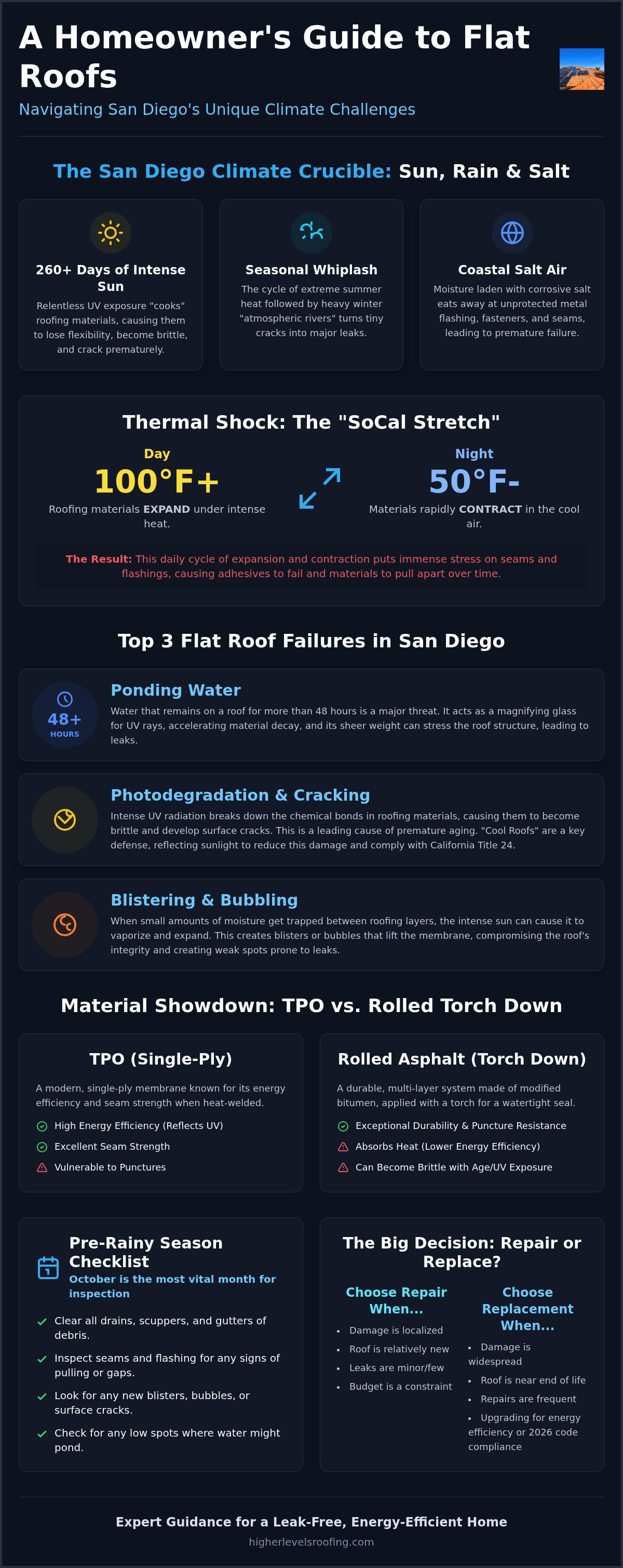
In San Diego architecture, Flat roofs are rarely perfectly level. Technically referred to as low-slope roofs, they feature a slight pitch to guide water toward drains or scuppers. You'll find these sleek designs gracing modern homes in La Jolla or mid-century properties in Encinitas. While they offer a clean, contemporary aesthetic, they face unique environmental pressures that contribute to common flat roof problems San Diego homeowners must manage. Most local properties utilize either TPO or rolled asphalt torch down systems to handle these specific demands.
San Diego enjoys over 260 days of sunshine annually. This abundance of light is wonderful for beach days, but it creates a relentless "cooking" effect on your roof. During July and August, surface temperatures on a dark flat roof can soar. This causes materials to bake, lose their flexibility, and eventually crack under the strain of the heat.
The real trouble often starts when the dry heat meets our winter "Rainy Season." Small, unnoticeable cracks formed during the summer heat become major entry points for water during January’s atmospheric rivers. A minor brittle spot that went ignored in October can lead to a flooded living room by mid-winter. This seasonal transition is why proactive maintenance is so essential for local property owners.
The UV Factor: San Diego’s Silent Roof Killer
The sun's intense UV radiation is a constant threat to your home's security. It breaks down the chemical bonds in bitumen-based materials and even some single-ply membranes. Photodegradation is the process where UV light chemically alters and weakens roofing materials over time, leading to brittleness and surface erosion. Because of this, "cool roofs" have become a necessity for Southern California living. These systems reflect sunlight rather than absorbing it. This protects the structure and helps you stay compliant with the latest California Title 24 energy standards while lowering your indoor temperatures.
Coastal Salt Air and Material Corrosion
Living near the water in Carlsbad or Coronado brings another challenge: salt air. This salt-laden moisture is highly corrosive to standard metal components. It eats away at metal flashing, fasteners, and even the seams of older systems. For homes within a few miles of the coast, we prioritize corrosion-resistant materials like stainless steel or specialized coatings. This attention to detail ensures that common flat roof problems San Diego coastal residents face don't result in premature system failure. Ensuring your fasteners and flashing can withstand the marine environment is a critical part of long-term roof health.
The 4 Most Common Flat Roof Problems San Diego Homeowners Face
While the climate sets the stage, the actual damage manifests in very specific ways. Understanding these common flat roof problems San Diego residents encounter helps you spot trouble before it reaches your ceiling. Most issues start small, but our unique weather patterns can turn a minor flaw into a structural headache within a single season.
Ponding Water and the Danger of Standing Still
Water that stays on a roof for more than 48 hours is officially "ponding." This is a major structural threat that shouldn't be ignored. In our region, even a slight settling of the house can turn a once-perfect slope into a shallow bowl. Standing water acts like a magnifying glass for the sun. It intensifies UV rays, which accelerates the degradation of the membrane beneath it. Over time, the sheer weight of the water stresses the decking and eventually finds a way through the seams. If you notice birds bathing on your roof long after the rain has stopped, you likely have a drainage issue that needs attention.
Thermal Shock: Day-to-Night Stress
San Diego roofs endure what we call the "SoCal Stretch." During a typical Santa Ana event, your roof surface might hit 100 degrees by noon and drop to 50 degrees by midnight. This rapid expansion and contraction puts immense pressure on every seam and flashing detail. To mitigate this, many homeowners switch to cool roofs that reflect solar energy and stay at more stable temperatures. Without this reflectivity, the constant movement eventually causes adhesives to fail and seams to pull apart. This is why high-quality installation is just as important as the material itself.
Blistering and bubbling are another frequent sight on local rooftops. This occurs when moisture gets trapped between the layers of your roofing system. As the sun heats the roof, that moisture turns into water vapor and expands. This creates bubbles or "blisters" that can eventually pop and leave your home vulnerable. It's often caused by a poor initial installation or a small leak that went unnoticed during the dry season. Once a blister pops, the protective layers are compromised, and a leak is almost inevitable.
Finally, drainage failure is a simple but devastating issue. If your scuppers or internal drains are clogged with debris, water has nowhere to go. This leads back to the ponding issues mentioned above. Regular maintenance is the only way to prevent this. A quick professional roof evaluation can identify these drainage bottlenecks before the next winter storm arrives, ensuring your home stays dry and secure.
Material-Specific Failures: TPO vs. Rolled Torch Down
Different materials react differently to our coastal sun and winter rains. While TPO and rolled torch down are the most popular choices for local properties, they each have distinct vulnerabilities. Identifying these material-specific failure points is the first step in diagnosing common flat roof problems San Diego owners experience. Your roof's lifespan depends heavily on how well its specific material handles our unique climate stressors.
TPO Roofing: Why Seam Integrity is Everything
TPO is a modern, single-ply membrane prized for its reflectivity and energy efficiency. During a TPO roofing installation, the sheets are fused together using hot air. This creates a monolithic bond that's theoretically stronger than the membrane itself. However, if the welder's temperature or speed is slightly off, you end up with "cold welds." These seams look secure but will eventually delaminate under the pressure of thermal expansion. Because TPO is a single-layer system, a single puncture from a dropped tool or a sharp branch can lead to immediate leaks. It's a high-performance material that demands a high-precision hand.
Torch Down Roofing: The Risks of Aging Asphalt
Rolled asphalt, or torch down roofing, is a multi-ply alternative known for its thickness and puncture resistance. It's a traditional favorite for many local neighborhoods. The weakness here lies in the asphalt itself. Over years of San Diego sun, the oils in the asphalt evaporate, causing the material to shrink and harden. You'll see "alligatoring," which is a pattern of deep cracks that look like reptile skin. Once these cracks appear, water can seep into the fiberglass mat and rot the structure from within. Granule loss is another red flag; if you see piles of gray sand in your downspouts, your roof is losing its UV protection.
Choosing between these systems depends on your specific needs. TPO holds up better against the heat but requires expert welding. Torch down is tougher against foot traffic but needs more frequent UV maintenance. Even if you're looking for a shingle roofing company for other parts of your home, ensure they have dedicated flat-roof specialists for these membranes. Professional installation is the only way to ensure your seams stay tight and your investment stays secure.
Preparing Your Flat Roof for the San Diego Rainy Season
In San Diego, October represents more than just the arrival of fall; it's the critical window for roof maintenance. This month offers the last stretch of predictable dry weather before the winter atmospheric rivers arrive. Waiting until the first major storm in January to address common flat roof problems San Diego properties face is a risky gamble. By the time you see a brown spot on your ceiling, the water has already saturated your insulation and potentially compromised your structural decking. Taking a proactive stance now ensures your home remains a sanctuary during the wet months ahead.
The Pre-Rain Inspection Checklist
A thorough visual inspection doesn't require you to be a roofing expert, but it does require a meticulous eye. Start by clearing all debris from your scuppers, gutters, and internal drains. Even a small handful of leaves can create a dam that triggers the ponding issues we discussed earlier. Next, walk the surface carefully to check for "soft spots." If the roof feels spongy or gives significantly under your weight, moisture has likely penetrated the membrane and begun to rot the wood beneath. Finally, pay close attention to the perimeter flashing and any penetrations like vent pipes or skylights. These transition points are where the "SoCal Stretch" of thermal expansion most frequently causes seals to fail.
Why DIY Patches Often Cause More Harm
It's tempting to grab a bucket of mastic or a roll of repair tape from a big-box hardware store, but generic solutions often lead to expensive disasters. Many off-the-shelf sealants are chemically incompatible with modern TPO membranes. Instead of creating a bond, these materials can cause the TPO to degrade or swell, widening the original leak. Perhaps more dangerously, applying a patch over a damp area traps moisture inside the roofing assembly. This trapped water, heated by the San Diego sun, creates a greenhouse effect that accelerates dry rot and mold growth within your home’s bones.
True security comes from professional craftsmanship and materials designed to meet the 2026 California Building Standards Code. If your visual check reveals cracks, blisters, or failed seams, it's time to consult an expert. You can use our guide for a roofing contractor San Diego County to ensure you're hiring a specialist who understands the nuances of low-slope systems. Don't leave your home’s safety to chance; schedule a professional inspection today to secure your roof before the rainy season begins.
Expert Flat Roof Repair and Replacement in San Diego
Resolving the common flat roof problems San Diego homeowners encounter requires more than a temporary patch; it demands a professional diagnostic approach. At Higher Levels Roofing, our process starts with a meticulous physical assessment of your system's core. We don't just look at the surface. We identify moisture trapped in the insulation and evaluate the structural integrity of the roof deck. This methodical strategy ensures we solve the underlying cause of your leaks rather than just masking the symptoms for another season.
Repairing vs. Replacing Your Flat Roof
Deciding whether to invest in a repair or a full overhaul often comes down to the "25% Rule." If the damaged area covers more than 25% of your total roof surface, or if the cumulative cost of ongoing repairs is mounting, a roof replacement San Diego residents trust is usually the most cost-effective path. Investing in a modern TPO roofing system provides an immediate return on investment by significantly lowering indoor temperatures. These highly reflective membranes reduce the workload on your air conditioning, which is a major benefit during our long, hot summers. For commercial properties, this energy efficiency translates directly into lower monthly overhead and increased property value.
The Higher Levels Commitment to Quality
Our business is built on a foundation of professional assurance and neighborly warmth. As a locally owned company operated by Carlos, we view every project as a contribution to our community’s landscape. We understand the unique environmental stressors in neighborhoods from La Jolla to Carlsbad, and we tailor our solutions to meet those specific needs. Our team prioritizes meticulous craftsmanship and strict compliance with the 2026 California building codes, ensuring your roof is as safe as it is aesthetically pleasing.
We believe in transparency and steady communication throughout the entire process. You won't face high-pressure sales tactics here; instead, you'll receive the expert guidance of a meticulous craftsman who understands the personal importance of your home. If you're tired of recurring leaks or high energy bills, it's time for a professional consultation. Contact Higher Levels Roofing for a Flat Roof Inspection today and let us provide the long-term security your property deserves.
Securing Your Home Before the Next Storm
Protecting your property starts with understanding that our local climate demands specialized roofing solutions. We've explored how the intense UV cycle and seasonal rains contribute to the most common flat roof problems San Diego residents face, from ponding water to seam delamination. Whether you choose the modern energy efficiency of TPO or the traditional durability of torch down, the quality of the craftsmanship remains the most significant factor in your roof's longevity.
Addressing small vulnerabilities today prevents the stress of emergency leaks when the atmospheric rivers arrive. As a licensed and insured San Diego contractor, our team specializes in providing the meticulous care your low-slope roof requires. We take pride in our five-star rated local craftsmanship and our deep knowledge of TPO and flat roof systems. Don't wait for a brown spot to appear on your ceiling. Take control of your home’s security and long-term value with a professional assessment you can trust.
Frequently Asked Questions
Is a flat roof a good idea in San Diego?
Flat roofs are an excellent choice for San Diego homes because they allow for modern architectural designs and efficient "cool roof" systems. In our climate, these roofs help manage indoor temperatures and comply with California Title 24 energy standards. While they require more attentive drainage maintenance than pitched roofs, their ability to reflect intense UV rays makes them a practical, high-performance solution for properties in La Jolla and Carlsbad.
How long does a flat roof typically last in Southern California?
A well-installed flat roof in Southern California typically lasts between 15 and 30 years depending on the chosen material and maintenance schedule. TPO systems often lean toward the longer end of that range due to their superior UV resistance. Rolled asphalt torch down systems usually provide 15 to 20 years of service. Regular professional inspections are vital to reaching these milestones, as the intense San Diego sun accelerates the aging of any exposed membrane.
Why does my flat roof have standing water after it rains?
Standing water, or ponding, usually occurs because of poor drainage or structural settling that has altered the roof's original slope. If water remains on your roof for more than 48 hours after a storm, it's a sign that your scuppers or internal drains are likely blocked or improperly positioned. This is one of the most common flat roof problems San Diego homeowners face. Ignoring it leads to accelerated material degradation and eventual structural leaks.
Can I walk on my flat roof to inspect it?
You can walk on most flat roofs for a visual inspection, but you must exercise extreme caution to avoid damaging the membrane. TPO surfaces can be surprisingly slippery when wet or dusty, while older torch down roofs may be brittle and prone to cracking underfoot. We recommend wearing soft-soled shoes and sticking to the perimeter when possible. For a truly comprehensive safety and integrity check, a professional evaluation is always the more secure option.
What is the best flat roof material for San Diego heat?
TPO roofing is currently the best material for managing San Diego’s intense heat and UV exposure. Its white, highly reflective surface prevents the "cooking" effect that often damages traditional dark materials. By reflecting solar energy away from your home, TPO helps lower cooling costs and reduces the thermal expansion stress on your roof's seams. It's a modern, energy-efficient solution that aligns perfectly with Southern California’s updated building codes and environmental demands.
How much does it cost to fix a flat roof leak in San Diego?
The cost to repair a flat roof leak varies based on the extent of the damage and the type of membrane involved. Minor seam repairs or flashing adjustments are generally more affordable than addressing large areas of saturated insulation or rotted wood decking. Every project requires a unique diagnostic approach to determine the most effective solution. We provide detailed estimates after a physical inspection to ensure you understand exactly what's needed to secure your property.
How often should I have my flat roof inspected?
We recommend a professional inspection at least twice a year, ideally in late spring and early fall. October is the most critical month for San Diego property owners to ensure their drainage systems are clear before the winter rains begin. Regular checkups allow us to identify common flat roof problems San Diego residents encounter, such as small punctures or failing seals, before they turn into expensive interior water damage or structural rot.
Do flat roofs need special insurance in San Diego County?
Flat roofs don't typically require a separate insurance policy, but they must meet specific local building and fire safety codes to remain fully covered. In many parts of San Diego County, including High Fire Hazard Severity Zones, a Class A fire-rated roof assembly is mandatory for new installations or major re-roofing projects. It's always wise to verify that your system is permitted and code-compliant to ensure your property insurance remains valid and provides maximum protection.
Comments