


TPO Roofing Guide for San Diego Property Owners

Updated: Aug 24
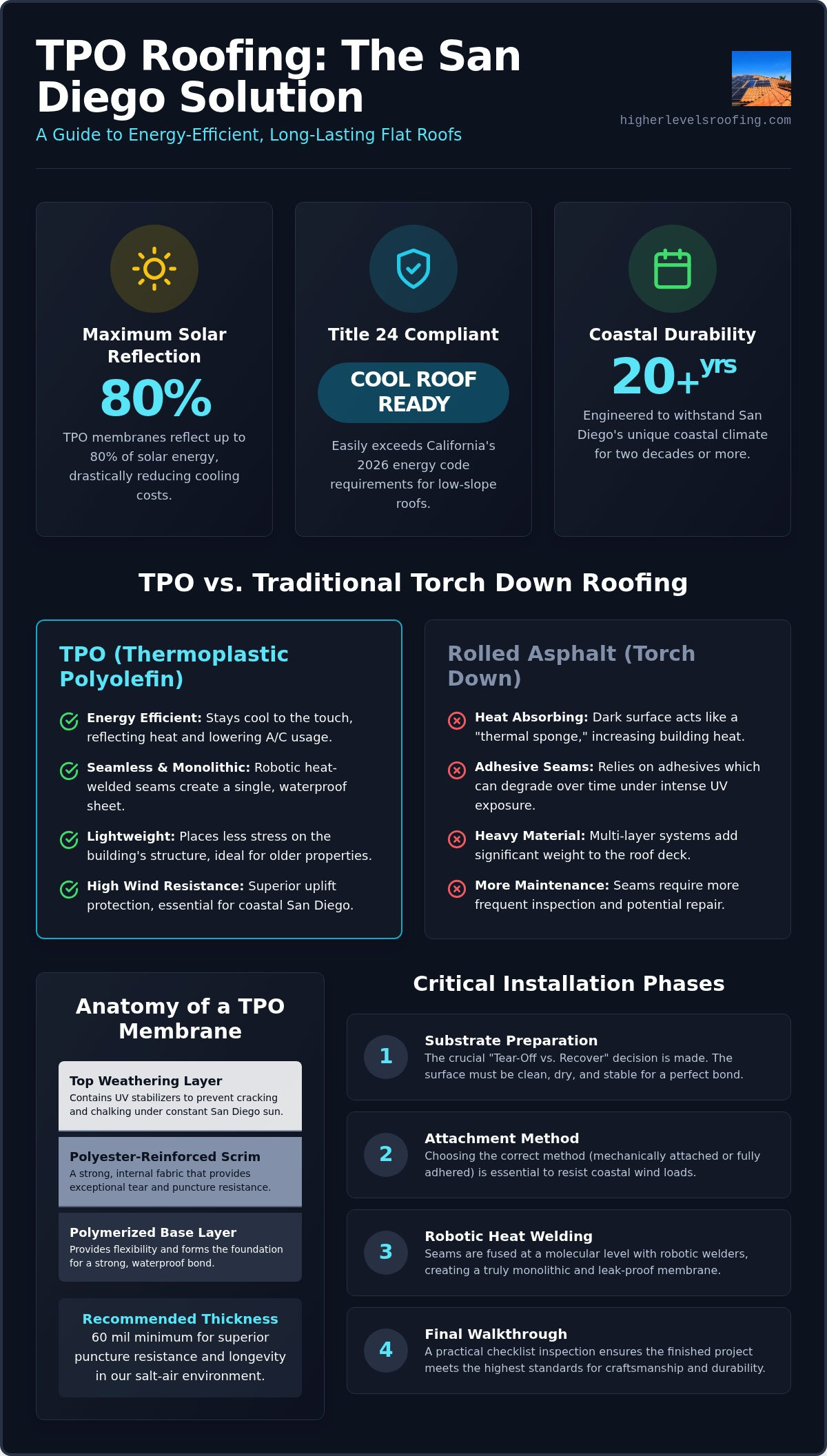
Is your flat roof working against your air conditioner every time the San Diego sun hits its peak? It's a common frustration for local property owners who see energy bills climb alongside the temperature. You likely want a roofing system that does more than just sit there; you need it to actively reflect heat and keep your interior comfortable. A professional tpo roofing installation offers exactly that, providing a high-performance shield that can reflect up to 80% of solar energy.
Reflective TPO and other cool-roof systems can be valuable on low-slope roofs, but a white membrane is not automatically proof that every project meets California code. Requirements depend on building type, alteration scope, roof slope, climate zone, the complete assembly, product rating, and available exceptions. Residential roof-replacement provisions are generally evaluated at 50% or more of the roof; commercial and multifamily projects must be checked under the provisions applicable to that building. Official CEC guidance: https://www.energy.ca.gov/filebrowser/download/8300?fid=8300.
Table of Contents
Understanding TPO Roofing: Why It Is San Diego’s Top Flat Roof Choice
TPO, or Thermoplastic Polyolefin, is a high-performance, single-ply membrane that has quickly become the gold standard for flat and low-slope roofs across Southern California. Unlike older rubber-based systems like EPDM or plastic-heavy PVC, TPO offers a balanced blend of flexibility and extreme durability. For many local property owners, a TPO single-ply roofing system is the most logical choice because it addresses the two biggest threats to a San Diego roof: intense UV radiation and rising energy costs. A professional tpo roofing installation provides a seamless, reflective barrier that protects your building's structural integrity while modernizing its efficiency.
Cool-roof benefits and code compliance should be evaluated separately. Reflective materials may reduce roof-surface heat, but savings vary, and product color alone does not establish compliance. Confirm the project climate zone, roof slope, complete assembly, CRRC rating, and any applicable exceptions before specifying material.
The Anatomy of a TPO Membrane
A TPO sheet isn't just a single layer of plastic; it's a sophisticated composite material. It consists of a polymerized base layer, a polyester-reinforced middle scrim for tear resistance, and a top weathering layer. This top layer is the most critical for San Diego properties because it contains specialized UV stabilizers. These stabilizers prevent the membrane from "chalking" or becoming brittle under our constant sunshine. While membranes come in 45, 60, and 80 mil thicknesses, we typically recommend at least 60 mil for local installations. The extra thickness provides better puncture resistance and a longer weathering life in our salt-air environment.
TPO vs. Rolled Asphalt Torch Down in San Diego
Many local business owners are transitioning from traditional rolled asphalt torch-down roofing to TPO for a better long-term ROI. While torch-down is a proven method, its dark surface acts as a thermal sponge, soaking up heat and transferring it directly into the building. TPO stays significantly cooler to the touch even in the middle of July. It is also a much lighter material, which is a major advantage for older San Diego structures that may not have the load-bearing capacity for heavy multi-layer asphalt systems. While a tpo roofing installation requires more technical precision during the seam-welding phase, the result is a roof that requires less frequent maintenance and provides superior wind uplift resistance along the coast.
Pre-Installation: Preparing the Substrate for a Perfect Weld
A successful tpo roofing installation is only as good as the surface beneath it. Before the first roll of membrane is ever laid down, the substrate must be meticulously prepared to ensure a flat, stable, and dry foundation. Skipping this phase often leads to "bridging" or poor adhesion, which can compromise the roof's ability to withstand San Diego’s coastal winds. We begin every project by stripping away the old layers or cleaning the existing surface to a professional standard, ensuring that the new system has the best possible start.
One of the most critical steps during pre-installation is identifying trapped moisture. If water is locked within the old roofing layers, it will eventually vaporize under the hot San Diego sun, creating pressure that causes the new TPO membrane to blister or delaminate. We use thermal imaging or core sampling to verify that the roof is completely dry. If you are concerned about the current state of your property, our team can provide a comprehensive roof assessment to identify these hidden issues before they become costly repairs.
The "Tear-Off vs. Recover" decision is another pivotal moment in the process. In California, replacing more than 50% of your roof area within a 12-month period triggers full compliance with the latest 2026 building and energy codes. If your existing roof is a single layer and the deck is in good condition, a "recover" (installing TPO over the old roof) can save on labor and disposal costs. However, if there are multiple layers or significant saturation, a full tear-off is the only way to guarantee a 20-year lifespan.
Step 1: Roof Deck Evaluation
We carefully inspect the structural integrity of the deck, whether it’s made of wood, steel, or concrete. In older coastal San Diego homes, dry rot is a frequent discovery due to years of salt-air exposure and minor leaks. We repair these sections immediately to ensure the deck can handle the mechanical fasteners or adhesives used in a tpo roofing installation. We also verify the slope of the deck; TPO is highly effective, but ponding water is a major enemy that can lead to premature membrane degradation if the drainage isn't corrected during this phase.
Step 2: Insulation and Cover Board Selection
For steep-slope residential roofs, the applicable cool-roof criteria depend on the project climate zone and listed exceptions. San Diego County includes more than one climate zone, so the property address must be checked before a shingle or tile is described as code-required.
TPO Attachment Methods: Choosing the Right Strategy for Your Building
How you secure the membrane to your roof deck is just as critical as the material itself. In San Diego, we have to account for specific environmental pressures, from the heavy coastal gusts in La Jolla to the intense thermal expansion felt in inland valleys. While traditional rolled asphalt torch down roofing is always fully bonded to the substrate using an open flame, a tpo roofing installation offers several versatile attachment methods. Each has its own strengths depending on your building's structural design and your specific budget requirements.
Beyond the standard mechanical and adhered options, newer technologies have expanded the toolkit for local property owners. Induction welding, often referred to by the brand name RhinoBond, uses a hybrid approach where the membrane is fused to plates beneath the surface using electromagnetic heat. This reduces the number of penetrations in the membrane. For projects where adhesive odors or fumes are a concern, such as schools or occupied residential complexes, self-adhered (SA) "peel-and-stick" TPO provides a clean, fast alternative that eliminates the need for liquid bonding agents.
When to Use Mechanically Attached TPO
Mechanically attached systems are the most common choice for large-scale commercial warehouses and retail spaces. In this process, we use heavy-duty screws and plates to fasten the membrane through the seams directly into the roof deck. It is a highly efficient method that keeps labor costs lower and allows for a faster installation timeline. However, this method has a distinct characteristic called "billowing." Because the membrane is only secured at the seams, high winds can cause the sheets to lift and flutter slightly. While this is structurally sound when installed to code, it may not provide the sleek, flat look some property owners prefer.
The Benefits of Fully Adhered Systems
For residential flat roofs and high-end coastal properties, fully adhered systems are the gold standard. We apply a specialized bonding adhesive across the entire surface of the cover board, essentially fusing the TPO membrane to the building. This creates a smooth, "no-flutter" aesthetic that is visually superior to mechanical fastening. More importantly, fully adhered systems offer the highest wind uplift ratings. If your property sits on a coastal bluff or in a high-wind zone, this method ensures the membrane stays perfectly flat and secure during a storm. This approach mimics the rock-solid security of a traditional torch-down roof but adds the modern benefits of UV reflectivity and Class A fire resistance required by the latest 2026 California building codes.
The Critical Phase: Heat Welding Seams and Flashings
The heat-welding phase is where a collection of separate membrane sheets becomes a single, monolithic barrier. During a professional tpo roofing installation, we use robotic hot-air welders to traverse the long straight seams of your roof. These machines provide a level of consistency that manual labor simply can't match. However, the machine's settings aren't "set it and forget it." In San Diego, our morning humidity can be significantly higher than the dry heat of the afternoon. We constantly adjust the welder’s speed and temperature to account for these shifts, ensuring the bond is always perfect regardless of the coastal weather.
Once the robot finishes its run, we don't just take its word for it. Every inch of the seam is "probed" using a specialized metal tool. If the probe slips into the seam even slightly, it indicates a "cold weld" where the layers didn't fully fuse. We immediately address these spots to guarantee a leak-free result. If you want to ensure your property receives this level of technical scrutiny, contact our expert team today for a professional consultation.
The Science of the Hot-Air Weld
A hot-air weld isn't just a surface-level stick; it's a molecular fusion. The welder injects air heated to over 1,000°F between the overlapping sheets, momentarily melting the TPO layers so they become one. This makes the seams the strongest part of the roof, often exceeding the tear strength of the membrane itself. It's a massive upgrade over taped EPDM or glued systems that eventually fail as the adhesive dries out. We also pay special attention to "T-Joints," where three layers of membrane meet. We apply a reinforced T-Joint patch at every intersection to eliminate the tiny channels where water could otherwise migrate.
Flashing and Edge Details
While the robot handles the wide-open spaces, our craftsmen focus on the penetrations. We install TPO-clad metal drip edges around the perimeter to lock the roof down against coastal winds. Every HVAC unit, vent, and skylight is wrapped in custom-fitted flashings and pipe boots. Hand-welding these complex corners and vertical transitions requires years of experience and a steady hand. Because human error is more likely in these intricate areas, hand-welding remains the most frequent point of failure in installations performed by inexperienced crews. We treat these details with the same meticulous care as the main seams to ensure your roof is watertight from edge to edge.
Post-Installation: Longevity and Choosing a San Diego Contractor
A professional tpo roofing installation is a significant investment that should protect your property for decades. Once the physical work is complete, your role as a property owner shifts to verification and long-term care. Before signing off on the final payment, perform a detailed walkthrough with your contractor. You should look for uniform, clean seams and ensure that all flashings around HVAC units and vents are tight and wrinkle-free. A meticulous craftsman will leave the site clean, with no scraps of membrane or metal left behind.
Roofing permit requirements depend on the project scope and the authority having jurisdiction. Within the City of San Diego, Information Bulletin 123 states that qualifying nonstructural reroofing may be permit-exempt when the roof structure and diaphragm are not altered. Permits are required for specified structural changes, heavier replacement roofing, removal and replacement of skip sheathing, and designated historic properties. Other cities and unincorporated county areas may use different rules, so the project address and scope must be verified before work begins. Official City guidance: https://www.sandiego.gov/development-services/forms-publications/information-bulletins/123. For low-slope roofs, verify the building type, project scope, climate zone, roof assembly, and CRRC-rated product. A reflective white surface may be beneficial, but it does not by itself establish that the installed assembly satisfies every applicable requirement.
Maintaining Your TPO Roof in San Diego
San Diego’s coastal air carries salt spray and urban grime that can settle on your white membrane over time. This buildup reduces the roof's solar reflectivity, which can cause your cooling costs to creep upward. We recommend washing the surface with a soft-bristle brush and a non-abrasive cleaner at least once a year to keep it bright. Bi-annual inspections are equally important. Schedule these before the winter rainy season to catch minor issues like edge delamination or "scrim-poling," which is when the internal reinforcement grid starts to show through the top weathering layer. Catching these signs early prevents moisture from migrating into your insulation.
Selecting Your San Diego TPO Expert
Finding the right partner for your tpo roofing installation requires more than a quick search. Verify that your contractor is a licensed local specialist and ask about their specific certifications for TPO systems. Experience in neighborhoods like La Jolla, Carlsbad, and Encinitas is a major advantage because these areas have strict environmental requirements and high wind loads. You can learn how we handle TPO commercial roofing in San Diego to see how we manage these complexities for local businesses.
Ready for a cool-roof upgrade? Get a free TPO installation estimate from Higher Levels Roofing today. We take pride in our direct accountability and meticulous attention to detail, ensuring your roof remains a source of pride and protection for years to come.
Secure Your Property with San Diego’s Most Reliable Flat Roof Solution
Transitioning to a TPO system is one of the smartest upgrades you can make for your property's long-term value. You now understand that a successful tpo roofing installation depends on meticulous substrate preparation and the precise science of heat-welded seams. By choosing a system that meets the 2026 Title 24 standards, you aren't just following the law. You're actively lowering your cooling costs and protecting your building from the unique challenges of our coastal climate.
Reliability comes from more than just high-quality materials. It comes from local accountability. As a licensed and insured San Diego roofing contractor, Higher Levels Roofing brings specialized expertise in both TPO and torch down systems to every project. We are locally owned and operated, maintaining a reputation built on 5-star reviews and a commitment to meticulous craftsmanship. Our team understands how to balance technical requirements with the personal importance of your home or business.
Ready to experience the peace of mind that comes with a high-performance roof? Schedule Your Professional TPO Roof Inspection in San Diego today. We look forward to helping you secure your property with a solution that lasts for decades.
Frequently Asked Questions About TPO Roofing
How long does a TPO roofing installation take for a commercial building?
Most commercial projects take between one and two weeks to complete from start to finish. The exact timeline depends on the building's total square footage and the number of penetrations like HVAC units or skylights. If our team needs to perform a full tear-off of old, saturated roofing layers, it typically adds a few days to the schedule compared to a straightforward recover project.
Can TPO be installed over an existing asphalt or metal roof?
You can install TPO over an existing roof as a "recover" if the structural deck is sound and there's currently only one roofing layer in place. This approach is a great way to save on labor and disposal costs. We always conduct a thorough inspection first to ensure no moisture is trapped in the old system before beginning the tpo roofing installation.
What is the average lifespan of a TPO roof in San Diego’s coastal climate?
A properly maintained TPO roof typically lasts between 20 and 30 years in our local environment. TPO is specifically engineered to handle high UV levels and salt air, making it an ideal choice for San Diego’s coastal properties. The heat-welded seams are designed to remain waterproof for the life of the membrane, provided the roof receives basic annual care.
Is TPO roofing slippery when wet?
TPO membranes are very slippery when wet or covered in morning coastal dew. The smooth surface offers little traction during damp conditions, so it's vital to use extreme caution if you must access the roof. We install textured walkway pads in high-traffic areas to provide a safer path for maintenance workers and protect the membrane from wear.
Does TPO roofing come in colors other than white?
A CRRC product rating reports solar-reflectance and thermal-emittance performance; it does not determine by itself whether the product is mandatory for a particular project. The code trigger, slope, climate zone, assembly, and exceptions still have to be evaluated.
What is the difference between 45 mil and 60 mil TPO membrane?
The main difference is the thickness of the top weathering layer and the overall puncture resistance of the sheet. A 60 mil membrane is significantly thicker than a 45 mil option, providing better protection against hail, dropped tools, and UV degradation. For most San Diego commercial and residential flat roofs, we recommend 60 mil to ensure the longest possible service life.
How much does TPO roofing installation cost per square foot in San Diego?
The total investment for your roof depends on several specific factors related to your building's design. Variables such as the total square footage, the complexity of the flashings, and the chosen attachment method all play a role in the final project cost. We provide customized estimates that reflect the current requirements of the San Diego building code and your specific property needs.
Can I walk on my TPO roof for maintenance or HVAC repairs?
You can walk on a TPO roof for routine maintenance, but it's important to avoid dragging heavy tools or equipment across the membrane. For areas that require frequent access, such as around HVAC units, we integrate reinforced walkway pads during the tpo roofing installation. These pads act as a shield, preventing punctures and extending the life of the roof in high-traffic zones.


Comments