


What is Roof Pitch? A Homeowner’s Guide to Understanding Your Roof’s Angle (2026)

Updated: Aug 24
The specific angle of your roof is the primary factor that decides your home's architectural soul and its structural longevity. It is common to feel confused when a contractor starts throwing around technical terms like roof pitch or 6:12 ratios. You likely want a roof that looks beautiful and drains properly during an intense El Niño season, yet the terminology can make the process feel complex. We understand that uncertainty and are here to provide the clarity you need to make an informed decision for your property.
California does not impose one identical cool-roof rule on every residential reroof. Under the 2025 Building Energy Efficiency Standards, effective January 1, 2026, residential roof-replacement provisions are generally evaluated when 50% or more of the roof is replaced. Criteria then depend on roof slope and climate zone: steep-slope provisions apply in climate zones 4 and 8–15, while low-slope provisions apply in climate zones 4 and 6–15, with listed exceptions and alternative compliance paths. Verify the address, slope, assembly, and CRRC-rated product. Official CEC guidance: https://www.energy.ca.gov/filebrowser/download/8300?fid=8300.
Table of Contents
What is Roof Pitch? Understanding the 'Rise and Run' of Your Home
When you look at your home, you aren't just seeing a protective cover; you're seeing a carefully calculated geometric angle. Roof pitch is the measurement of your roof's vertical rise divided by its horizontal run. In simpler terms, it describes the steepness of your home's top surface. While you might hear "pitch" and "slope" used interchangeably, they have slight technical differences. Slope is typically the ratio professionals use during installation, while pitch historically relates to the fraction of the total span. For a San Diego residence, this measurement defines everything from the classic Mediterranean silhouette of a Rancho Santa Fe estate to the clean lines of a modern coastal build.
The Basic Math: Rise Over Run Explained
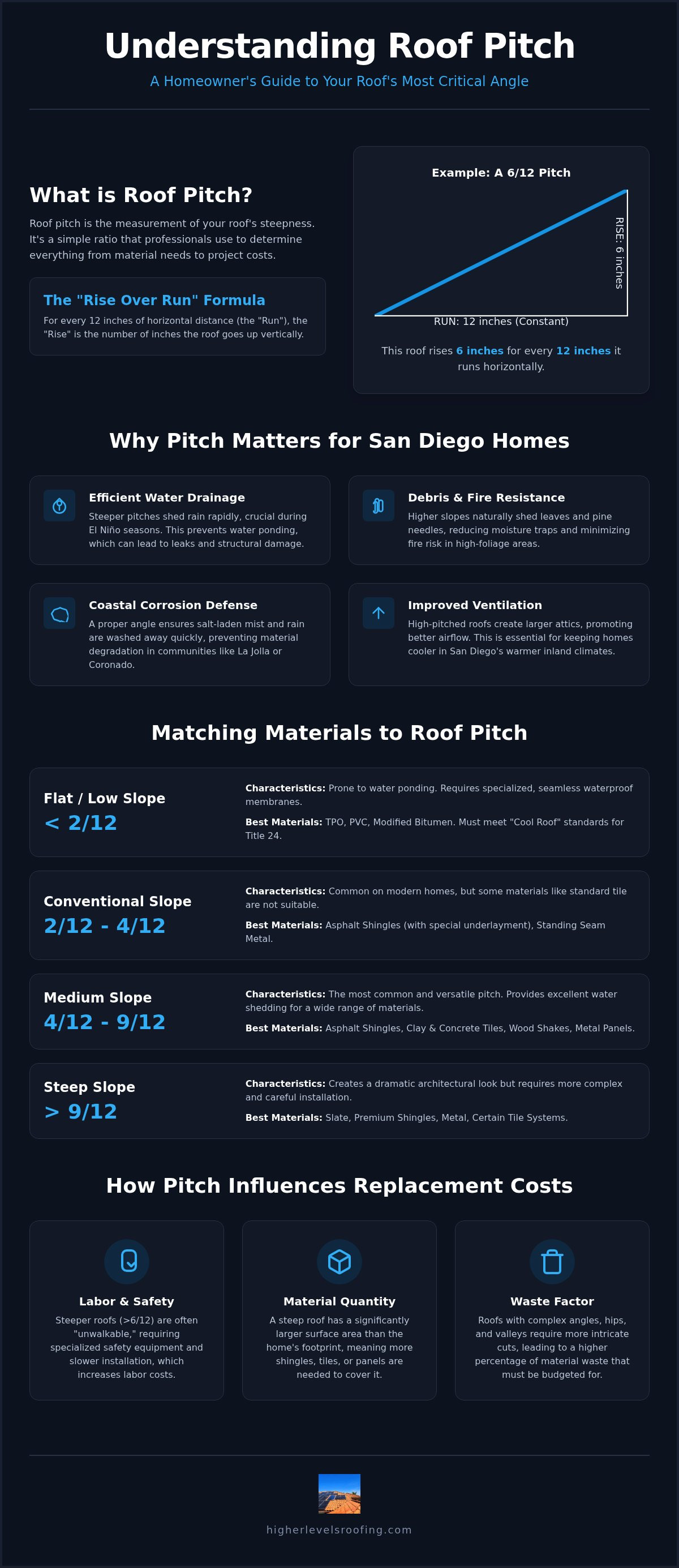
To visualize this, think of your roof as a right triangle. The horizontal base is the "run," and the vertical height is the "rise." In the American roofing industry, the run is almost always a constant 12 inches. This universal standard allows homeowners and contractors to communicate clearly regardless of the home's size. If your roof rises 4 inches for every foot it moves horizontally, it's called a 4/12 pitch. A 6/12 pitch is a roof that rises 6 inches for every 12 inches of horizontal distance. This ratio is the blueprint for how gravity interacts with your home, determining how quickly water, debris, and heat move off your structure.
Why Contractors Use This Specific Measurement
Precision is vital when we plan a project for your property. We use roof pitch to calculate the exact surface area of your home, which is often much larger than the square footage of your floor plan. A steeper angle means more actual roof surface, directly affecting how many bundles of asphalt shingles or clay tiles we need to order. It also determines the "waste factor." Steeper roofs often involve more complex cuts around hips and valleys, which leads to more scrap material that must be factored into the initial order.
Precise measurement is the first step in getting a free roofing estimate that reflects the true scope of the work. It allows us to account for the specific safety equipment needed and the time required for a meticulous installation. By understanding these numbers, you can move forward with a clear picture of your project's requirements and the craftsmanship involved in protecting your San Diego home.
Why Roof Pitch is Critical for San Diego Homeowners
San Diego can receive periods of heavy rain, including atmospheric-river and El Niño-influenced storms, but seasonal forecasts should not be stated as certain months in advance. The practical recommendation is to inspect drainage, flashings, penetrations, and vulnerable roof areas before the wet season and address documented problems promptly.
Beyond water management, the incline influences how your home handles debris and structural weight. Homes in neighborhoods with heavy foliage, like Scripps Ranch or parts of Carlsbad, benefit from steeper slopes that naturally shed leaves and pine needles. This reduces the risk of organic material trapping moisture against your shingles. Architecturally, the pitch also creates the "curb appeal" that defines San Diego living. Whether it's the low-slung profile of a mid-century modern home or the dramatic peaks of a Mediterranean villa, the angle is the foundation of your home's visual identity.
Water Runoff and Coastal Weather Resistance
For those living in coastal communities like La Jolla or Coronado, the roof pitch is a vital factor in resisting salt air corrosion. Low-slope roofs are particularly susceptible to slow-moving water, which can trap salt crystals and accelerate the degradation of materials. If water lingers too long, it can seep under shingles or tiles, leading to the signs you need a new roof, such as interior water stains or mold growth in the attic. A properly angled roof ensures that salt-laden mist and rain are washed away before they can cause hidden damage to the substrate.
Impact on Attic Space and Ventilation
The physics of your roof also dictates your indoor comfort. High-pitch roofs naturally create more vertical volume in your attic, which is essential for effective ventilation. In San Diego’s warmer inland climates, hot air rises and gathers at the highest point of the structure. A steep roof provides the necessary space for this heat to be vented out, significantly reducing your cooling costs during the summer months. Conversely, flat or low-slope structures often require more complex mechanical ventilation systems to achieve the same result. Understanding how your home breathes starts with knowing its angle. If you are unsure how your current incline affects your home's performance, consulting with a local specialist can provide the clarity you need for your next project.
Matching Your Roof Pitch with the Right Materials
Not every roofing material is suitable for every home. The physics of water drainage and gravity dictate your options. If your roof pitch is too shallow, standard shingles will fail because they aren't designed to be watertight against standing water. Conversely, if your roof is exceptionally steep, heavy materials like clay tiles require reinforced fastening and expert weight distribution to stay secure. Choosing the wrong material for your specific angle isn't just an aesthetic mistake; it is a structural risk that can lead to leaks, deck rot, and premature system failure.
Cool-roof benefits and code compliance should be evaluated separately. Reflective materials may reduce roof-surface heat, but savings vary, and product color alone does not establish compliance. Confirm the project climate zone, roof slope, complete assembly, CRRC rating, and any applicable exceptions before specifying material.
Steep-Slope Materials: Shingles and Tiles
Asphalt shingles are the versatile standard for most San Diego residences with a pitch between 4/12 and 12/12. They offer a reliable balance of cost and durability, making them the workhorse of the industry. For homeowners seeking that classic Mediterranean look, clay and concrete tiles are the gold standard. These materials provide maximum visibility on steeper inclines, creating a striking architectural statement that defines neighborhoods from Rancho Santa Fe to Carlsbad.
However, weight is a critical factor. Clay tile and concrete S tiles are significantly heavier than shingles. On a steep slope, we meticulously inspect your home's framing to ensure it can support the load. When installed correctly, these materials offer superior fire resistance and longevity. You can explore the various aesthetic and performance choices in our Ultimate Guide to Roof Tiles.
Low-Slope and Flat Roof Solutions
Flat roofs, technically defined as having an incline between 1/4:12 and 2:12, are common in contemporary La Jolla architecture and commercial buildings. You cannot use traditional shingles here. Because water moves slowly on these surfaces, it can easily back up under shingle tabs through capillary action, leading to hidden rot. Instead, we utilize specialized waterproof membranes like TPO roofing or rolled asphalt torch down systems.
TPO is particularly effective for modern residential flat-tops because it is highly reflective, helping your home stay cool during hot Southern California summers. It meets the strict 2026 standards for low-slope reflectance, often exceeding the required Aged Solar Reflectance of 0.63. For a deeper look at how these high-performance systems work on contemporary structures, see our TPO commercial roofing case study. These systems provide a seamless, watertight seal that shingles simply cannot offer on a flat surface.
Common Roof Pitch Categories: Where Does Your Home Fall?
Every home in San Diego fits into a specific category of steepness. These classifications aren't just for blueprints; they dictate the safety protocols, labor requirements, and material limitations of your project. Understanding where your home falls on the spectrum of roof pitch helps you anticipate the complexity of your upcoming replacement. Most residential structures fall into one of four primary categories, each with its own set of technical demands.
Flat Roofs (0/12 to 2/12): These are common in contemporary San Diego architecture and commercial buildings. They require specialized membranes like TPO to remain watertight.
Low Pitch (2/12 to 4/12): These roofs are too shallow for standard shingle installation without extra protection. They often require double underlayment or a self-adhering ice and water shield to prevent moisture from backing up under the materials.
Conventional Pitch (4/12 to 9/12): This is the standard for most suburban homes across the county. It provides excellent drainage and allows for a wide variety of material choices, including asphalt shingles and concrete tiles.
Steep Pitch (9/12 and up): Often found in Victorian-style homes or specialized custom builds, these roofs are highly visible and aesthetically dramatic.
If you're ready to determine which category your home fits into, contact us for a professional assessment to ensure your project starts with accurate measurements.
The 'Walkable' vs. 'Non-Walkable' Distinction
In the roofing industry, we distinguish between walkable and non-walkable surfaces. A 6/12 pitch is generally the limit for a roofer to walk safely without specialized harnesses or scaffolding. Once a roof pitch exceeds this angle, it becomes "non-walkable," requiring significantly more safety equipment and staging. This distinction directly impacts the labor portion of a roofing quote. Steeper roofs, typically those 8/12 and above, can increase the overall cost of a replacement by 15% to 25%. This is due to the increased time needed for workers to navigate the incline safely and the additional complexity of hauling heavy materials like clay tiles up a sharp angle.
Pitch and San Diego Architectural Styles
The angle of your roof is often the most defining feature of your home's style. Spanish Colonial Revival homes, ubiquitous in neighborhoods like Point Loma, typically feature a medium pitch. This angle is designed to showcase beautiful clay tiles while ensuring heavy rains shed quickly. Mid-Century Modern homes, on the other hand, often utilize low-slope or flat designs. These require seamless solutions like rolled asphalt torch down to maintain their sleek, minimalist profile. Craftsman homes are characterized by low-to-medium pitches with wide overhanging eaves, providing shade and protection while maintaining a grounded, sturdy appearance. Matching your maintenance strategy to these architectural constraints is the key to preserving your home's character and value.
How Pitch Influences Your Roof Replacement Costs
The angle of your roof is one of the most significant variables in your project's final budget. Many homeowners are surprised to find that two houses with the same square footage can have vastly different price points. A 10/12 pitch roof will always cost more than a 4/12 roof of the same size. This discrepancy exists because a steeper roof pitch increases the actual surface area of the structure. Beyond just having more area to cover, the steepness dictates the safety protocols and equipment required to complete the job correctly.
Labor and safety are the primary drivers of these costs. On steep, "non-walkable" surfaces, our team must utilize specialized harnesses, safety scaffolding, and roof jacks to move securely. These precautions are essential for the protection of the craftsmen and your property, but they also increase the total time required for installation. It takes significantly longer to stage materials and tear off old shingles on a sharp incline than it does on a standard suburban slope. When we calculate a quote, we factor in these additional hours and the specialized gear necessary for a meticulous finish.
Technical requirements also change based on the incline. For low-pitch roofs, standard underlayment often isn't enough to meet building codes or manufacturer warranties. These shallow surfaces may need double-layered underlayment or a self-adhering ice and water shield to prevent moisture from backing up during heavy rain. Conversely, steep roofs often feature more complex architectural details like hips and valleys. These intersections lead to a higher "waste factor," as more material must be cut and discarded to ensure a perfect fit around the roof's geometry.
The Complexity Factor in San Diego Roofing
San Diego homes often feature complex roof lines with multiple pitches meeting at various angles. These transitions require expert flashing and precise cutting to remain watertight. Every additional facet or change in the roof pitch adds to the installation time. At Higher Levels Roofing, we provide detailed site assessments to ensure our quotes are accurate and transparent from the start. For a deeper look at how to plan your project finances, we recommend reading our Guide to Roof Replacement in San Diego.
Final Advice: Consult a Local Expert
While you can try to estimate your roof's angle from the ground, DIY measurements are often inaccurate. Layers of old shingles or uneven decking can skew your results by several degrees. A professional inspection is the only way to identify underlying drainage issues or structural concerns related to your pitch. We take pride in our role as a trusted local advocate, helping you navigate these technical details with ease. Contact Higher Levels Roofing for a professional pitch assessment and quote today.
Secure Your Home’s Future with Professional Insight
Understanding your roof pitch is the first step toward a successful home renovation. We have explored how this single measurement dictates everything from the materials you can use to the final cost of labor. Whether you are managing a steep-slope Mediterranean villa or a modern flat-roof coastal home, knowing your angle ensures your property remains watertight and compliant with 2026 local regulations. This knowledge empowers you to speak confidently with contractors and make decisions that protect your home's long-term value and curb appeal.
As locally owned and operated specialists in tile, shingle, and TPO systems, we bring meticulous craftsmanship to every San Diego neighborhood. Don't leave your structural security to guesswork or inaccurate DIY measurements. Get a precise roof pitch assessment and free estimate from Higher Levels Roofing today. Our licensed and insured San Diego experts are ready to provide the professional assurance and neighborly warmth you deserve for your next project. We look forward to helping you build a roof that stands the test of time and enhances your community's landscape.
Frequently Asked Questions
How do I calculate my roof pitch from the ground?
You can estimate your roof's angle from the ground by using a smartphone pitch-finder app or by holding a level against the gable end of your house. However, ground-level measurements are often inaccurate due to perspective and existing shingle layers. For a precise calculation, it is best to have a professional use a pitch gauge or drone technology to ensure your material order is exact.
What is the most common roof pitch in San Diego?
Most suburban residences in San Diego feature a conventional pitch between 4/12 and 6/12. This range is popular because it handles our occasional heavy rain cycles efficiently while remaining walkable for routine maintenance. You will also find many flat or low-slope roofs in modern coastal designs in La Jolla, which require specialized waterproof membranes instead of standard shingles.
Can I change the pitch of my roof during a replacement?
Changing the roof pitch is possible, but it is a major structural project that requires new rafters and professional engineering. This process involves altering the home's entire skeleton, which significantly increases the timeline and complexity of the job. Most homeowners choose to maintain their existing roof shape unless they are performing a full-scale home addition or structural remodel.
What is the minimum pitch for an asphalt shingle roof?
The minimum pitch for asphalt shingles is 2/12, though specialized installation is mandatory for any slope below 4/12. For these low-slope areas, we must install a double layer of underlayment or a self-adhering membrane to prevent water from backing up under the shingles. Using shingles on a pitch lower than 2/12 will void your manufacturer's warranty and lead to leaks.
Does a steeper roof last longer than a flat roof?
Steeper roofs generally have a longer lifespan because they utilize gravity to shed water and debris instantly. Moisture is the primary cause of roof degradation, and a steep angle prevents the ponding that often occurs on flatter surfaces. While modern flat roof systems like TPO are highly durable, they require more frequent inspections to ensure drainage remains clear and effective.
Is a 12/12 pitch roof considered very steep?
A 12/12 pitch is considered very steep and is technically a 45-degree angle. This means that for every 12 inches the roof moves horizontally, it rises exactly 12 inches vertically. These roofs are classified as "non-walkable," meaning our team must use specialized safety equipment, roof jacks, and harnesses to perform any installation or repair work on the surface safely.
Why is labor more expensive for high-pitch roofs?
Labor costs are higher because steep inclines require specialized safety equipment and significantly more time to navigate. Workers cannot move freely on the surface, so they must install staging and roof jacks to create stable work platforms. Additionally, hauling heavy materials like clay tiles up a sharp angle is physically demanding and slows the overall pace of the installation process.
Which roof pitch is best for solar panel installation in San Diego?
A roof pitch between 4/12 and 7/12 is usually best for solar efficiency in our region. This angle aligns well with the sun's path to maximize energy production throughout the year. If your roof is flatter or steeper than this range, solar installers can often use tilt-up mounting racks to achieve the optimal orientation for the Southern California climate.
Comments