


Red Flags When Hiring a Roofing Contractor: A Homeowner’s Checklist

What if the biggest roofing red flag isn’t the price, but what the estimate leaves unclear? The red flags when hiring a roofing contractor often show up in gaps in accountability: vague work descriptions, unclear responsibilities, or pressure to commit before you’ve had time to understand the project. A low bid may look appealing, but you can’t compare proposals fairly if you don’t know what each one includes.
It’s reasonable to want clear answers about licensing, insurance, workmanship, and what happens if the project changes. You shouldn’t have to make a rushed decision to protect your home. In San Diego, reviewing a contractor’s credentials and the details behind the estimate can help you make a more informed choice.
This checklist covers warning signs to watch for, how to compare proposals by scope and accountability rather than headline price, and what to do when something doesn’t add up. You’ll know what to review before signing or paying, and how to keep the decision focused on a clearly defined roofing project.
Table of Contents
Red flags when hiring a roofing contractor: warning signs worth taking seriously
Roofing contractor red flags in estimates, payment terms, and project scope
Licensing, insurance, and local accountability: checks for San Diego homeowners
A practical checklist for responding to roofing contractor red flags
Choosing a roofing team with clear scope and accountable service
Red flags when hiring a roofing contractor: warning signs worth taking seriously
Choosing someone to work on your roof can feel stressful. The project affects your home, and a confident sales pitch doesn’t always make it easy to judge whether the plan is sound. Use this checklist to assess the information in front of you, not to assume the worst because of one awkward conversation.
A red flag is a sign that transparency, documentation, safety, or accountability may be weak. Check whether the contractor can explain the proposed work, identify who is responsible, and put important details in writing. These are useful signals to review before you commit.
Warning signs worth a closer look include:
Pressure to decide before you can review the proposal.
Urgent claims about roof damage without a clear explanation of the recommended work.
Project details or exclusions discussed verbally but left out of writing.
Unclear identification of the business or the person responsible for your project.
Repeatedly unanswered questions or explanations that change from one conversation to the next.
One unclear interaction doesn’t automatically mean a contractor is unreliable. They may have missed a question or need time to clarify a detail. What matters is how they respond: do they follow up, explain the issue, and update the written information? A repeated pattern is more concerning, especially when it affects your understanding of the work, who will perform it, or who is accountable if the plan changes. Focus on what you can verify, not personality or sales style.
High-pressure sales and promises that sound too certain
Be cautious if you’re told to sign immediately or if vague urgency keeps you from reviewing the proposal. A contractor may point out a concern, but you should be able to understand what they observed and why they recommend a particular repair or replacement. Don’t treat a confident statement as a diagnosis on its own. Pause, request a clear written explanation of the proposed work, and take the time you need to review it.
Missing documentation and unclear responsibility
A verbal description can be easy to misunderstand once work begins. Pay attention if the scope, exclusions, or responsibilities remain unclear after you ask for them in writing. You should also be able to identify the business you’re dealing with and the person serving as your project contact. Clear documentation gives both sides a shared record of the agreed work and helps you understand who is responsible for carrying it out.
Clear documentation turns a roofing plan into a record you can use to hold the responsible parties accountable. If a contractor responds to reasonable questions with clear, consistent details, that can help restore confidence. If pressure continues or important explanations remain contradictory, step back before signing or paying. Record the concern, compare the written response with what was discussed, and decide whether the project terms are clear enough to proceed.
Roofing contractor red flags in estimates, payment terms, and project scope
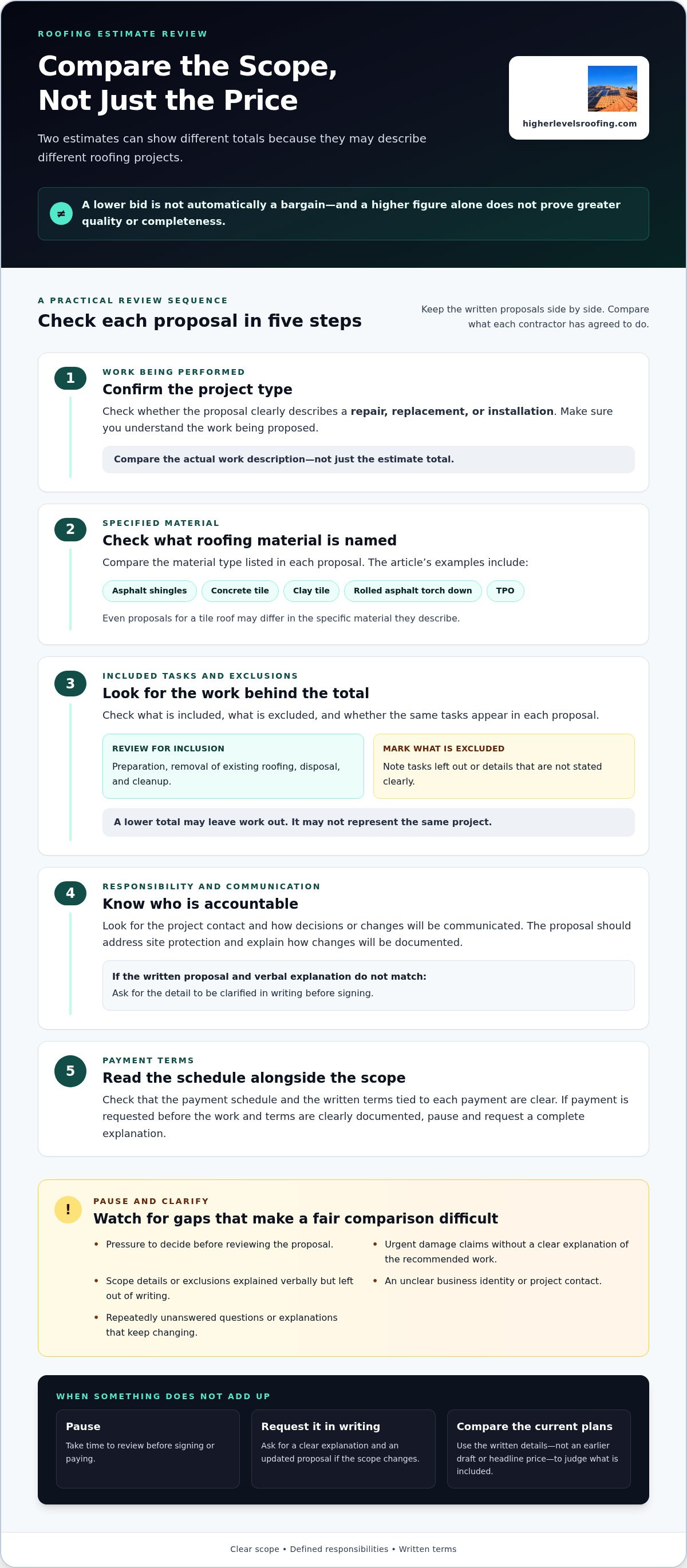
A proposal can look simple at first glance: one scope of work and one total. But two estimates may describe different projects. One might include removing and disposing of existing roofing, while another leaves those tasks out. Materials, preparation, cleanup, and exclusions can also vary. A lower figure isn’t automatically a bargain, and a higher one doesn’t prove the proposal is more complete.
To compare fairly, put the proposals side by side and review what each contractor has actually agreed to do. The red flags when hiring a roofing contractor may be found in omissions, not just the final number.
What an understandable roofing proposal should make clear
Look for a written description of the work, roofing material, included tasks, and stated exclusions. The proposal should also address site protection, cleanup, who handles project communication, and how changes will be documented. If a detail that matters to your home is missing, or a verbal explanation doesn’t match the paperwork, ask for clarification in writing before signing.
For a useful comparison, note whether each proposal specifies:
The work being performed, such as repair, replacement, or installation.
The material type, such as asphalt shingles, concrete tile, clay tile, rolled asphalt torch down, or TPO.
What preparation, removal, and cleanup tasks are included, and what is excluded.
Who your project contact is and how decisions or changes will be communicated.
The payment schedule and the written terms tied to each payment.
Mark differences rather than treating them as minor details. For example, two proposals may both describe a tile roof but differ in the specific material or in which parts of the project they cover. If the scope changes during your discussions, ask for an updated written version so you’re comparing the current plans, not an earlier draft.
How to interpret a low bid or payment request
A low bid deserves a closer scope review, not an automatic rejection. Check whether it names the same material, includes equivalent tasks, and explains exclusions as clearly as the other proposals. A total that leaves out work may not represent the same project. Likewise, a high figure alone doesn’t establish quality or completeness. The details make the comparison meaningful.
Review the payment schedule alongside the written scope. If you’re asked to pay before the work and payment terms are clearly documented, pause and request a complete explanation. Don’t assume a verbal promise will resolve a discrepancy later.
San Diego roofing projects can differ based on roof design, selected materials, and the work involved, so use the same scope questions when considering a roof replacement in San Diego. Higher Levels Roofing provides local residential and commercial installation, replacement, and repair services. Review the project needs and written details with Higher Levels Roofing’s roofing services.
Licensing, insurance, and local accountability: checks for San Diego homeowners
Before judging a proposal, confirm who is behind it and whether the project paperwork matches that business. A simple sequence helps: identify the contractor, review California records, then compare the information with the written agreement. These checks give you a stronger basis for assessing accountability, without treating one credential as a complete measure of the work.
How to check a contractor through California’s CSLB
The California Contractors State License Board (CSLB) is the official resource for contractor license information and consumer guidance. Use its official website to find the license lookup and review current guidance. Search using the business name or license number, then compare the identity in the results with the name on the proposal and agreement. If the records and paperwork appear to refer to different businesses, pause and ask for the discrepancy to be explained in writing.
Review the current record and available details carefully, including license status and any bond or workers’ compensation information shown. Then read the agreement as a separate check: does it identify the same business, describe the project, and make the responsible parties clear? Follow current CSLB guidance for questions about licensing requirements, since requirements can depend on the work and circumstances. Don’t rely on an old screenshot or a number mentioned in conversation when current official records are available.
Why local accountability matters in San Diego County
Local familiarity can help a contractor understand a project’s context, but a nearby address or knowledge of a neighborhood isn’t proof of sound workmanship. Whether your home is in San Diego, La Jolla, San Marcos, Encinitas, or Carlsbad, look for practical signs of accountability: an identifiable business, a clear project contact, and consistent communication as details are discussed. These make it easier to know who is responsible for responding to project questions.
Keep credentials and performance in perspective. A credential check confirms important business information, but it doesn’t by itself prove the quality of a roof’s workmanship. Consider it one part of your assessment, alongside the clarity of the project documents, the contractor’s explanations, and whether the agreed scope is carried out consistently.
As you review records, note any mismatch between the license lookup, the business name on the proposal, and the party identified in the agreement. A difference may have an understandable explanation, but resolve it before moving forward. Unanswered questions or inconsistent identities are red flags when hiring a roofing contractor because they make it harder to determine who is accountable. Assess credentials, written scope, and communication together rather than relying on local presence alone.
A practical checklist for responding to roofing contractor red flags
A concern doesn’t have to become a confrontation. Turn uncertainty into a specific question, then see whether the written response resolves it. Taking time to review the facts can help you make a deliberate decision instead of committing under pressure.
Use this sequence whenever an estimate, conversation, or project detail doesn’t add up:
Pause. Don’t sign or make a payment while a material term is unclear.
Record the concern. Note the date, what was said, and the exact detail that differs from the proposal.
Request clarification in writing. Ask for the relevant scope, exclusion, or responsibility to be explained plainly.
Compare the response. Check whether it matches the proposal and any earlier written communication.
Keep proposals, revised estimates, messages, and notes together in one folder. Label updated versions by date so you can tell which document reflects the current plan. If a concern involves a specific roof area, note what you were told about it and keep any related project communication nearby. An organized record makes it easier to compare statements and spot unresolved differences.
What to do when an estimate or conversation raises concerns
Be precise. Instead of writing “the estimate seems off,” identify the inconsistency. For example, the conversation may describe a task that the written scope doesn’t mention. Ask for a clear written explanation or a revised proposal that addresses the discrepancy. Then compare the reply with the original terms. A helpful response should make the project easier to understand, not leave you guessing about what was agreed.
Keep the original proposal and any revised versions.
Save messages and record the date of important conversations.
Write down the exact question you need answered.
Check whether the answer resolves the issue in the written terms.
When to pause and choose a different direction
One slow reply or imperfect interaction isn’t proof of misconduct. Give the contractor a reasonable opportunity to clarify a straightforward question. But if important terms remain unclear, explanations contradict the written proposal, or pressure continues after you’ve asked for clarification, pause before signing or paying. Wait until you understand the commitment and can make a considered choice.
If the project involves asphalt shingles, material-specific questions can shape what you compare in a proposal. Consider the roof’s stated material, the work included, and whether the written scope explains the project clearly. A shingle roofing company selection guide can offer a focused framework for evaluating those material-related details alongside the contractor’s communication.
If you’re ready to discuss a roofing project with a San Diego-area contractor, contact Higher Levels Roofing about installation, replacement, or repair. Keep your questions and project details together so the conversation stays focused on the work your home needs.
Choosing a roofing team with clear scope and accountable service
The strongest choice isn’t necessarily the proposal with the lowest total or the most confident presentation. Look for a written scope you can understand, communication that answers your questions consistently, and a clearly identified business responsible for the project. These are practical measures of accountability that help you judge the details instead of relying on a sales impression alone.
Use your notes from the earlier checks to make a final comparison. Can you tell what work is included, which materials are proposed, and who is responsible for the project? Do the business details and written terms align? If something remains unclear, resolve it before committing. The goal isn’t to find a proposal with no questions at all. It’s to choose a team that can address important questions clearly and document the agreement.
How Higher Levels Roofing serves San Diego properties
Higher Levels Roofing is a licensed contractor serving San Diego and nearby communities. The company provides residential and commercial roof installation, replacement, and repair services. Its roofing work includes asphalt shingles, clay and concrete tile, rolled asphalt torch down, and TPO.
Material selection depends on the specific project, so review how each proposal describes the roofing system and work involved rather than assuming one material suits every property. A clear conversation about your roof’s condition, project goals, and proposed scope can help you understand the options under consideration. The same careful review applies whether you’re planning a repair, replacement, or new installation.
Take the next step with a clear project conversation
Before moving ahead, gather your questions and the project details you want addressed. Note the areas of the roof that concern you, the type of work you’re considering, and any proposal terms that need clarification. Bringing those points into the discussion keeps it focused and helps you assess whether the proposed work fits your needs.
There’s no need to rush your decision. The red flags when hiring a roofing contractor are most useful when they help you identify what needs clarification and compare your options. Choose a team whose business identity, project scope, and communication give you a clear picture of the work you’re considering.
If you’re considering a roofing project in the San Diego area, explore roofing services with Higher Levels Roofing and discuss installation, replacement, or repair for your property.
Move forward with a clearer roofing decision
Protecting your home doesn’t require you to become a roofing expert. It does mean giving yourself room to understand the decision, record what matters, and expect clear answers about the work you’re considering. Treat red flags when hiring a roofing contractor as prompts to clarify, not reasons to panic. If concerns are resolved, you can weigh the proposal on its merits. If essential terms remain uncertain, pause and reconsider before committing.
Your next step can be simple: gather your questions, note the project priorities that matter most to your property, and have a focused conversation about the options. A calm, informed decision is more useful than a rushed one and gives you a stronger starting point for your roofing project.
Start a conversation about your roofing project with Higher Levels Roofing. Take the time you need, ask what matters to you, and move forward when the plan feels clear.
Frequently Asked Questions
Is the lowest roofing estimate always a red flag?
No. A lower estimate may reflect a different material, a smaller work area, or an assumption that another task is unnecessary. The key is whether the contractor can explain the difference in plain language. Compare specific line items, such as removal, replacement, and disposal, rather than totals alone. Among the red flags when hiring a roofing contractor, a low bid becomes concerning when its scope stays vague or the contractor pressures you to accept it without clarification.
Can a roofing contractor ask for a deposit before work begins?
Yes, a deposit request alone doesn’t establish whether the agreement is appropriate. Payment terms depend on the project and contract, so read the full agreement and consult current California consumer guidance before paying. Check what the deposit covers, how later payments are described, and whether the schedule matches written project milestones. If the contractor can’t explain the terms or insists you pay before you understand them, pause and seek clarification.
How do I verify a roofing contractor’s license in California?
Use the California Contractors State License Board’s official license lookup and consumer resources. Search with the business name or license number, and compare the listed business identity with the proposal and contract. If a company uses a different legal name or business structure, clarify how that relates to the agreement before proceeding. Review the CSLB’s current guidance directly for requirements that may apply to your project; don’t rely on an old article or informal online post.
What should I do if a roofing contractor will not put the estimate in writing?
Don’t commit based only on a verbal estimate. Ask for a written proposal that identifies the work, materials, exclusions, and who is responsible for project decisions. For example, if a conversation mentions replacing damaged decking, the proposal should explain whether that work is included or handled separately. Keep the written response with your project records. If important terms remain undocumented after you ask, consider whether you can make an informed decision.
Is an out-of-town roofing contractor automatically a red flag?
No. A contractor’s location alone doesn’t establish workmanship or accountability. For a property in San Diego, La Jolla, San Marcos, Encinitas, or Carlsbad, focus on whether the business can explain how project questions will be handled and who your point of contact is. Consider practical details too, such as how site visits, updates, and changes will be coordinated. Clear arrangements matter more than a local address by itself.
What happens if I already signed a roofing contract and notice a red flag?
Keep a copy of the signed agreement and related messages, then identify the specific concern in writing. Review the contract for terms about changes, communication, and next steps. If you’re unsure what the agreement means, consult current California consumer guidance or an appropriately qualified adviser. Don’t assume you can cancel, or that a particular deadline applies, without checking the contract and relevant rules for your situation.
Comments