


Energy-Efficient Roofing in San Marcos: A 2026 Buying Guide

Updated: Sep 30
The roofing material that looks most energy-conscious on a product sheet may not be the best fit for your home. Choosing energy efficient roofing San Marcos property owners can rely on means looking beyond broad claims to how a roof’s surface, existing structure, and condition work together.
If you’re unsure whether shingles, concrete tile, clay tile, or a flat-roof option can help manage heat, you’re not alone. Performance depends on more than material alone: solar reflectance and thermal emittance matter, as does whether the roof is suitable for your property. A polished claim is no substitute for evidence tied to the specific product and project.
This guide will help you compare roofing materials and heat-performance factors, understand what to verify before choosing an option, and prepare useful questions for a contractor. We’ll also look at how an assessment of your existing roof can narrow the choices. Higher Levels Roofing serves San Marcos and the wider San Diego area, including La Jolla, San Marcos, Encinitas, and Carlsbad, with residential and commercial roofing installation, replacement, and repair. The company can help property owners consider options in light of their roof’s actual needs.
Table of Contents
What Makes Energy Efficient Roofing San Marcos Homeowners Need?
Energy-efficient roofing isn’t just a material or a light color. It’s how the roof surface and the layers beneath it work together to manage heat entering and leaving a building. In brief, an energy-efficient roof helps limit unwanted heat transfer as part of a roof assembly suited to the building and its conditions. That definition separates a material’s measured properties from whole-home energy outcomes, which also depend on insulation, ventilation, building design, and how occupants use the space.
How does a roof affect indoor heat and energy use?
Sunlight warms the roof surface. Some of that heat can then pass through the roof assembly toward the attic and indoor rooms. A surface’s solar reflectance describes how much sunlight it reflects rather than absorbs. Thermal emittance describes how readily it releases absorbed heat. These properties help explain a material’s behavior, but they don’t predict a home’s total energy use on their own. The overview of Efficient energy use also describes reflective roof surfaces as one way to reduce cooling demand.
Other parts of the assembly matter. Insulation slows heat moving between the roof area and living space—an approach demonstrated by specialists like Third Coast Spray Foam, who focus on how air sealing and advanced insulation limit heat gain. Ventilation helps manage air in the attic, but it doesn’t replace insulation or correct an unsuitable roof assembly. Roof color can affect how much sunlight the surface absorbs, while existing materials, gaps, and the building’s design influence how heat travels. The outcome also varies with occupant habits, such as thermostat settings and how often cooling systems run.
Which local conditions should San Marcos homeowners assess?
Sun exposure makes a property-specific review useful, but roofs in the same city don’t necessarily face the same conditions. Consider the roof’s orientation, the hours of direct sun on different slopes, nearby trees or structures that provide shade, and what’s happening in the attic. A shaded roof plane may behave differently from one exposed to prolonged direct sun.
For energy efficient roofing San Marcos homeowners should compare, a site inspection can ground the decision in the actual roof rather than general assumptions. Ask a roofing contractor to review the roof type and visible condition, and to consider attic conditions as part of the assessment. Don’t rely on an unverified climate-zone label or broad claims about local weather. Confirm applicable local information before using it to guide a material choice. The goal is a recommendation that fits the property, not a one-size-fits-all promise.
How Roofing Materials Influence Energy Performance
No single material is automatically the most energy-efficient choice. Surface properties can affect how a roof responds to sunlight, but the roof’s design, condition, insulation, and installation all influence the finished assembly. For energy efficient roofing San Marcos property owners should compare documented product information alongside roof compatibility, durability, and appearance.
What should buyers compare across roof materials?
Start with product-specific solar reflectance and thermal emittance data, when available. Don’t assume a light color or a label such as “cool” guarantees a particular result. Ratings apply to specific products and finishes, so check the documentation for the exact option under consideration. The Cool Roof Rating Council explains how to review rated roofing products. For broader background on styles and construction, see this roofing material types guide.
Which materials may suit different roof types?
The table is a starting point, not a ranking. Ask a contractor to assess the existing structure and roof design before narrowing your choices.
These materials aren’t interchangeable. A homeowner comparing shingles with tile has different structural and design considerations from a property owner choosing a low-slope system. Ask for evidence tied to the proposed product, not broad claims about a whole material category. A project-specific assessment can help connect those details to your roof’s actual needs. Discuss roofing options with Higher Levels Roofing, which serves San Marcos with residential and commercial installation, replacement, and repair.
How to Compare Energy-Efficient Roofing Options for Your Property
A useful comparison starts with fit, not a single “best” material. Consider the roof’s shape and condition, the existing structure, appearance, maintenance needs, and product documentation together. Reflective roofing can be part of a heat-management strategy, but reflectance alone doesn’t guarantee lower household energy use. Insulation, ventilation, installation, and building use also affect the result.
Use the U.S. Environmental Protection Agency’s explanation of cool roofing principles as background, then ask for evidence specific to the product being proposed. Look for documentation that identifies the material, color or finish, and measured performance. Treat general phrases like “cool” or “energy-saving” as claims to verify, not as a substitute for product data. A clear comparison should also address upkeep and whether the system suits the roof’s existing design.
When might shingles or tile be worth comparing?
Asphalt shingles and clay or concrete tile can each be considered for suitable sloped residential roofs, but their visual character, structural fit, and product specifications differ. Compare the proposed product’s documented performance and finish, and ask whether the existing structure and roof design suit the choice. For more background on tile options, see this San Diego roof tile guide.
When should a buyer assess TPO or rolled roofing?
Low-slope and commercial roofs call for comparisons suited to their configuration. TPO and rolled asphalt torch down are categories to discuss where the roof design is appropriate. Neither should be assumed to deliver a particular energy result without product-specific evidence and an assessment of the full system. Commercial property owners can review this TPO commercial roofing case study for related project context.
Comparison takeaway: A reflective surface may influence heat absorption, but it can’t determine whole-building performance by itself. The roof covering, installation, insulation, ventilation, and compatibility with the property work as a system. That’s why energy efficient roofing San Marcos buyers compare should be evaluated as a complete assembly, with claims tied to verified documents and the specific roof.
If you’re weighing options, a contractor can review your roof type, existing condition, and project goals before recommending a direction. Explore a project-specific roofing assessment with Higher Levels Roofing.
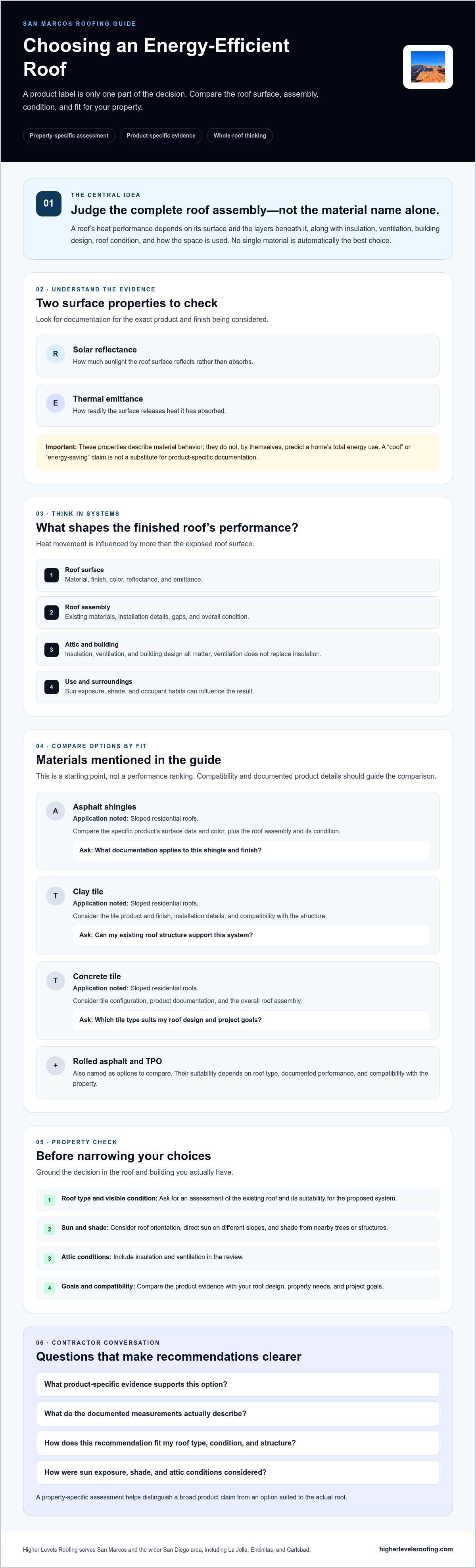
What to Check Before Choosing an Energy-Efficient Roof in San Marcos
A careful selection process helps connect product claims to the roof you actually have. Use this checklist to organize your evaluation before settling on a material or project scope.
1. Identify the roof type. Note whether the roof is sloped or low-slope, and whether the project is residential or commercial. Different designs suit different roofing systems.
2. Inspect the existing condition. Ask for a review of visible wear and the current roof assembly. Existing issues may affect what can be installed and what work the project should include.
3. Clarify your goals. Decide whether your priority is managing heat, addressing roof condition, choosing a particular appearance, or balancing several needs. Include maintenance expectations in the discussion.
4. Compare product documentation. Request information for the exact material, color, and finish being considered. Check that performance claims apply to the proposed product and clarify what parts of the roof assembly they cover.
5. Request a professional assessment. Consider roof orientation, sun exposure, shade from trees or nearby structures, attic conditions, and compatibility with the existing structure. Conditions can vary from one property to another, even within San Marcos.
Which questions should you ask about materials and installation?
Ask the contractor to show product documentation behind any reflectance, emittance, or energy-performance claim, and explain whether it describes the surface material or a larger roof assembly. Confirm that the proposed system suits the roof’s slope, structure, existing layers, drainage, and project scope. Ask how installation details will be specified and how ventilation will be assessed. Before work proceeds, verify which California and local requirements apply to your specific project.
How can you evaluate a roofing contractor’s recommendation?
A sound recommendation should connect the proposed material to your roof’s condition and your stated goals, not rely on a broad “energy-saving” label. Ask for the work scope and product details in writing, confirm the contractor’s license, and clarify how project updates and questions will be handled. For more contractor-selection guidance, review this San Diego County roofing contractor checklist.
These checks give you a practical basis for evaluating energy efficient roofing San Marcos options without relying on unverified promises. Higher Levels Roofing is a licensed contractor serving San Marcos, with residential and commercial installation, replacement, and repair services. Request a project-specific roofing assessment to discuss your roof type, existing conditions, and goals.
Plan Your San Marcos Roofing Project with Higher Levels Roofing
Choosing a roof is easier when the recommendation starts with the property, not a one-size-fits-all claim. Higher Levels Roofing is a licensed contractor serving San Marcos and the wider San Diego area, including La Jolla, Encinitas, and Carlsbad. Its residential and commercial services include roof installation, replacement, and repair, with asphalt shingles, clay and concrete tile, rolled asphalt torch down, and TPO among its confirmed material offerings.
A project discussion can help connect your priorities, such as heat management or addressing an aging roof, with the roof’s design and current condition. The right options depend on the property. A sloped roof may call for a different comparison than a low-slope roof, and product documentation should support any performance statements made about a proposed material. No material choice alone can promise a particular household energy result.
What can a project-specific roofing assessment clarify?
An assessment can establish what type of roof you have, identify visible condition concerns, and consider exposure factors such as orientation and shade. It can also help clarify which materials appear compatible with the roof design and your goals. Ask how the recommendation relates to the property and what product details support it.
Before moving forward, discuss the project scope, proposed materials, and installation approach. Ask which applicable California and local requirements need to be confirmed for your particular project. A clear explanation gives you a practical basis for comparing options, without relying on broad “energy-saving” language or assuming every San Marcos property has the same needs.
What are the next steps for a San Marcos roofing project?
Prepare for a productive conversation by gathering any roof history you have, noting known concerns such as leaks or wear, and writing down your priorities. Include questions about product documentation, compatibility, installation details, and what work is included. If you have a particular material or appearance in mind, mention it, but stay open to recommendations based on the roof itself.
Higher Levels Roofing offers installation, replacement, and repair across its confirmed roofing categories, including asphalt shingles, clay and concrete tile, rolled asphalt torch down, and TPO. A project-specific discussion can help determine which options merit closer consideration for your home or commercial property. For energy efficient roofing San Marcos property owners can evaluate with care, focus on how the recommendation fits the roof and what evidence supports it, rather than expecting guaranteed savings or results.
Bring your questions and roof details to the conversation. Discuss your San Marcos roofing project with Higher Levels Roofing.
Make Your Next Roofing Decision with Confidence
The right roof choice depends on more than a reflective surface or a broad “energy-saving” claim. Compare verified product details, roof condition, and compatibility with your property, then weigh those factors alongside appearance and maintenance. That’s a sound way to assess energy efficient roofing San Marcos homeowners can consider without assuming every material or roof assembly performs the same way.
Higher Levels Roofing is a licensed contractor serving San Marcos and the wider San Diego area, including La Jolla, Encinitas, and Carlsbad. Its residential and commercial services include installation, replacement, and repair, with asphalt shingles, clay and concrete tile, rolled asphalt torch down, and TPO among its offerings. A project-specific discussion can help clarify which options suit your roof and what questions to resolve before work begins.
Gather your roof history, note any concerns, and share your priorities. Discuss your San Marcos roofing project with Higher Levels Roofing. With the right information and a careful assessment, you can move forward with a choice grounded in your property’s needs.
Frequently Asked Questions
What is the most energy-efficient roofing material for a home in San Marcos?
There isn’t one material that’s most efficient for every home. The right option depends on the roof’s shape, structure, condition, and full assembly, as well as product-specific performance documentation. Compare asphalt shingles, clay tile, or concrete tile only after confirming each suits your roof. Ask for verified data on the exact product and finish, and consider insulation and ventilation alongside the roofing material.
Can a new roof help keep a San Marcos home cooler?
A new roof may help manage heat entering a home if its materials and assembly suit the property, but a particular result isn’t guaranteed. Surface reflectance and thermal emittance are relevant product characteristics; insulation, ventilation, roof condition, and building design also affect indoor comfort. For energy efficient roofing San Marcos homeowners should assess, ask a contractor to explain how the proposed roof system addresses your home’s conditions and what evidence supports any performance claims.
How do I know whether my roof needs replacement or can be improved?
A professional inspection can help determine whether repair, replacement, or another project scope is appropriate. Tell the contractor about leaks, visible damage, roof age if known, and past repairs. Ask them to explain the condition of the existing roof and whether it can support the options you’re considering. A material change alone may not address underlying roof concerns, so base the decision on the roof’s actual condition.
Are cool roof requirements applicable to every San Marcos roofing project?
Don’t assume the same requirements apply to every project. Applicable rules can depend on the property, project scope, and current state and local requirements. Before choosing a product, ask the contractor to identify which requirements apply and confirm them with the relevant local building department. Verify product documentation against those requirements rather than relying only on a general “cool roof” description or an assumption about the property’s location.
Does Higher Levels Roofing install solar panels?
No. Higher Levels Roofing does not offer solar panel installation. Its confirmed services focus on residential and commercial roofing installation, replacement, and repair. If you’re considering roofing alongside a separate solar project, clarify the scope and responsibilities with each provider. For insights into residential and commercial setups and to learn how systems are planned with providers like GridFree Solar, read more. Keep roofing-material performance claims distinct from solar generation claims, and ask for documentation relevant to the roofing work being proposed.
Which roofing materials does Higher Levels Roofing offer in San Marcos?
Higher Levels Roofing offers asphalt shingle roofing, flat concrete tile roofing, concrete S tile roofing, clay tile roofing, rolled asphalt torch down roofing, and TPO roofing. The company also provides roof repair services. It serves San Marcos and the wider San Diego area, with residential and commercial installation, replacement, and repair. Ask which offerings are suitable for your roof type and project after its condition has been assessed.
How should I compare roofing estimates for energy efficiency?
Compare more than the proposed material or the estimate total. Check that each estimate describes a comparable project scope, roof assembly, installation details, and product specifications. Ask for documentation behind reflectance, emittance, or energy-use claims, and clarify whether those details apply to the exact product and finish listed. Also confirm how roof condition, ventilation, and property compatibility were considered. Request written answers to any unresolved questions before choosing.


Comments