


Commercial Flat Roofing Contractors in San Diego: The 2026 Hiring Checklist

Updated: Sep 28
What if the biggest threat to your San Diego property isn't a sudden Pacific storm, but a contractor who doesn't understand the 2026 California Building Code? Choosing between commercial flat roofing contractors can feel like a gamble when you're balancing strict Title 24 "cool roof" mandates against the practical need for a leak-free facility. You don't want to stay awake at night wondering if your new TPO membrane was heat-welded correctly or if your contractor will even answer the phone six months from now.
We understand that a commercial roof is a massive investment that requires a steady, expert hand. You need a partner who treats your building like a cornerstone of the local community, not just another job site. This article promises to give you total control over the hiring process with a comprehensive 2026 checklist designed for the unique challenges of the Southern California coast.
We'll clarify the confusion between Torch Down and TPO systems, explain how to navigate the latest Wildland-Urban Interface codes, and provide the exact questions you must ask to ensure your contractor is as committed to your building's long-term security as you are.
Table of Contents
Why Flat Roofing Requires a Specialized Commercial Contractor
Unlike pitched roofs that shed water using gravity and overlapping shingles, commercial flat roofing systems are actually "low-slope" surfaces. They rely entirely on a continuous, waterproof membrane to keep your inventory and employees dry. This shift from gravity-based protection to chemical and mechanical bonding is exactly why hiring generalists or residential-only teams often leads to disaster. Expert commercial flat roofing contractors understand that a flat roof is a living piece of engineering that must breathe, drain, and expand.
In San Diego, we deal with a specific cycle of coastal moisture and intense afternoon sun. When water sits on a roof for more than 48 hours, it's called ponding. This standing water creates a magnifying glass effect that bakes the membrane underneath, leading to premature brittleness. Large commercial footprints also experience significant thermal expansion. A 20,000-square-foot warehouse expands and contracts differently than a three-bedroom home in La Jolla. Without specialized knowledge of expansion joints and flexible membrane attachment, the roof will literally pull itself apart at the seams.
The Engineering of Low-Slope Drainage
Precision is everything when managing water on a flat surface. A successful installation requires a minimum slope of 1/4-inch per foot to move water toward scuppers and internal drains. Professional commercial flat roofing contractors use "crickets"—tapered insulation structures—to direct water away from HVAC curbs and parapet walls. If these are missing or poorly designed, water pools in dead zones. This leads to structural deck rot or mold growth that can compromise your building's air quality and safety.
Commercial vs. Residential Flat Roof Standards
Commercial roofs carry burdens that residential systems simply don't. Consider the heavy HVAC units required for a commercial facility. These units create vibration and localized heat, requiring reinforced load-bearing support that standard contractors aren't trained to install. Warranty structures and fire safety codes also create a clear divide between the two sectors:
Load-Bearing Needs: Commercial systems must support heavy equipment and frequent foot traffic for maintenance.
Warranty Coverage: Commercial warranties often include "no-dollar-limit" (NDL) clauses that are only valid if the installation meets strict manufacturer specifications.
Fire Resistance: The 2026 California Wildland-Urban Interface Code (CWUIC) mandates Class A fire-rated assemblies in many San Diego zones, a standard that requires commercial-grade materials.
Choosing a specialist ensures that your roof doesn't just look good on day one, but remains a compliant, durable asset for decades.
The San Diego Contractor Credentials Checklist
Verifying the background of commercial flat roofing contractors is about more than just checking a box. It's about protecting your capital asset and ensuring the safety of everyone under your roof. In California, the first step is non-negotiable: your contractor must hold an active C-39 Roofing Contractor License. This specific classification ensures they've demonstrated the technical competency required for complex low-slope systems. Beyond the license, you need to confirm they carry general liability and workers' compensation insurance that specifically covers commercial heights. Adherence to OSHA safety guidelines for roofing is a hallmark of a professional operation; if a contractor can't provide a written safety plan, they aren't ready for your project.
Local experience matters in a region as diverse as San Diego County. A contractor who primarily works in the desert won't understand the unique demands of a building in La Jolla or Carlsbad. Ask for local references and look for teams that have successfully navigated California Title 24 compliance. These "Cool Roof" standards are mandatory for most commercial buildings in our area, requiring specific solar reflectance values to reduce the urban heat island effect. If you're looking for a team that understands these local nuances, consider starting with a professional roof assessment from a local expert who knows our neighborhoods.
Local Knowledge and Coastal Compliance
Coastal San Diego presents a harsh environment for roofing hardware. Salt air is incredibly corrosive. Expert contractors will specify stainless steel or high-grade galvanized fasteners and flashings to prevent premature failure. Additionally, San Diego County has specific wind uplift requirements due to our unique geography. A qualified team will ensure your TPO or Torch Down system is fastened or adhered to meet these local engineering standards, preventing the membrane from peeling back during a high-wind event.
Transparency and Professional Standing
The difference between a "guy with a truck" and a professional firm is often found in the paperwork. Avoid one-page estimates that lack detail. A professional proposal should include a clear scope of work, material specifications, and a timeline for completion. Look for manufacturer certifications from industry leaders like GAF or Firestone. These certifications mean the manufacturer trusts the contractor to install their products, which often allows the contractor to offer extended NDL (No Dollar Limit) warranties that generalists simply can't provide. Your roof is a long-term investment; treat the vetting process with the meticulousness it deserves.
Evaluating Flat Roof Systems: TPO vs. Rolled Torch Down
San Diego property owners often face a crossroads when selecting a membrane for their building. The intense Southern California sun and coastal humidity demand a material that won't degrade after just a few seasons. Most commercial flat roofing contractors will steer you toward one of two primary systems: Thermoplastic Polyolefin (TPO) or Rolled Asphalt Torch Down. Each has distinct advantages depending on your building's architecture and how much foot traffic the roof receives. TPO is the modern standard for energy efficiency, while Torch Down remains a heritage choice for sheer physical toughness.
The lifespan of these systems varies significantly. A well-installed TPO roof typically lasts 20 to 30 years, thanks to its UV resistance and flexible nature. In contrast, Rolled Asphalt Torch Down, also known as modified bitumen, usually offers a service life of 15 to 20 years. Maintenance requirements also differ. TPO requires periodic cleaning to maintain its reflective properties, while Torch Down needs regular inspections of the granule surface and seams to ensure the asphalt hasn't become brittle from heat exposure.
When to Choose TPO for Your Business
TPO is an ideal solution for retail centers, warehouses, and office buildings where cooling costs are a major concern. It's a single-ply, reflective white membrane that naturally lowers the internal temperature of your facility. One of its greatest strengths is the installation process. Experienced commercial flat roofing contractors use hot-air welders to fuse the seams together, creating a monolithic surface that is incredibly resistant to leaks. For a deeper dive into this technology, read our TPO Roofing Guide for San Diego Property Owners.
The Case for Rolled Asphalt Torch Down
While TPO is popular, Rolled Asphalt Torch Down is still a powerhouse for specific use cases. If your roof houses heavy HVAC equipment that requires weekly maintenance visits, you need a system with exceptional puncture resistance. Torch Down consists of multiple layers of asphalt modified with rubber or plastic, making it much thicker than single-ply membranes. It handles the San Diego sun by using a ceramic-granule top layer that shields the underlying bitumen. It's a reliable, time-tested choice for smaller commercial footprints or buildings with complex roof layouts where a torch-applied system can more easily seal around tight corners and pipes.
Regardless of the system you choose, success depends on the meticulousness of the installation. A steady, expert hand ensures that every seam is tight and every flashing is secure against the elements.
The Pre-Installation Checklist: Vetting the Contractor’s Process
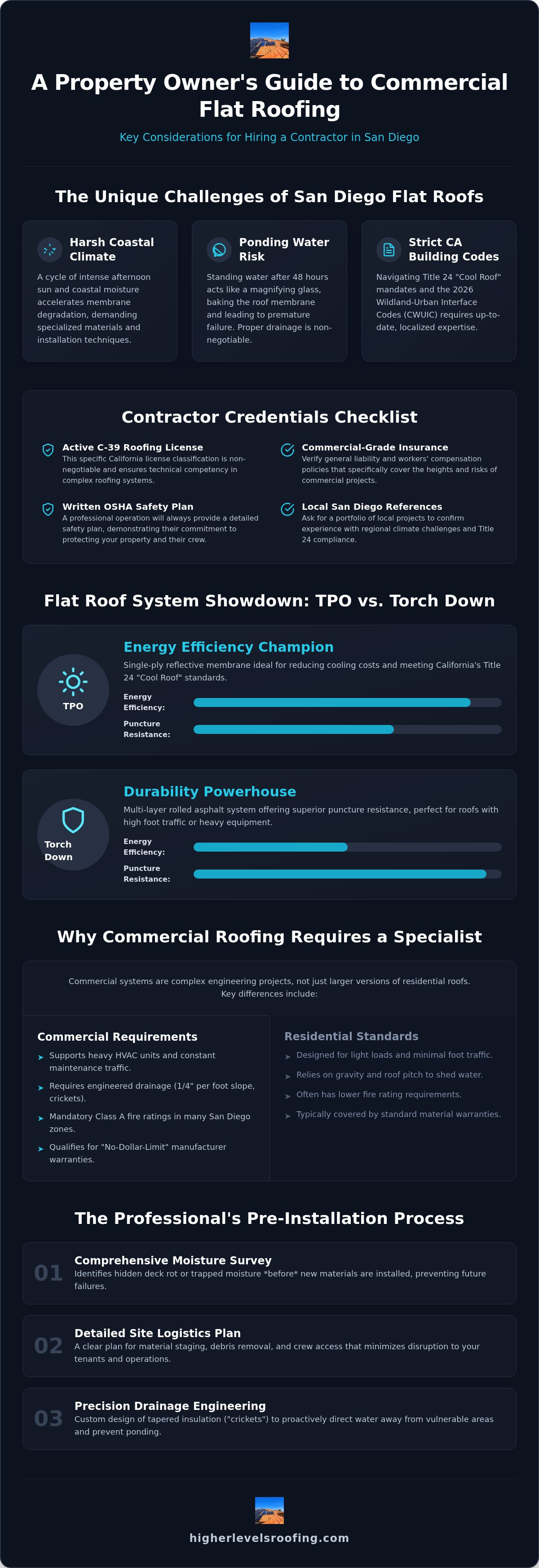
Before the first roll of TPO or Torch Down is ever staged, the best commercial flat roofing contractors will provide a clear roadmap for the entire project. A successful installation isn't just about what happens on the roof; it's about the meticulous planning on the ground. This process begins with a comprehensive moisture survey and deck inspection. It's a critical error to install a new membrane over a compromised deck or wet insulation, as trapped moisture will eventually lead to structural rot and mold. We use specialized tools to identify these hidden issues before the project officially kicks off.
Logistics planning is the next non-negotiable step. In dense San Diego neighborhoods, managing debris and staging materials requires a strategy that doesn't block your customers or tenants. You need to know exactly how the contractor will manage the site. Additionally, safety protocols must be verified. A professional team will always be ready to discuss their OSHA compliance and fall protection plans. Finally, ask about quality control. At Higher Levels Roofing, Carlos provides direct on-site oversight to ensure every detail matches our standards for craftsmanship. If you want to see this level of detail in action, schedule your pre-installation consultation today.
Minimizing Business Disruption
Retail and office environments can't simply stop because of a construction project. We coordinate noise-heavy tasks, such as tear-offs, for off-peak hours or weekends when possible. Our team also implements noise mitigation strategies to keep your interior environment professional. Ensuring safe customer ingress and egress is a top priority; we clearly mark staging areas and debris zones to keep the public away from active work sites.
Post-Installation and Maintenance
At project closeout, review the completed scope, drainage details, cleanup and warranty documents with the contractor. Manufacturer and workmanship warranties cover different responsibilities; read the actual terms and maintenance requirements. For longer-term planning, see our TPO roof replacement guide.
Partnering with Higher Levels Roofing for Your Commercial Property
Choosing from the sea of commercial flat roofing contractors in Southern California is a decision that impacts your building's value for decades. At Higher Levels Roofing, we bridge the gap between a high-end service provider and a trusted local specialist. We are locally owned and operated. This means we bring a level of accountability that national chains simply can't match. We are your neighbors. When we work on a project in Carlsbad or Del Mar, we're contributing to the landscape of our own community. This local pride drives our commitment to meticulous craftsmanship. We don't just "install" a roof; we engineer a long-term security solution.
Our expertise is concentrated on the systems that perform best in our unique environment. We specialize in TPO and Rolled Asphalt Torch Down roofing because these systems offer the durability and reflective properties required to meet California's strict energy standards. We understand that every building has a different story and a different set of needs. Our team focuses on the intersection of functional necessity and visual appeal. We maintain clear, steady communication from the initial moisture survey to the final walk-through. You'll never feel rushed or left in the dark.
The Higher Levels Difference in San Diego
We prioritize a person-to-person business relationship. You'll have direct access to our principals, including Carlos, for every project we undertake. This direct line of communication ensures that your specific requirements are never lost in translation. We possess a deep understanding of San Diego’s coastal climate, from the corrosive salt air of the beach to the intense inland heat. This local expertise allows us to select the exact fasteners and membranes that will withstand our region's specific challenges. We stay ahead of evolving building codes so you don't have to. For a detailed look at our results, please review our TPO Commercial Roofing Case Study.
Schedule Your Professional Consultation
Our process mirrors a professional consultation rather than a sales pitch. When you request a commercial roof evaluation, we provide a methodical overview of your building’s current state. We identify potential failure points before they become costly emergencies. We provide customized solutions for property owners in La Jolla, San Marcos, and throughout the county. Our goal is to leave you feeling informed and in total control of your investment. Reliability and calm confidence are what we offer. Contact Higher Levels Roofing for a quote and experience the difference that a dedicated local advocate can make for your business.
Securing Your San Diego Property for the Decades Ahead
Protecting your commercial facility requires more than just a new membrane; it requires a partnership with experts who understand the physics of low-slope drainage and the nuances of San Diego's coastal climate. By following this 2026 checklist, you've learned how to distinguish generalists from specialized commercial flat roofing contractors who prioritize Title 24 compliance and structural integrity. Whether you choose the energy efficiency of TPO or the rugged durability of a multi-layer Torch Down system, the success of your project rests on the precision of the installation and the transparency of the process.
As a licensed San Diego C-39 contractor, Higher Levels Roofing provides the accountability and steady hand your facility deserves. We are specialists in TPO and Torch Down systems, and every project we undertake is backed by our meticulous craftsmanship guarantee. Don't leave your property's safety to chance when you can have a dedicated local advocate by your side. Get a Free Commercial Flat Roof Evaluation from Higher Levels Roofing. We look forward to helping you build a more secure future for your business.
Frequently Asked Questions
How much does a commercial flat roof cost per square foot in San Diego?
Estimating the total investment for a project involves looking at several variables beyond just the square footage. The choice of membrane, the condition of the existing roof deck, and the complexity of the drainage system all play a role. We suggest speaking with commercial flat roofing contractors to receive a detailed proposal that covers your specific building's requirements and local permit fees.
What is the best flat roofing material for coastal properties in La Jolla?
TPO is often the superior choice for coastal properties in La Jolla. Its heat-welded seams provide a monolithic barrier against salt-heavy humidity and coastal mist. While Torch Down is durable, TPO's reflective surface helps meet strict energy mandates while resisting the corrosive effects of the marine layer. Our team focuses on using stainless steel fasteners in these zones to prevent premature rust.
How long does a commercial flat roof installation typically take?
Most commercial projects take between one and three weeks to complete. Small retail spaces might be finished in five days, while large-scale warehouses require more time for staging and safety setup. The duration varies based on weather conditions, the complexity of the existing drainage system, and the logistics of managing tenant access during the construction phase.
Can I repair my flat roof, or do I need a full replacement?
Repairs are often viable if the leaks are confined to a small area and the roof deck is structurally sound. If the membrane is brittle from age or if moisture has compromised the insulation, a replacement is the safer long-term choice. Our commercial flat roofing contractors use moisture surveys to pinpoint wet spots, ensuring we only recommend a full tear-off when it's absolutely necessary.
What is Title 24, and does my commercial roof need to comply?
Title 24 is California's energy efficiency standard that mandates "cool roofs" for most commercial buildings. In San Diego, this means your new roof must meet specific aged solar reflectance and thermal emittance values. These requirements help lower your building's internal temperature and reduce the strain on the local power grid. Compliance is required for almost all new installations and major alterations.
How often should I have my commercial flat roof inspected?
We recommend professional inspections at least twice a year. The best times are in the fall before San Diego's winter rains begin and again in the spring. Regular checks allow you to clear debris from scuppers and identify small membrane tears before they turn into expensive interior water damage. Proactive maintenance can extend your roof's lifespan by several years.
Is TPO roofing better than Torch Down for retail buildings?
TPO is usually the preferred option for retail buildings because its white, reflective surface significantly lowers air conditioning costs. It's a key part of staying compliant with local energy codes. Torch Down is a better alternative only if your retail roof sees heavy foot traffic from frequent equipment servicing, as its multi-layer asphalt construction offers superior puncture resistance.
Comments