


Best Roofing for Coastal Homes in La Jolla: A 2026 Guide

The roof that looks most at home beside the coast isn’t automatically the best choice for the conditions it must handle. Finding the best roofing for coastal homes La Jolla means weighing salt air, moisture, sun, and wind alongside your home’s style and existing roof structure.
It’s reasonable to want a roof that looks good and suits your home without more upkeep than you expect. But the visible covering is only part of the decision. Underlayment, flashing, fasteners, roof edges, and installation details all contribute to the finished system. Your home’s design, existing roof, and applicable project requirements can also narrow the options.
This guide compares asphalt shingles, clay and concrete tile, and options to discuss for low-slope roofs. You’ll learn what to consider about appearance, maintenance, compatibility, and system details, plus what to ask a qualified local roofing contractor. The goal is to create a property-specific shortlist, not a one-size-fits-all answer.
Table of Contents
What Makes the Best Roofing for Coastal Homes in La Jolla?
A coastal-ready roof is more than its covering. It combines a material suited to the property with compatible system components and installation details, then requires maintenance appropriate to the roof and site. The surface, layers beneath it, and details at edges and transitions all contribute to how the roof performs.
There isn’t one answer for every home. The best roofing for coastal homes La Jolla depends on the home’s exposure, design, existing roof, and the owner’s maintenance preferences. A property near the water may face different conditions from one farther inland or sheltered by its surroundings. Roof shape, orientation, elevation, and nearby structures can also affect how much sun, wind, and marine moisture reach different sections.
How La Jolla’s coastal conditions can affect a roof
Salt carried in coastal air may affect exposed metal components, including flashing and fasteners. The degree of exposure and its effects vary with the site and materials. Marine moisture can leave roof surfaces and details damp, while shade, airflow, and roof design affect drying conditions. These are factors to discuss during an assessment, not proof that every coastal roof will develop the same problems.
Sun and wind also vary from property to property. Roof orientation, surrounding shelter, slope, and edges influence how sunlight falls and how wind interacts with the covering. Instead of choosing based on a broad claim about coastal weather, ask a contractor to consider the conditions at your home and identify roof details that may need particular attention.
Why the whole roof system matters
The visible material is only one part of the assembly. Underlayment sits beneath the covering, flashing addresses transitions and openings, fasteners secure components, and roof edges need appropriate detailing. These parts work together, so a material that suits the home still needs compatible components and careful installation. For a foundational overview of roofing materials and roof layers, see Wikipedia’s roofing article.
Installation quality affects how well components work together. Maintenance needs depend on the selected materials and site conditions. No material alone guarantees a particular result or lifespan. Ask which components are proposed for your roof, how they suit the covering and property, and what maintenance the assembly may require. Those answers make a material comparison more useful than appearance alone.
Coastal Roofing Materials for La Jolla: Tile, Shingles, and Other Options
Tile and asphalt shingles offer different looks and considerations, but neither is automatically right for every coastal home. Compare the visible covering with the existing roof and ask how supporting components will be selected and installed. For a broader overview, see this roofing materials guide.
Clay and concrete tile for coastal homes
Clay tile, flat concrete tile, and concrete S tile create different rooflines. Start by comparing each profile with the home’s architecture and existing roof, then ask whether the structure is suitable for the proposed assembly and what the specific products require. Don’t assume the tiles alone determine upkeep. Ask how the complete roof system will be assessed and maintained.
Asphalt shingles and alternatives
Homeowners may consider asphalt shingles for their familiar appearance and range of styles. Their suitability for a coastal property depends on the selected product, installation details, and maintenance expectations. Ask for those specifics instead of relying on broad claims about a material category.
For a low-slope roof, ask which system is appropriate for the property and project. Higher Levels Roofing offers rolled asphalt torch down and TPO roofing, along with asphalt shingles, clay tile, and concrete tile. A property-specific discussion can clarify which confirmed option merits consideration and what system details to review. Explore roofing options as you prepare questions for a local assessment. Metal roofing is discussed in the wider market, but it isn’t among Higher Levels Roofing’s listed offerings.
Which Coastal Roofing Option Fits Your La Jolla Home Best?
No single roofing material is automatically best for every coastal property. A home near open water, one sheltered on a different street, and one with a distinctive roof shape may each call for different considerations. The best roofing for coastal homes La Jolla is the option that fits the site, architecture, existing roof, and your preferences for maintenance.
Match roof material to exposure and home design
Start with the property. Consider how open the roof is to ocean air and wind, whether nearby buildings or landscaping provide shelter, and how the roof’s shape and edges may affect exposure. Then consider the home’s architectural style. Clay or concrete tile may complement some designs, while asphalt shingles may suit others. Appearance alone can’t confirm structural suitability or system compatibility, so an in-person assessment can help identify what needs checking beneath the visible surface.
Nearby homes aren’t a substitute for that assessment. Even houses on the same block can differ in orientation, shelter, roof layout, existing materials, and structural conditions. A neighbor’s material choice may offer ideas, but it doesn’t establish what’s suitable for your property.
Balance durability, maintenance, and appearance
Before comparing proposals, decide what matters most to you. Ranking your priorities can make trade-offs easier to discuss:
Appearance: Which profiles and textures suit the home’s architecture?
Maintenance: What inspections or care may the proposed product and complete roof system require?
Compatibility: What does the existing roof need, and what should be assessed before choosing a covering?
Exposure: How will the proposed material and installation address conditions at this specific site?
Maintenance expectations vary with the product, installation, and local conditions. Ask for details rather than relying on broad claims about a material. A comparison of roof tiles in San Diego and La Jolla can help you consider tile styles and questions to raise.
Metal roofing may appear in general coastal-roofing comparisons, but it isn’t an offering listed by Higher Levels Roofing. For a property-specific discussion of the company’s confirmed shingle and tile options, you can explore Higher Levels Roofing. Bring your priorities and questions. The goal is to find an option that fits your home, not to force every property into the same answer.
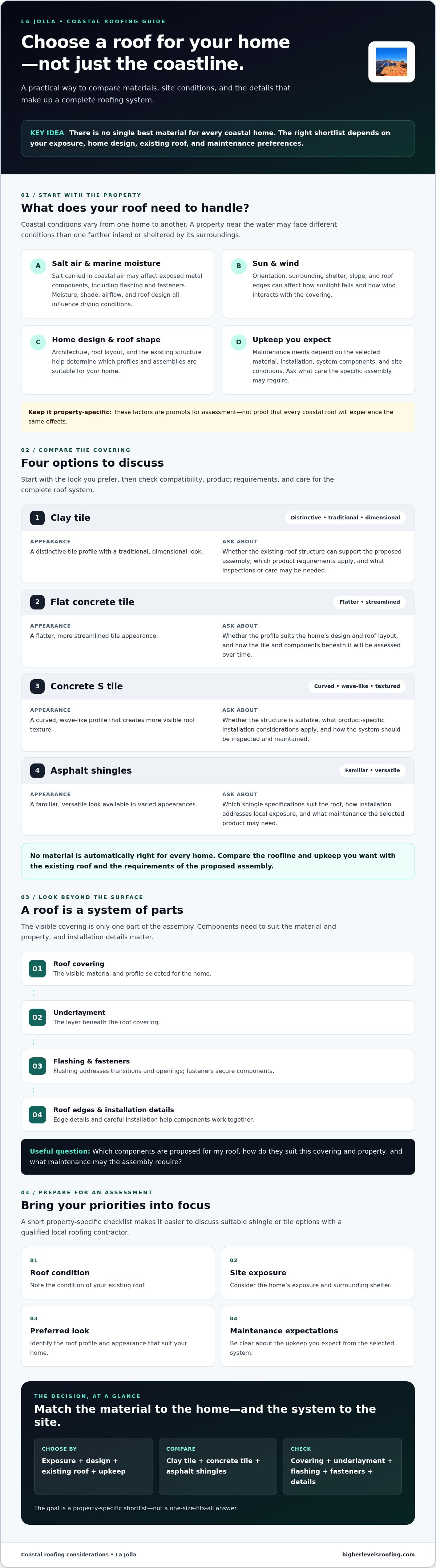
A La Jolla Coastal Roofing Checklist Before You Choose
Preparing a few notes makes it easier to compare roofing proposals. Record what you know about the home, then ask contractors to explain how their recommendations address its specific conditions. This turns the question of the best roofing for coastal homes La Jolla into a practical, property-focused conversation.
Questions to answer about your property
What do you know about the current roof? Record its approximate age, visible wear, previous repairs, and any known water-intrusion history. These observations help start the conversation but don’t replace a professional inspection.
How exposed is the site? Note how open the home is to ocean air and wind, along with areas of shade or shelter. If different roof sections seem to face different conditions, include that in your notes.
Which appearance suits your home? Gather examples of roof profiles or finishes you like, and consider how they’ll look with the architecture and surrounding exterior.
What maintenance are you comfortable with? Consider the upkeep you expect, then ask what inspections or care may be appropriate for each proposed product and system.
Questions to ask a roofing contractor
Why does this material fit my property? Ask the contractor to connect the recommendation to your site exposure, roof design, existing structure, and priorities. If more than one option may work, ask what trade-offs distinguish them.
What does the proposed scope include? Request a clear description of the roofing material and related work. Ask how the contractor will assess flashing, fasteners, underlayment, roof edges, and other relevant components, and which items are included in the proposal.
What product details should I compare? Ask for the specifications of the proposed material and supporting components, along with an explanation of how they work together. This helps you compare complete systems rather than surface coverings alone.
What requirements apply to this project? Confirm the contractor’s licensing and ask how current local requirements will be checked for your property and project scope. Request that relevant requirements and proposed materials are clearly identified in the proposal.
For more context on planning a replacement, see this San Diego roof replacement guide. Once you’ve gathered your notes, discuss your roofing options with Higher Levels Roofing and ask which confirmed shingle or tile choices may be appropriate for your home.
Plan a Coastal Roof That Suits Your La Jolla Home
A sound roofing decision follows a clear sequence: understand the conditions at your property, compare materials that may suit its design and existing roof, then review the components and installation scope that complete the system. That process is more useful than choosing a covering based on appearance alone. The best roofing for coastal homes La Jolla is a property-specific match, not a universal recommendation.
How Higher Levels Roofing can support a material decision
Higher Levels Roofing is a licensed contractor serving La Jolla and the wider San Diego area. Its residential offerings include asphalt shingles, clay tile, and concrete tile. These options can be discussed in light of your home’s roof structure, design, exposure, and maintenance preferences. Suitability needs to be assessed for the property, and the proposed scope and material details should be confirmed for each project.
For a useful comparison, ask how the recommendation relates to your existing roof and which system components are included. If you’re considering installation, replacement, or repair, clarify what the assessment covers and which work is proposed. This keeps the conversation grounded in your home’s needs rather than assumptions about a material category.
Your next step toward a coastal roofing plan
Before speaking with a contractor, note where the roof seems most exposed or sheltered, any known roof concerns, the styles you prefer, and how much ongoing maintenance you’re comfortable with. Bring questions about the existing roof, proposed covering, underlayment, flashing, fasteners, and roof edges. Clear answers make it easier to understand the recommendation and compare proposals.
You don’t need to settle on a material before discussing the property. Start with the home’s condition and priorities, then review options and project scope with a local roofing contractor. To talk through your roofing needs with Higher Levels Roofing, Talk with Higher Levels Roofing.
Choose a Coastal Roof With Confidence
The best roofing for coastal homes La Jolla isn’t a single material that suits every property. Start with your home’s exposure and design, then consider the existing roof, maintenance preferences, and system details behind the visible covering. Comparing these factors helps you focus on options that fit your priorities instead of relying on a broad material ranking.
Higher Levels Roofing is a licensed roofing contractor serving the San Diego area, including La Jolla. Its residential offerings include asphalt shingles, clay tile, and concrete tile. Which option may suit your home depends on a property-specific assessment and project scope.
Bring your observations and questions to a conversation with a local roofing professional. Talk with Higher Levels Roofing about your La Jolla roof to discuss installation, replacement, or repair needs. The clear next step is to review your property and options with the company.
Frequently Asked Questions
Is clay tile a good roofing choice for a La Jolla coastal home?
Clay tile may suit some La Jolla coastal homes, but it isn’t automatically right for every property. The decision depends on the roof structure, site exposure, installation details, home design, and your maintenance preferences. Ask a qualified roofing contractor to assess the existing roof and explain the specific tile system under consideration. A nearby home’s tile roof can offer inspiration, but it doesn’t establish suitability for your property.
Can asphalt shingles work on a coastal home in La Jolla?
Yes, asphalt shingles can work on some coastal homes in La Jolla. Suitability depends on the specific shingle, roof design, exposure, installation, and maintenance needs. Ask the contractor to identify the product specifications and explain how the complete roof system is planned for your property. Higher Levels Roofing offers asphalt shingle roofing, but a property assessment is needed before making a recommendation. Compare the proposed components as well as the visible shingles.
Does salt air damage roofs in La Jolla?
Salt carried in coastal air can affect exposed metal roof components. Marine moisture, sun, and wind may also influence wear. The degree of exposure varies by property, so one home’s roof condition doesn’t predict another’s. Ask a roofing professional to examine the covering, flashing, fasteners, and other relevant details. Maintenance recommendations should reflect the roof’s actual condition, materials, and surroundings.
What is the best roofing material for a home near the ocean?
The question “best roofing for coastal homes La Jolla” has no one-material answer. Compare options against your home’s exposure, roof structure, architectural style, maintenance expectations, and proposed system details. Clay tile, concrete tile, and asphalt shingles are among Higher Levels Roofing’s residential offerings. A local assessment can identify which options to consider and what installation details to address before you choose.
How often should a coastal roof in La Jolla be inspected?
Inspection timing depends on the roof material, age, exposure, visible condition, and applicable product guidance. Rather than rely on one schedule for every La Jolla home, ask a qualified roofing contractor what interval makes sense for your roof. Arrange an assessment if you notice visible damage or signs of water intrusion. Confirm ongoing maintenance recommendations against product requirements and conditions at your property.
What should I compare when choosing coastal roofing materials?
Compare how each material suits your property, its appearance, expected maintenance, compatibility with the existing roof structure, and the proposed installation scope. Ask how the contractor will assess flashing, fasteners, underlayment, and exposed roof edges. Request product-specific information instead of relying on broad claims about coastal durability. A useful comparison reflects your home’s conditions and priorities, not a universal ranking of roofing materials.
Does a roofing contractor need to check more than the roof covering?
Yes. The visible covering is only one part of a roof system. Ask the contractor to assess underlayment, flashing, fasteners, roof edges, existing conditions, and installation requirements, then explain which items the proposal includes. Confirm licensing, project scope, material specifications, and applicable local requirements for your home. Higher Levels Roofing is a licensed contractor serving La Jolla, San Diego, San Marcos, Encinitas, and Carlsbad.


Comments