


TPO Roof Repair in San Diego: The 2026 Property Owner’s Guide to Membrane Maintenance

Updated: Aug 24
Did you know that a single compromised seam on your TPO roof can spike your cooling costs by up to 30% during a San Diego summer? For many property owners, that white membrane isn't just a cover; it's a critical tool for managing energy efficiency in our intense coastal sun. It's stressful to manage rising utility bills while wondering if a hidden leak is silently damaging your interior drywall or valuable inventory. You deserve a roof that provides total security without the constant guesswork of whether to patch or replace.
This 2026 guide is designed to simplify TPO roof repair San Diego by showing you exactly how to maintain your membrane against salt air and UV exposure. We'll explore the latest California Title 24 energy standards and the practical steps needed to extend your roof's life. You'll learn how to distinguish minor maintenance from major failures, evaluate the true costs of repairs, and select a local specialist who treats your property with the meticulous care it deserves.
Table of Contents
What is TPO Roofing and Why is it Popular in San Diego?
Thermoplastic Polyolefin (TPO) is a high-performance, single-ply roofing membrane that has become the premier choice for flat and low-slope properties throughout Southern California. It isn't a simple plastic covering; it's a sophisticated engineered system designed to protect your structure while lowering its temperature. Property owners across the county are increasingly choosing this material because it balances durability with impressive thermal performance. Whether you own a sleek, modern home in North Park or manage a large industrial warehouse in Miramar, TPO provides a reliable, long-term solution for our specific environment.
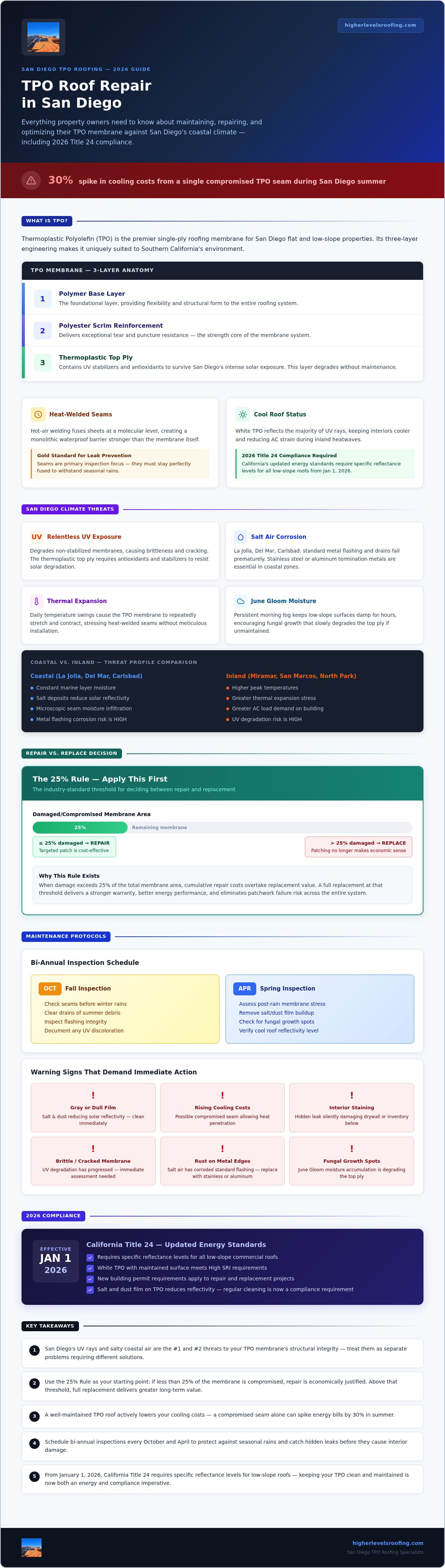
The strength of this material lies in its three-layer anatomy. It begins with a polymer base, followed by a strong polyester scrim reinforcement layer that provides exceptional tear and puncture resistance. The system is finished with a thermoplastic top ply, which contains the UV stabilizers and antioxidants necessary to survive San Diego's intense sun exposure. While many competitors fail to mention it, these layers can degrade if not properly maintained, eventually leading to the need for TPO roof repair San Diego specialists to restore the membrane's integrity.
The Role of Heat-Welded Seams
One of the most significant advantages of TPO is how the individual sheets are joined. Unlike older roofing systems that rely on liquid adhesives or tapes that can dry out and fail over time, TPO uses hot-air welding. This process fuses the sheets together at the seams, creating a physical molecular bond that transforms separate sections into a single, monolithic waterproof barrier. These welded seams are considered the gold standard for leak prevention because they're actually stronger than the membrane itself. When we perform an inspection, these transition points are our primary focus, as they must remain perfectly fused to withstand seasonal rains.
Energy Efficiency and 'Cool Roof' Status
Reflective TPO and other cool-roof systems can be valuable on low-slope roofs, but a white membrane is not automatically proof that every project meets California code. Requirements depend on building type, alteration scope, roof slope, climate zone, the complete assembly, product rating, and available exceptions. Residential roof-replacement provisions are generally evaluated at 50% or more of the roof; commercial and multifamily projects must be checked under the provisions applicable to that building. Official CEC guidance: https://www.energy.ca.gov/filebrowser/download/8300?fid=8300.
Climate Challenges: TPO Performance in San Diego’s Coastal Air
San Diego’s climate is iconic, but it’s exceptionally demanding on commercial roofing materials. The relentless UV exposure in Southern California can degrade non-stabilized membranes, causing them to become brittle and crack over time. While TPO is naturally reflective, salt air corrosion presents a unique threat to the secondary components of your system. In coastal zones like La Jolla or Del Mar, standard metal flashing and drains often fail prematurely. We prioritize using stainless steel or aluminum termination metals in these areas to prevent rust and ensure the perimeter remains watertight. Adhering to University TPO Roofing Standards helps ensure that these material choices meet long-term durability goals for institutional and commercial properties alike.
Professional TPO roof repair San Diego services often involve replacing corroded fasteners or metal edges that have succumbed to the marine environment before the membrane itself fails. San Diego buildings also experience significant movement due to daily temperature swings. This thermal expansion causes the TPO membrane to stretch and contract. Without meticulous installation, this constant movement stresses the heat-welded seams. During "June Gloom," the persistent morning fog keeps low-slope surfaces damp for hours. This moisture can encourage fungal growth that slowly eats away at the top ply if the roof isn't properly maintained.
Coastal Microclimates and Membrane Wear
The performance of a roof in inland San Marcos differs wildly from one in coastal Carlsbad. While inland roofs face higher peak temperatures, coastal systems battle constant marine layer moisture that can seep into microscopic seam imperfections. Salt deposits can accumulate on the surface, creating a thin film that reduces the roof's solar reflectivity and traps heat. Regular cleaning is essential to maintain that "cool roof" status and keep your energy bills low. If you notice a gray or dull film on your white roof, it’s likely salt and dust blocking its performance.
Wind Uplift and Edge Security
Coastal winds are a persistent force that property owners cannot ignore. If the edge termination isn't installed with precision, wind can get under the membrane, leading to dangerous "blow-offs" or uplift. You might notice "bridging" at the roof corners, where the membrane pulls away from the angle of the wall and looks like a tight drum. This is a clear sign that the system is under extreme stress and requires immediate attention. If you suspect your edges are weakening, it’s wise to consult a local specialist who understands these specific coastal pressures and can secure your perimeter before the next wind event.
TPO Roof Repair vs. Replacement: A San Diego Decision Guide
Deciding whether to invest in a localized fix or a full system overhaul is the most common concern for local property owners. We typically utilize the "25% Rule" as a professional benchmark for this choice. If the cumulative cost of necessary repairs exceeds 25% of the total replacement value, it’s usually more economical to transition to a new installation. This prevents you from pouring capital into a failing asset that will likely require more attention in the coming months. A professional TPO roof repair San Diego strategy focuses on extending the life of your current asset while being honest about when that asset has reached its limit.
The age of your membrane is the next critical factor. TPO systems generally have a functional lifespan of 15 to 20 years in our climate. If your roof is approaching the 18-year mark, even a high-quality patch might only be a temporary bandage on a system that is fundamentally degrading. We also perform core sampling during our evaluations. This involves taking a small, circular cross-section of the roof to inspect the insulation layers beneath. If the insulation is dry, a repair is often viable. However, if the core reveals saturated insulation, the moisture is already trapped, and a surface repair will not stop the underlying rot.
Common TPO Repair Scenarios
Many of the issues we see aren't caused by the material itself, but by external activity. HVAC technicians often accidentally puncture the membrane while servicing rooftop units, leaving small holes that can lead to significant interior damage. Storm debris is another local factor; heavy palm fronds from nearby trees can create tears during our seasonal wind events. We also frequently re-weld seams that have pulled apart due to poor original installation or extreme thermal movement. It’s important to understand that DIY TPO patching often fails because the aged membrane requires specific chemical preparation and precise heat-welding that standard hardware store adhesives simply cannot match.
When Replacement is Inevitable
You should look for "alligatoring" on the surface of your roof. These are networks of fine cracks in the thermoplastic top ply that indicate the material has lost its essential plasticizers and flexibility. When these cracks become widespread, the internal polyester scrim becomes exposed to moisture and sun, leading to rapid failure. If you are seeing persistent leaks in multiple areas of the building, it’s a sign that the system’s integrity is compromised beyond localized fixes. For a deeper look at your options, you can review our TPO Roofing Guide for San Diego Property Owners to help determine your next steps.
Maintenance Protocols to Avoid Costly TPO Repairs
Consistent care is the only way to avoid the sudden expense of a full replacement. In our region, we recommend a bi-annual rhythm for every property owner. October is your deadline for a "Pre-Rainy Season" check to ensure drains are clear before the winter storms arrive. April serves as your "Post-Rain" assessment to identify any damage sustained during the wet months. This proactive approach ensures that TPO roof repair San Diego remains a minor maintenance task rather than a structural emergency. It’s about catching a thinning seam or a clogged scupper before it turns into an interior flood.
San Diego’s air carries a heavy load of fine dust and salt, especially in areas near the I-5 corridor or the coast. This accumulation creates a gray film over time that absorbs heat instead of reflecting it. Washing your roof doesn't just improve its appearance; it restores the membrane’s "cool roof" properties. This simple step helps you maintain the energy savings promised by 2026 Title 24 standards. A clean roof can reduce cooling costs by 15% to 30% compared to a neglected, dirt-covered surface.
Standing water is the primary enemy of any flat roof system. If your scuppers or drains are blocked, "ponding" water puts constant hydrostatic pressure on your heat-welded seams. While TPO is exceptionally durable, it isn't invincible against months of stagnant water. For restaurant owners, grease is a specific hazard that requires attention. Animal fats and oils from exhaust vents can chemically soften the TPO membrane, leading to rapid degradation. Installing grease traps or specialized protection pads is a non-negotiable step for food service properties to prevent the membrane from dissolving.
The San Diego Maintenance Checklist
Clear palm fronds and eucalyptus debris: These are common in neighborhoods like Balboa Park or Scripps Ranch. They can easily puncture a membrane during a Santa Ana wind event.
Check pipe boots and skylight flashing: Look for signs of coastal rust. These penetrations are the most common points of failure for TPO roof repair San Diego projects.
Document everything: Take clear photos during every inspection. This paper trail is vital for insurance claims or maintaining your manufacturer’s warranty compliance.
Professional Roof Inspections
Sometimes the most dangerous leaks are the ones you can't see with the naked eye. We utilize infrared moisture detection to find water trapped beneath the membrane before it rots your structural decking. A professional eye is also trained to spot "cold welds"-seams that appear fused but didn't achieve a true molecular bond during the original installation. To see how these maintenance steps impact long-term property value, read our TPO Commercial Roofing in San Diego: A Performance & Cost Case Study (2026). If you haven't had your system checked this year, you can schedule a professional maintenance review to protect your investment and ensure your roof is ready for whatever the season brings.
Higher Levels Roofing: Your San Diego TPO Repair Experts
At Higher Levels Roofing, we understand that your property is more than just a building. It's a significant investment that requires precise, professional care to maintain its value. Carlos and our dedicated team approach every TPO roof repair San Diego project with the eye of a meticulous craftsman. We don't believe in quick fixes that fail after the first heavy rain; instead, we focus on restoring the long-term security of your membrane through technical expertise and neighborly service. This commitment to quality has made us a steady hand for property owners who value transparency and craftsmanship over high-pressure sales tactics.
Roofing permit requirements depend on the project scope and the authority having jurisdiction. Within the City of San Diego, Information Bulletin 123 states that qualifying nonstructural reroofing may be permit-exempt when the roof structure and diaphragm are not altered. Permits are required for specified structural changes, heavier replacement roofing, removal and replacement of skip sheathing, and designated historic properties. Other cities and unincorporated county areas may use different rules, so the project address and scope must be verified before work begins. Official City guidance: https://www.sandiego.gov/development-services/forms-publications/information-bulletins/123. California does not impose one identical cool-roof rule on every residential reroof. Under the 2025 Building Energy Efficiency Standards, effective January 1, 2026, residential roof-replacement provisions are generally evaluated when 50% or more of the roof is replaced. Criteria then depend on roof slope and climate zone: steep-slope provisions apply in climate zones 4 and 8–15, while low-slope provisions apply in climate zones 4 and 6–15, with listed exceptions and alternative compliance paths. Verify the address, slope, assembly, and CRRC-rated product. Official CEC guidance: https://www.energy.ca.gov/filebrowser/download/8300?fid=8300.
Our TPO Repair Process
Every project begins with a comprehensive site assessment and moisture detection. We use specialized tools to find water that might be hiding beneath the surface, ensuring we don't just patch a hole while leaving structural rot behind. Once the damage is mapped, we utilize professional-grade TPO cleaners to prep the membrane. This step is vital because a heat weld is only as strong as the preparation. We then employ both robotic and precision hand-welding techniques to create a permanent, molecular seal. This bond is often stronger than the original material, providing a leak-proof finish that withstands the coastal elements.
Protect Your Investment Today
Flat roof leaks don't wait for a convenient time to happen. Acting fast is the only way to prevent minor drips from becoming expensive structural issues or mold concerns. Higher Levels Roofing is the trusted choice for property owners in San Diego, Encinitas, and beyond because we treat every roof as if it were our own. We take pride in our accountability and the lasting quality of our work. Don't let a small membrane tear compromise your entire building. Schedule your professional TPO roof inspection with Higher Levels Roofing today.
Secure Your San Diego Property for the Years Ahead
Managing a flat roof doesn't have to be a source of constant stress. By understanding the unique coastal challenges and adhering to a bi-annual maintenance rhythm, you can significantly extend the life of your TPO membrane. Whether you are navigating the 2026 Title 24 standards or applying the 25% Rule to a problematic leak, the goal is always long-term security and peak energy efficiency. Professional TPO roof repair San Diego ensures that your building remains a leak-free, high-performance asset in our intense Southern California sun.
Higher Levels Roofing is here to provide the steady, expert hand you need. As a licensed and insured San Diego contractor, we specialize in heat-welded TPO systems and prioritize meticulous craftsmanship in every project. We are a locally owned business that values transparency and neighborly trust over high-pressure sales. Our 5-star approach is designed to alleviate your anxieties and protect your investment for decades to come.
Get a Free TPO Roof Repair Estimate in San Diego
Your roof is your first line of defense. We look forward to helping you keep it strong, reflective, and reliable.
Frequently Asked Questions
How much does TPO roof repair cost in San Diego?
The cost of a repair depends on the size of the damaged area, the accessibility of the roof, and the thickness of the existing membrane. Minor punctures are generally less complex to fix than widespread seam failures that require extensive heat-welding. Every TPO roof repair San Diego project is unique, so we evaluate the specific labor and material requirements for your property to provide an accurate resolution.
Can you patch a TPO roof yourself?
Professional heat-welding is the only reliable way to patch a TPO membrane. While hardware stores sell peel-and-stick tapes, these adhesives often fail to create a permanent bond with the thermoplastic material and can eventually peel away under the San Diego sun. Using the wrong products can also void your manufacturer’s warranty, so it is safer to have a specialist use a hot-air welder for a molecular seal.
How long does a TPO roof typically last in San Diego's climate?
A well-installed TPO system usually lasts between 15 and 20 years. Our local weather is generally favorable for flat roofs, but the high UV index in Southern California can accelerate surface aging if the roof is neglected. Regular cleaning and bi-annual inspections are the best ways to ensure your system reaches its full life expectancy without mid-life failures.
Is TPO roofing resistant to salt air in coastal areas like La Jolla?
The TPO membrane itself is highly resistant to salt spray and coastal moisture. The real concern in areas like La Jolla or Del Mar is the corrosion of metal flashing, fasteners, and drains. We use high-quality termination metals like stainless steel or aluminum to ensure the perimeter of your roof remains as durable as the membrane itself.
What are the most common causes of TPO roof leaks?
Most leaks stem from accidental punctures caused by HVAC technicians or heavy debris during windstorms. Other frequent issues include "cold welds" from the original installation that eventually pull apart and clogged drainage systems that lead to ponding water. Identifying these issues early through a professional TPO roof repair San Diego inspection prevents moisture from reaching your building’s interior.
Can a new TPO membrane be installed over my old flat roof?
You can often install a TPO "recover" over an existing roof if the underlying structure is sound and dry. California building codes generally allow a maximum of two roofing layers. We perform moisture scans and core samples to ensure no water is trapped before suggesting an overlay, as covering wet insulation will lead to structural rot.
Does TPO roofing meet California Title 24 energy requirements in 2026?
Cool-roof benefits and code compliance should be evaluated separately. Reflective materials may reduce roof-surface heat, but savings vary, and product color alone does not establish compliance. Confirm the project climate zone, roof slope, complete assembly, CRRC rating, and any applicable exceptions before specifying material.
How do I know if my TPO seams are failing?
You may notice the edges of the membrane sheets "tenting" or curling upward where they should be flat. A professional uses a specialized probing tool to gently check the seam's integrity and identify spots where the weld has weakened. If you can slide a thin tool under the edge of a seam, the molecular bond has failed and requires immediate re-welding.


Comments