


Storm Damage Roof Assessment Encinitas: The Complete 2026 Homeowner Checklist

The most serious threat to a coastal home after a punishing winter atmospheric river isn't the single missing shingle you spot from your driveway; it's the broken waterproof seal hidden beneath the surface. Conducting a methodical storm damage roof assessment Encinitas homeowners can depend on requires prioritizing systematic diagnostics over hasty cosmetic patches. We understand the hesitation you feel after severe weather hits. Stepping onto slick, steep rooflines puts your personal safety at risk, and walking across fragile clay or concrete tiles can quickly turn minor wind uplift into extensive, cracked underlayment damage.
You don't need to risk a fall or tolerate high-pressure sales pitches from out-of-town storm chasers to protect your home. With the right diagnostic strategy, you can confidently identify exterior trauma, catch concealed interior moisture rot, and present indisputable proof to your insurance adjuster. This 2026 checklist guides you step-by-step through a safe evaluation process, helping you document storm impacts accurately and determine whether an isolated repair or a complete replacement is right for your property.
Table of Contents
Encinitas Storm Damage Ground Assessment: Safe Perimeter Inspection Checklist
Component-by-Component Roof Assessment Checklist for Encinitas Homes
Coastal Wind Uplift vs. Moisture Intrusion: Diagnosing Encinitas Storm Damage
Insurance Claim Documentation Checklist for Storm Damage in San Diego County
Choosing an Encinitas Roofing Contractor for Repair or Replacement
Encinitas Storm Damage Ground Assessment: Safe Perimeter Inspection Checklist
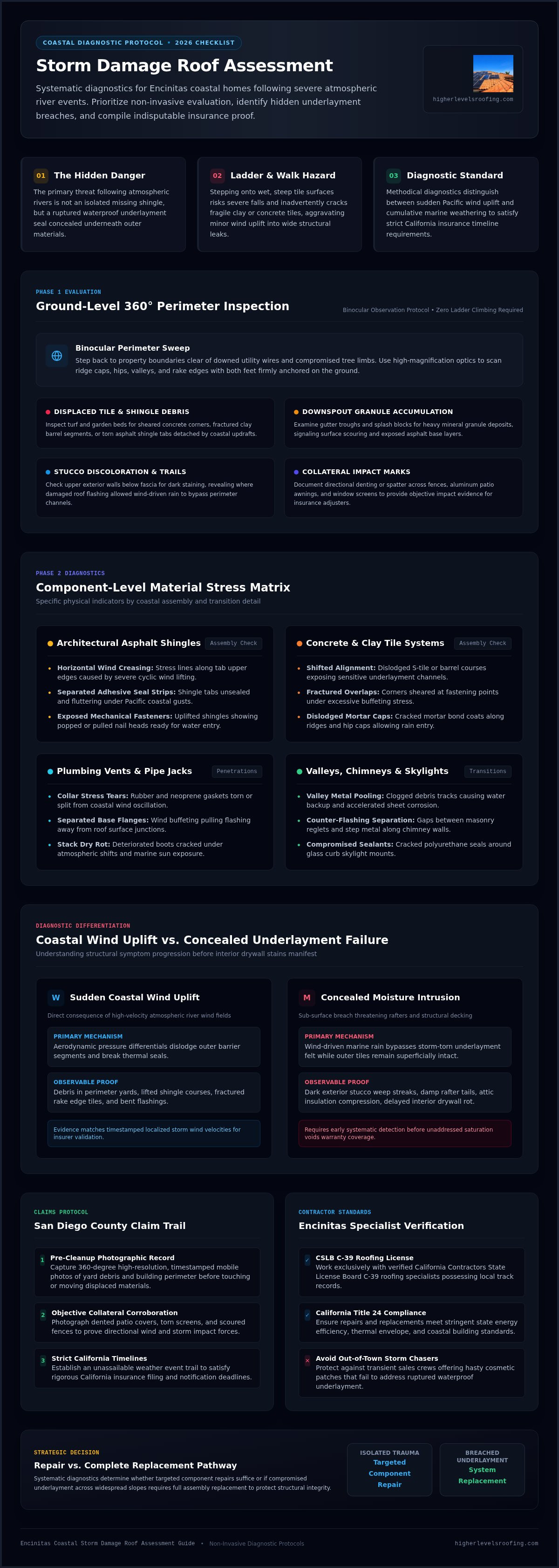
Performing an initial storm damage roof assessment Encinitas homeowners can handle safely starts squarely at ground level. Before considering any ladder work or reaching out to an insurance adjuster, conduct a methodical 360-degree perimeter walk around your home's foundation and yard. Severe winter gales driven off the Pacific frequently displace perimeter components without causing obvious immediate collapses. Capturing clear, time-stamped mobile photos during this preliminary sweep establishes a clean baseline of physical evidence before yard cleanup begins.
Perimeter Safety Protocols and Binocular Inspections
Never attempt to climb onto a wet, steep-pitch, or wind-damaged roof surface. Coastal dampness turns concrete and clay tile surfaces exceptionally slick, and walking across storm-stressed materials will easily crack underlying felt. Instead, step back toward the property perimeter and scan ridgelines, hips, valleys, and rake edges with high-magnification binoculars. You get a crisp, elevated view while keeping both feet on solid ground, well clear of downed power lines or cracked tree limbs leaning against the eaves.
Ground-Level Exterior Warning Signs Checklist
Look closely at perimeter landscaping, downspouts, and architectural details. Ground evidence often pinpoints critical roof failures long before moisture stains appear inside your living room, so you don't need to leave the ground to spot these major red flags:
Displaced Tile and Shingle Debris: Search garden beds and turf for sheared concrete tile corners, fractured clay barrel segments, or torn asphalt shingle tabs stripped away by coastal updrafts.
Downspout Granule Accumulation: Check drainage splash blocks and gutters for heavy piles of mineral granules, which signal excessive surface scouring and unsealed asphalt baselayers.
Stucco Discoloration and Moisture Trails: Inspect upper exterior walls beneath fascia lines for dark streaks, indicating that compromised roof flashing weatherproofing has allowed wind-driven rain to bypass exterior water channels.
Collateral Impact Marks: Check perimeter wood fences, aluminum patio covers, and window screens for directional spatter or denting, which provides objective documentation during any subsequent storm damage roof assessment Encinitas insurance adjusters evaluate.
Component-by-Component Roof Assessment Checklist for Encinitas Homes
A rigorous storm damage roof assessment Encinitas residences undergo moves systematically from outer coverings down to structural framing. Hidden moisture paths often bypass outer barriers without presenting obvious holes. Evaluating each layer ensures you identify vulnerabilities before unaddressed leaks rot structural rafters or void your warranty protection.
Assessing Shingle and Coastal Tile Assemblies
Different materials show storm stress in distinct ways. When inspecting architectural asphalt shingles, look for horizontal wind creasing along tab edges, lifted adhesive strips, and exposed nail heads. For concrete S-tile and clay barrel systems, check for shifted alignments, cracked overlaps, and dislodged mortar caps. A tile surface might appear intact from below even when severe wind-driven rain has torn the felt underlayment beneath it. To better understand how various roofing materials resist Pacific weather, consult our comprehensive guide to roof tiles.
Flashing, Penetrations, and Valley Metal Checklist
Metal transitional components face extreme strain during high-velocity coastal windstorms. Carefully review these high-risk junctures across your roof plan:
Plumbing Vents and Pipe Jacks: Check rubber and neoprene collars for stress tears, dry rot, or wind separation around vent stacks.
Valleys and Low-Slope Junctions: Clear debris build-up in valley metal tracks and check for localized corrosion where pooling water compromises sheet joints.
Chimneys and Skylights: Inspect counter-flashing along masonry joints for cracked polyurethane sealants or separated step metal.
Documenting these transition points with clear photos adheres directly to standards outlined in the California Department of Insurance Residential Property Claims Guide, helping streamline claim processing with your insurance adjuster.
Interior Attic and Roof Deck Moisture Audit
The interior structure tells the real truth about your roof's integrity. Grab a flashlight and enter the attic crawlspace during daylight hours. Inspect the underside of plywood roof decking and structural rafters for telltale signs of intrusion, such as active dripping, dark mold rings, or localized wood sagging. Look for fiberglass or cellulose insulation that appears compacted, stained, or damp. On homes with rolled asphalt torch-down or flat TPO sections, water migration can travel horizontally along joists before dropping downward. If your attic shows early evidence of moisture penetration, partnering with Higher Levels Roofing for a targeted assessment ensures small structural issues are caught before costly structural repairs become necessary.
Coastal Wind Uplift vs. Moisture Intrusion: Diagnosing Encinitas Storm Damage
Pacific weather systems hitting North County create unique physical stresses that inland properties never encounter. Under the California Building Code (ASCE 7-22), coastal properties in Encinitas sit within Exposure Category C and D oceanward wind zones. These sustained wind speeds create intense negative pressure along eaves, ridges, and hips. A professional storm damage roof assessment Encinitas homeowners commission must separate sudden, storm-induced mechanical failures from chronic marine weathering.
Mechanics of Coastal Wind-Shear and Tile Chatter
Bluff winds rush up coastal elevations and break into turbulent vortices when they hit exterior fascia boards. This aerodynamic lift causes two major mechanical breakdowns:
Thermal Seal Separation: Strong gusts pry upward on architectural asphalt shingle tabs. Once the factory-applied thermal sealant bond snaps, shingles flap in subsequent winds, tearing around nail heads and exposing underlayment to open water.
Tile Chatter and Chafing: Wind forces concrete S-tile and clay barrel assemblies to vibrate rapidly against the deck. This dynamic motion, known as chatter, grinds aging asphalt-saturated organic felt into powder. The tiles drop back into position looking completely intact from the curb, masking severe underlayment breaches beneath.
Unfastened or deteriorating mortar-set ridge caps in older neighborhoods like Old Encinitas or Leucadia represent the earliest structural failure points when high gusts strike.
Wind-Driven Rain and Hidden Capillary Water Migration
Pacific atmospheric rivers don't drop precipitation straight down. Gale-force coastal winds drive rain sideways and upward at steep angles, creating capillary action that forces water under standard tile overlaps. Standard gravity-fed drainage paths fail under this intense lateral pressure.
On low-slope surfaces, such as flat TPO membranes or rolled asphalt torch-down additions, standing water and driving winds exploit micro-punctures. Salt spray accelerates the oxidation of standard steel clips and galvanized flashings over years of marine layer exposure. When an atmospheric river strikes, these weakened fasteners shear under tension. Exploring different types of roofing materials helps you determine how well modern profiles stand up to continuous oceanward weathering. When evaluating physical damage, verifying trade credentials via the CSLB guide to hiring a licensed contractor ensures your storm damage roof assessment Encinitas documentation is signed off by a qualified professional.
Insurance Claim Documentation Checklist for Storm Damage in San Diego County
Securing a fair settlement for coastal storm damage requires an organized evidentiary trail. Under the California Fair Claims Settlement Practices Regulations, insurance carriers must acknowledge your claim notice within 15 calendar days and make a coverage decision within 40 days of receiving proof of loss. Performing a detailed storm damage roof assessment Encinitas adjusters can easily verify prevents initial claim pushback and keeps your claim moving forward without unnecessary delays.
Evidence Gathering and Photographic Standard Operating Procedures
Insurance adjusters rely strictly on verifiable facts, not general impressions. Before touching any fallen debris or performing temporary patch work, systematically assemble your proof:
Correlate Official Weather Reports: Note the exact date and time of loss, pulling local National Weather Service bulletins and coastal wind-gust recordings from nearby reporting stations.
Capture Multi-Angle Imagery: Take wide, high-resolution photographs of all exterior roof elevations, followed by close-ups of cracked tiles, lifted shingles, and flashing separations. Make sure your smartphone camera settings log GPS location and timestamps automatically.
Record Interior Staining: Photograph ceiling drywall rings, peeled paint along exterior walls, and damp framing in your attic before moisture evaporates.
Preserve Physical Debris: Place cracked clay barrel edges, fractured concrete tile corners, and torn shingle tabs into a storage bin to present as tangible physical evidence during the on-site walkthrough.
Navigating the Adjuster Meeting and Avoiding Claim Denials
Insurance companies often attempt to categorize roof damage as long-term coastal corrosion or pre-existing wear rather than sudden storm impact. When the adjuster arrives at your property, having your own roofing professional present levels the playing field. A knowledgeable local expert walks the roof line with the adjuster, pointing out localized uplift patterns and explaining structural underlayment failures that casual visual inspections miss.
Your documentation must also account for municipal compliance. The City of Encinitas enforces local amendments to the California Building Code requiring Class A fire ratings for replacement roofing, alongside Title 24 Cool Roof mandates for substantial alterations. If your carrier approves repairs, your contractor's estimate must incorporate these mandatory legal requirements. When you are ready to build an airtight scope of repairs, request a professional roof assessment from Higher Levels Roofing to secure the detailed documentation your claim demands.
Choosing an Encinitas Roofing Contractor for Repair or Replacement
Selecting the right team to evaluate storm trauma makes all the difference between long-term property protection and recurring moisture headaches. Following severe coastal squalls, out-of-town storm chasers often move through North County neighborhoods offering cheap cosmetic fixes and high-pressure contracts. Protecting your investment requires an expert eye rooted right here in our community. A thorough storm damage roof assessment Encinitas homeowners rely on demands a licensed professional who understands local microclimates from the bluffs of Old Encinitas to the valleys of Olivenhain.
Contractor Credentialing and Local Verification Checklist
Never commit to any roofing project without verifying your contractor's state standing. California strictly requires every active C-39 roofing contractor to carry workers' compensation coverage without exception, along with active surety bonding and general liability protection. To protect yourself against liability and substandard craftsmanship, review our comprehensive roofing contractor san diego county hiring guide before signing paperwork. Working with a dedicated, locally owned specialist ensures direct owner oversight on your job site rather than transient sales crews who disappear after the weather clears.
Repair Scope vs. Complete Roof Replacement Decisions
Deciding between localized repairs and a comprehensive reroof depends on the structural depth of the storm's impact. Determining which route protects your home comes down to evaluating three distinct conditions:
Targeted Roof Repair Services: Best suited for isolated issues where high winds broke a handful of shingle tabs, displaced flat concrete tiles, or damaged a localized vent collar while the surrounding underlayment remains pliable and watertight.
Complete Roof Replacement: Necessary when wind-shear causes widespread tile chatter that tears aging underlayment across entire slopes, or when water intrusion leads to rotted structural decking. In California Climate Zone 7, replacing over 50% of your roof covering also triggers compliance with Title 24 Cool Roof standards.
Long-Term Restoration Value: Learn about system lifespans and modern coastal materials by reading our roof replacement san diego homeowner guide.
When you need an honest, forensic storm damage roof assessment Encinitas properties deserve, consult with Higher Levels Roofing. Led by principal Carlos, our team provides meticulous craftsmanship, transparent evaluations, and owner-operated accountability across every residential project.
Secure Your Encinitas Home Against the Next Pacific Storm
Taking a methodical approach after severe coastal weather clears protects both your personal safety and your long-term investment. You don't have to guess whether shifted tiles or lifted shingle tabs conceal serious underlayment breaches. By completing a structured ground perimeter check, documenting clear physical proof for your insurance carrier, and separating sudden wind-shear from gradual marine wear, you establish total control over your recovery. A prompt, accurate storm damage roof assessment Encinitas homeowners rely on prevents small moisture paths from escalating into severe structural rot.
Higher Levels Roofing delivers the steady, expert guidance your property deserves. As a locally owned craftsman operation led directly by principal Carlos, we bring dedicated technical mastery across architectural asphalt shingles, clay tile, concrete S-tile, and flat TPO systems. Every evaluation strictly respects California Building Code requirements and Title 24 energy standards throughout San Diego County. Protect your sanctuary with verified local expertise. Schedule a comprehensive storm damage roof assessment with Higher Levels Roofing today to restore total confidence in your home's defenses.
Frequently Asked Questions
How do I know if my Encinitas roof has storm damage without climbing on it?
Walk your property perimeter with high-powered binoculars to examine ridgelines, valleys, and rake edges safely from the ground. Check your yard, planters, and walkways for dislodged clay tile corners, concrete fragments, or blown-off shingle tabs. Look closely at downspout splash blocks for unusual accumulations of mineral granules, and inspect your upper exterior stucco walls for dark water trails beneath the roof eaves.
Will my homeowners insurance policy cover roof damage caused by coastal wind and rain?
Most standard hazard policies cover sudden, accidental physical losses caused by severe wind-shear, wind-driven rain intrusion, and falling tree limbs. However, carriers routinely deny claims attributed to gradual wear, deferred maintenance, or chronic salt corrosion. Scheduling a professional storm damage roof assessment Encinitas homeowners trust provides the precise photo documentation and weather-event verification needed to substantiate sudden storm causation under California Fair Claims standards.
How soon after a severe storm should I have my roof assessed in Encinitas?
You should arrange an inspection within 24 to 48 hours after severe weather subsides. California insurance guidelines require prompt notification once damage is discovered, and hidden capillary leaks can rapidly saturate roof decking and attic insulation. Quick action documents physical evidence before sun or subsequent rain alters the scene, establishing an undeniable link between the specific weather date and your roofing failure.
Can cracked concrete or clay tiles be repaired, or does the entire slope need replacement?
Individual cracked tiles can often be replaced if the underlying felt underlayment remains intact, pliable, and properly sealed. However, if coastal wind gusts caused widespread tile chatter that abraded or tore the waterproofing layer underneath, isolated tile swaps won't prevent persistent leaks. In cases where underlayment across an entire slope is torn or aged past its useful lifespan, a comprehensive replacement is usually necessary to protect your home.
What is the danger of waiting to repair minor wind-lifted asphalt shingles?
When wind uplift breaks the factory thermal sealant bond on a shingle tab, that seal never readheres on its own. Subsequent coastal gusts will repeatedly flex the loose tab, tearing the fiberglass mat around nail heads and exposing the deck beneath. Delaying repairs allows wind-driven marine mist and rain to seep under adjacent courses, leading to hidden wood rot and costly attic mold problems.
What should I do if water begins actively leaking through my ceiling during a storm?
Place a sturdy bucket beneath the leak and clear away nearby furniture or electronics immediately. If the drywall ceiling shows a bulging water pocket, carefully puncture the center with a screwdriver or small nail to relieve hydrostatic pressure and prevent a sudden ceiling collapse. Take clear photos of the active leak, and contact a licensed local roofing contractor as soon as business hours open to arrange an inspection.
How does coastal salt air in Encinitas worsen post-storm roofing vulnerabilities?
Marine salt mist accelerates the corrosion of standard metal fasteners, valley flashing, and pipe collars throughout coastal San Diego. When heavy winter storms strike, these pre-corroded fasteners snap under intense wind uplift pressure. Once tiles or shingles shift, damp salt air penetrates directly into the roof assembly, corroding exposed deck nails and drying out organic felt underlayment. Conducting a regular storm damage roof assessment Encinitas properties require keeps these microclimate risks in check.


Comments