


Flat Roof Repair San Diego: The 2026 Property Owner’s Guide to Durable Solutions

Updated: Aug 19
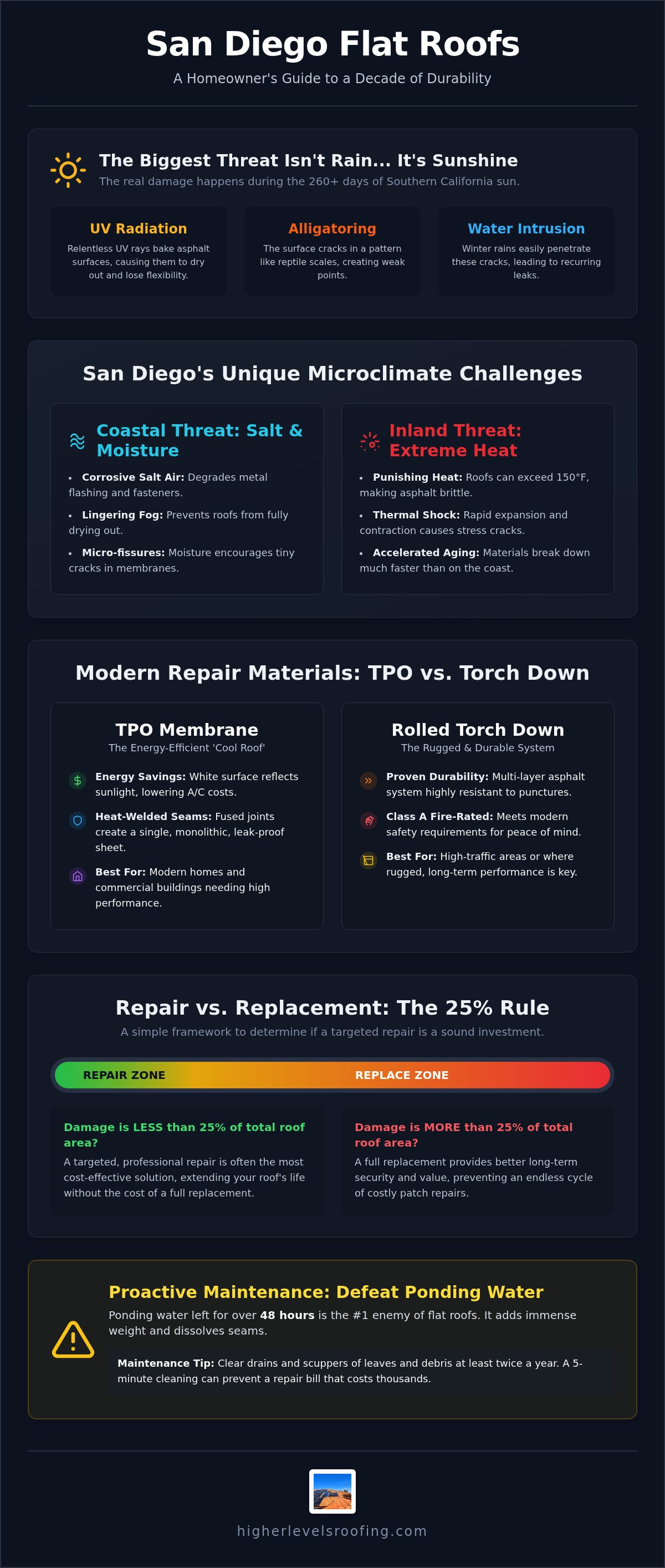
What if the biggest threat to your roof isn't the next atmospheric river, but the 260 days of relentless Southern California sunshine? While most homeowners only think about flat roof repair San Diego when they spot pooling water after a storm, the real damage usually happens during the dry months. UV rays bake asphalt surfaces until they 'alligator' and crack, leaving your property vulnerable to the next big soak. It's a frustrating cycle, especially when recurring leaks seem to appear in the same low-slope areas year after year.
We understand that maintaining a flat roof can feel like a constant battle against gravity and the elements. You deserve a home that stays dry without the stress of a full, unbudgeted replacement. This guide covers the essentials of modern repair techniques for 2026, from understanding the latest Class A fire-rated requirements to choosing between TPO and Torch Down solutions. We'll show you how to extend your roof's life by another decade by identifying when a precision patch is smarter than a total overhaul.
Table of Contents
Understanding San Diego's Flat Roof Challenges
In the world of San Diego architecture, a "flat" roof is rarely ever truly flat. These systems are technically categorized as low-slope, meaning they have a pitch of 10 degrees or less. This slight angle is critical because it relies on gravity to move water toward specialized drainage points. However, because the slope is so minimal, even a small error in installation or a minor obstruction can lead to significant issues. When property owners search for flat roof repair San Diego, they are often dealing with the fallout of our unique Southern California microclimates.
Our region's weather is deceptive. While we don't face the heavy snow loads of the north, our roofs contend with intense UV radiation and temperature swings. During a typical summer afternoon, a dark roof surface can reach temperatures exceeding 150 degrees. This heat causes the roofing membrane to expand. As the sun sets and the marine layer rolls in, the material cools and contracts rapidly. Over time, this "thermal shock" leads to a phenomenon called alligatoring, where the asphalt or coating cracks in a pattern resembling reptile scales. These cracks are the perfect entry point for moisture during our winter rainstorms.
Coastal vs. Inland Flat Roof Performance
The specific needs of your roof often depend on your zip code. In coastal communities like La Jolla, Del Mar, and Carlsbad, the primary threat is the salt-laden air. Salt is highly corrosive and can quickly degrade metal flashing and the fasteners that hold common flat roof materials in place. Moisture from the morning fog often lingers, preventing the roof from drying out completely and encouraging the growth of micro-fissures in older membranes.
Inland areas like San Marcos or Poway face a different battle. The extreme daytime heat is more punishing here, often causing older asphalt-based roofs to become brittle much faster than they would near the coast. At Higher Levels Roofing, we don't believe in a one-size-fits-all approach. We tailor our material recommendations to your specific neighborhood, ensuring that a property in Encinitas gets the moisture resistance it needs, while a building in Escondido is equipped to handle the inland sun.
The Role of Proper Drainage in Low-Slope Systems
Ponding water is the undisputed enemy of any flat roof. If you notice water sitting on your roof for more than 48 hours after a rainstorm, you have a drainage problem that needs immediate attention. Standing water adds immense weight to the structure and begins to dissolve the adhesives and seams that keep your building watertight. Most leaks don't actually start in the middle of a membrane; they begin at the "penetrations" and drainage points.
Scuppers and Drains: These are the most common leak points. Debris like leaves or silt can clog these outlets, forcing water to back up under the roofing material.
Mechanical Units: AC units and vents require careful sealing. If the flashing around these units fails, water will find its way into your ceiling.
Maintenance Tip: San Diego property owners should clear their drains at least twice a year. A simple five-minute cleaning can prevent a repair bill that costs thousands.
By staying proactive and understanding these local challenges, you can protect your investment and avoid the stress of a sudden, preventable leak.
Comparing Flat Roof Repair Materials: TPO vs. Torch Down
When it's time for a flat roof repair San Diego property owners often find themselves at a crossroads. Selecting a material isn't just about the initial cost; it's about chemistry and long-term compatibility. If you attempt to patch a TPO roof with asphalt-based products, the materials simply won't bond. This creates a weak point that will fail during the next rainstorm. At Higher Levels Roofing, we focus on the two most reliable systems for our specific climate: TPO and Rolled Torch Down. These materials align with modern Low-Slope Roofing Design Principles to ensure your property stays dry for years to come.
TPO Membrane: The 'Cool Roof' Solution
Thermoplastic Polyolefin, or TPO, has quickly become the standard for energy-conscious owners in Southern California. It's a single-ply white membrane that naturally reflects sunlight away from your building. This reflectivity is a game changer during San Diego's hot summer months, as it significantly lowers the temperature of the roof surface and reduces your AC workload. Beyond energy savings, TPO is prized for its heat-welded seams. Unlike older systems that rely on glues or tapes, TPO seams are fused together using high-heat air tools. This process creates a monolithic, watertight surface that is incredibly resistant to leaks. It's an ideal choice for commercial buildings and modern residential carports that require a clean, high-tech finish.
Rolled Torch Down: The Traditional Powerhouse
Rolled Asphalt Torch Down, also known as Modified Bitumen, is the rugged veteran of the roofing industry. This system consists of durable layers of asphalt that have been modified with rubber or plastic polymers for increased flexibility. During the installation or repair process, a professional uses a torch to heat the underside of the material, melting it directly onto the roof substrate. This creates a thick, puncture-resistant barrier that handles foot traffic and equipment maintenance much better than thinner membranes. For many of San Diego’s iconic mid-century modern homes, Torch Down provides the heavy-duty protection needed for expansive, low-slope surfaces.
We prioritize these two systems because they offer the best balance of longevity and repairability in our coastal environment. Whether we are performing a targeted flat roof repair San Diego residents can rely on, or a full system upgrade, we ensure the new material integrates perfectly with your existing structure. If you aren't sure which material is currently protecting your home, we can help you identify the best solution for your specific maintenance needs.
Repair vs. Replacement: The 2026 Decision Framework
Deciding whether to patch a leak or invest in a full replacement is one of the most stressful choices a property owner faces. It isn't just about the immediate cost. It's about the long-term integrity of your building. To simplify this process, we recommend using the "25% Rule." If the cost of a necessary flat roof repair San Diego exceeds a quarter of the total replacement value, a full re-roof is usually the more financially sound path. This framework prevents you from "throwing good money after bad" on a system that is fundamentally failing.
The age of your membrane is the second critical factor. Most flat roof systems, whether TPO or Modified Bitumen, have a reliable lifespan of 15 to 20 years. If your roof is at year 18 and begins to leak, a patch might buy you a few months, but systemic failure is likely just around the corner. We often look to the GSA Facilities Standards (P100) for guidance on high-performance roofing benchmarks. These standards emphasize that durability depends on more than just the top layer; it relies on the entire assembly remaining dry and intact. When localized issues like a single cracked flashing are the culprit, a repair is a fantastic way to extend your roof's life. However, widespread seam failure suggests the material has reached its limit.
Signs Your Flat Roof Needs Immediate Repair
Catching a problem early can save you thousands. You should look for interior water stains or paint that looks like it's "bubbling" on your ceiling. These are clear indicators that moisture has breached the membrane. On the roof itself, keep an eye out for blisters or "pillows." These are pockets of air or moisture trapped between the layers. If left unaddressed, these blisters will eventually pop and create an open door for San Diego's seasonal rains. Separated seams or cracked flashing around vents and chimneys are also prime candidates for a targeted repair before they cause structural damage.
When a Full Re-Roof is the Smarter Investment
Sometimes, a repair is just a temporary bandage. If you have multiple active leaks across different sections of your building, the system is telling you it can no longer provide protection. Another major red flag is saturated insulation. If the roof feels "spongy" when you walk on it, water has likely soaked into the substrate. In this scenario, simply patching the top layer won't solve the underlying rot. Upgrading to a modern, energy-efficient system like TPO roofing often provides a much better return on investment. You'll gain a new warranty, lower your energy bills, and enjoy the peace of mind that comes with a watertight property. A professional inspection from Higher Levels Roofing can provide the clarity you need to make this decision with confidence.
The Step-by-Step Flat Roof Repair Process
Successful flat roof repair San Diego begins long before a torch or welder touches the surface. The most critical step is often the most overlooked: finding the actual entry point. Water is patient and deceptive. It often enters through a tiny crack in the flashing ten feet away from where it eventually drips through your ceiling. We start every project with a meticulous investigation to ensure we aren't just treating a symptom, but curing the cause.
Once the source is identified, the area must be prepared with surgical precision. Any repair attempted on a dirty or damp surface is destined to fail within months. We clear away all debris, silt, and oxidized material to reveal a stable substrate. This preparation ensures that the new patch becomes a permanent part of the existing roof rather than a temporary cover-up.
Repairing TPO Membranes
TPO requires a specific chemical and thermal bond to remain watertight. Because the material naturally sheds dirt and oils, the surface must be abrasively cleaned with specialized solvents before any welding occurs. We use a hand-held or robotic heat welder to fuse a new TPO patch directly to the existing membrane. This isn't a glue-down process. It's a molecular fusion that creates a single, monolithic layer. To provide an extra level of security, we often apply high-grade perimeter sealants around the edges of the patch to protect against San Diego's salt air and moisture infiltration.
Patching Rolled Torch Down Roofing
With Modified Bitumen or Torch Down systems, the process is more labor-intensive but incredibly durable. We begin by cutting out the damaged or saturated sections of the membrane. This allows us to inspect the underlying wood deck for signs of dry rot or structural weakness. If the deck is sound, we apply a high-tack primer to the area to maximize adhesion. Our experts then use a propane torch to carefully heat the underside of the new material. As the asphalt begins to "bleed" or melt, we press it into place, creating a seamless, rubberized seal that is virtually impenetrable. This technique requires a steady hand to ensure the asphalt flows perfectly without overheating the material.
The final stage of any repair is verification. We perform a seam-probe test to ensure every inch of the patch is fully bonded. By following this methodical approach, we turn a stressful leak into a long-term solution. If you suspect your roof has been compromised by recent weather, you can schedule a professional inspection to identify the true source of the problem before it escalates.
Why Choose Higher Levels Roofing for San Diego Flat Roofs?
Selecting a contractor to handle your property's protection is a decision that balances technical requirements with personal trust. In a region as diverse as San Diego County, you need a partner who understands that a roof in the humid marine layer of Encinitas faces different stresses than one in the dry heat of El Cajon. Higher Levels Roofing has built a reputation for flat roof repair San Diego residents can rely on by combining professional assurance with neighborly warmth. We don't just see a project; we see a home or a business that deserves long-term security and aesthetic pride.
Our approach is grounded in transparency and accountability. We've seen the results of high-pressure sales tactics and cut corners, and we've chosen a different path. We focus exclusively on high-grade materials like TPO and Modified Bitumen because we know they perform best in our specific climate. Whether you're dealing with a minor localized leak or require a comprehensive commercial re-roofing strategy, our team provides a steady, expert hand to guide you through the process. We believe in providing solutions that last, mirroring the quality standards of industry leaders like Hawaii Architectural Sales who specialize in high-end architectural systems, ensuring your investment is protected for years to come.
Our Commitment to Craftsmanship
Excellence in roofing isn't found in the broad strokes; it's found in the meticulous details of every seam and flashing. Carlos personally oversees our projects to ensure that every repair meets our rigorous internal standards. This dedication to craftsmanship extends beyond low-slope systems. Our deep understanding of the local architectural landscape allows us to integrate flat roof expertise with our broader knowledge of clay tile roofing and asphalt shingles. This holistic view of your property's structure ensures that every transition point is watertight and every material choice is optimized for durability.
Get Your San Diego Flat Roof Estimate
If you've noticed pooling water or interior ceiling stains, the best time to act is now. Scheduling a professional inspection with our team is straightforward and stress-free. During our consultation, you won't find any fluff or hidden agendas. We provide a clear, honest assessment of your roof's condition and a detailed plan for the necessary flat roof repair San Diego weather demands. We'll explain the difference between a targeted patch and a full upgrade, giving you the information you need to feel in control of your property's maintenance. Contact us today to secure your free estimate and protect your property before the next rainy season arrives.
Secure Your Property’s Long-Term Protection
A watertight roof is more than just a maintenance checkbox; it's the foundation of your property's value and your peace of mind. By selecting modern, climate-specific materials like reflective TPO or rugged Torch Down asphalt, you can effectively combat the unique environmental stressors of the San Diego coast and inland valleys. Investing in a professional flat roof repair San Diego now prevents minor vulnerabilities from turning into costly structural damage during the next rainy season.
Higher Levels Roofing is a licensed and insured San Diego contractor with deep expertise in specialized low-slope systems. As a local, family-owned and operated business, we take genuine pride in providing neighborly warmth alongside technical excellence. We're here to help you navigate your roofing decisions with transparency and calm confidence. Schedule Your Free San Diego Flat Roof Inspection today for a thorough assessment from a team that truly understands our local landscape. You've worked hard for your property, and we're here to help you keep it safe and secure for years to come.
Frequently Asked Questions
How much does a typical flat roof repair cost in San Diego?
Costs vary based on the extent of the damage and the specific materials involved. A minor patch on a sound membrane is a manageable investment compared to addressing widespread systemic failures or saturated insulation. Factors such as roof accessibility and the specialized tools required, like heat welders for TPO, will influence the final quote. We focus on providing transparent assessments so you can make an informed decision for your property's long-term health.
How long does a flat roof repair usually take to complete?
Most targeted repairs can be finished within a single day. If your project involves multiple leak points or complex flashing around HVAC units, it might take two to three days to complete properly. We maintain a steady, methodical pace to ensure every seam is verified and watertight. This deliberate approach prevents the frustration of recurring leaks and ensures your home stays dry during the next storm.
Can I repair a flat roof myself or do I need a professional?
Professional intervention is essential for membrane repairs due to the specialized equipment and technical knowledge required. While you can certainly clear your own drains, systems like TPO require high-heat air welders to create a proper bond. Attempting a DIY fix with incompatible glues or tapes often leads to premature failure and can void your existing warranty. Trusting a professional ensures the repair is compliant with current building standards.
What is the best material for a flat roof in a coastal area like La Jolla?
TPO is highly recommended for coastal communities because its heat-welded seams provide a monolithic barrier against salt-laden moisture. The reflective white surface also resists the intense UV rays that can cause older materials to become brittle. For homes in areas like La Jolla, we also prioritize marine-grade flashing and stainless steel fasteners. These components are specifically designed to resist the corrosive effects of the San Diego sea air.
How often should I have my flat roof inspected in Southern California?
We recommend a professional inspection at least twice a year to maintain your roof's integrity. In Southern California, the ideal times are late autumn before the rainy season and early spring after the storms have passed. Regular monitoring allows us to catch minor UV cracking or debris buildup before they require an extensive flat roof repair San Diego owners might otherwise face. Proactive care is the best way to extend your roof's lifespan.
Is TPO better than Torch Down for residential flat roofs?
Both materials have distinct advantages depending on your building's design and your specific needs. TPO is a modern, single-ply membrane prized for its energy efficiency and superior leak resistance. Torch Down is a rugged, multi-layer system that offers excellent puncture resistance and handles foot traffic very well. We help you choose the material that best matches your existing roof and provides the most durable solution for your residential property.
Will my insurance cover flat roof repair after a San Diego storm?
Insurance coverage usually hinges on whether the damage resulted from a sudden, accidental event or gradual deterioration. If a severe storm causes immediate impact damage, your policy will likely provide some level of coverage. However, leaks caused by general aging or a lack of maintenance are typically excluded. It's always a good idea to have a professional assessment documented to assist you when discussing a claim with your insurance provider.
What is ponding water and why is it dangerous for my flat roof?
Ponding water is standing water that fails to drain or evaporate within 48 hours of a storm. It is a major threat because the weight and constant moisture can break down the membrane and stress the seams. If left unaddressed, ponding leads to structural rot and expensive interior damage. Ensuring proper drainage is a critical component of any successful flat roof repair San Diego project to protect your building's long-term stability.


Comments