


How Much Does a New Roof Cost in San Diego? (2026 Pricing Guide)

Updated: Aug 27
Could the most affordable estimate sitting on your kitchen table actually be the most expensive mistake you make this year? It's a common worry for local homeowners trying to figure out how much does a new roof cost in San Diego 2026 while facing a stack of conflicting quotes. You want a home that's protected from coastal salt air and inland heat, but the math doesn't always seem to add up when you factor in California's strict building codes and the rising cost of specialized materials.
We understand that investing in your property feels like a high-stakes decision, especially with the latest Title 24 energy requirements adding new layers of complexity to every project. You deserve a clear, honest look at what goes into a professional installation without the high-pressure sales tactics or hidden surprises. This guide provides a transparent breakdown of current material trends, local labor rates, and the specific regulations that shape our local market. We'll explore why San Diego averages differ from national trends and how to spot the hidden damage that often lurks beneath old shingles or tiles. Our goal is to give you the confidence to choose a solution that protects your home for the long term.
Table of Contents
2026 San Diego Roofing Price Overview
If you've searched online for roofing estimates, you've likely seen national averages that suggest a new roof costs around $10,000. In our local market, those numbers are unfortunately misleading. When asking how much does a new roof cost in San Diego 2026, homeowners should expect a different reality shaped by California's unique economic and regulatory environment. You need an accurate picture of the local landscape to plan your home's future with confidence.
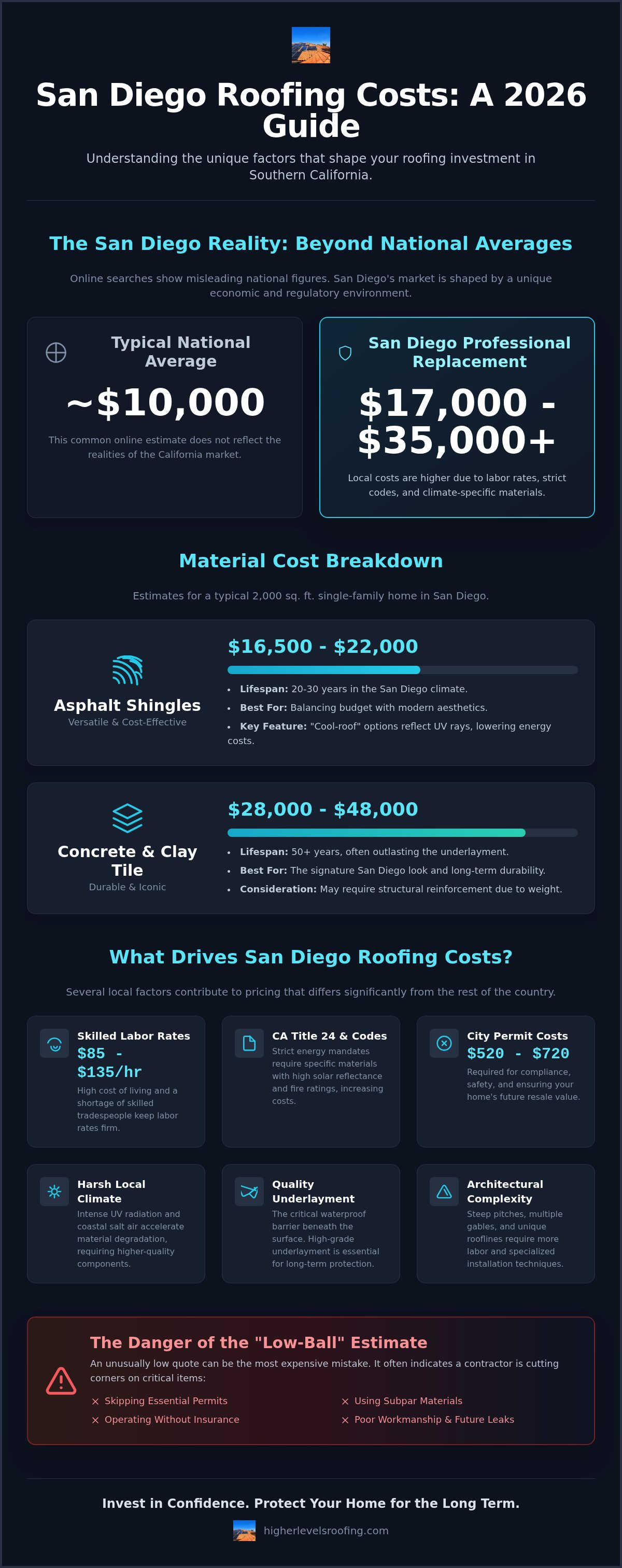
For a typical 2,000 square foot single-family home in San Diego, a professional roof replacement generally ranges from $17,000 to $35,000 or more. The final figure depends heavily on the commercially available roofing materials you select. For instance, asphalt shingle installations for a home of this size typically fall between $16,500 and $22,000. If you prefer the classic look of concrete or clay tile, the range often shifts to $28,000 and $48,000 respectively. Labor remains the largest variable. With California labor rates for skilled roofers averaging between $85 and $135 per hour, the investment reflects the high cost of living and the expertise required to meet local standards.
The Danger of the "Low-Ball" Estimate
It's tempting to choose the lowest bid, but an unusually low quote is often a red flag. Fly-by-night contractors frequently cut costs by skipping essential permits or operating without proper insurance. In the City of San Diego, reroofing permits alone can cost between $520 and $720. Skipping these steps might save money today, but it leaves you liable for injuries on your property and can complicate your home's resale value. Poor workmanship often leads to premature material failure. You don't want to pay for the same roof twice.
Market Factors Influencing 2026 Pricing
Several factors contribute to the current pricing landscape. While supply chains have stabilized compared to previous years, material inflation continues to track with broader economic trends. We also see a persistent shortage of skilled labor in the San Diego construction sector, which keeps professional rates steady. Beyond the visible surface, the quality of underlayment plays a significant role in the total project cost. Understanding how much does a new roof cost in San Diego 2026 requires looking at these hidden components. High-quality underlayment is essential for long-term durability, especially for tile roofs where the waterproof barrier often fails before the tiles themselves.
Your home is your most valuable asset. Between the coastal salt air and the intense UV heat of the inland valleys, your roof works harder here than in most other parts of the country. A professional, permitted installation isn't just a regulatory requirement; it's a safeguard for your family's security and your property's value.
Material Breakdown: From Shingles to Spanish Tile
Your choice of material defines the character of your home and the long-term weight of your investment. When calculating how much does a new roof cost in San Diego 2026, you'll find that the material you select is the primary lever. Every option must adhere to the California Building Standards Code, which mandates specific fire ratings and solar reflectance levels. Beyond regulatory compliance, you must consider how the intense Southern California sun and coastal salt air interact with different surfaces.
Asphalt Shingles: Durability vs. Cost
Asphalt shingles remain a popular choice because they balance affordability with modern style. While basic 3-tab shingles are the most budget-friendly, most homeowners now opt for high-definition architectural shingles. These provide a thicker profile and better wind resistance. Color choice is particularly vital in our climate. Lighter, "cool-roof" shingles reflect UV rays, which helps lower attic temperatures during those inland heatwaves. You can typically expect an asphalt system to last 20 to 30 years in the San Diego sun before the granules begin to significantly degrade.
Tile Roofing: Replacements and Relays
Tile is the signature look of San Diego architecture. However, it's also one of the heaviest materials. If you're switching from shingles to tile, your home may require structural reinforcement to handle the weight. Concrete tiles are a durable, mid-range option, while clay tiles represent the premium tier for their color longevity and classic aesthetic.
A unique local solution is the "Lift and Relay" process. Many homes built in the 1970s and 80s have tiles that are still in excellent condition, but the waterproof underlayment beneath them has turned brittle. In these cases, we can carefully remove your existing tiles, install a new high-grade underlayment, and then reinstall the original tiles. This approach provides a renewed system while saving you thousands on material costs. It's an excellent way to manage how much does a new roof cost in San Diego 2026 without sacrificing the Spanish-style look. If you're curious about whether your current tiles qualify for a relay, speaking with a local roofing expert can provide the clarity you need.
Commercial and Flat Roof Options
For modern residential additions or commercial properties in La Jolla and Carlsbad, flat roofing solutions like TPO (Thermoplastic Polyolefin) are the gold standard. TPO is a single-ply membrane that offers exceptional energy efficiency by reflecting heat away from the building. You can read more about its benefits in this TPO commercial roofing in San Diego analysis. For smaller residential flat sections, such as balconies or garage roofs, rolled asphalt torch down roofing remains a reliable, cost-effective choice that provides a seamless waterproof barrier.
The "San Diego Tax": Local Regulations and Climate Factors
Calculating how much does a new roof cost in San Diego 2026 involves more than just selecting a material and hiring a crew. Your home's specific location within the county introduces variables that contractors often call the "San Diego Tax." These aren't arbitrary fees. They are the necessary costs of meeting California's rigorous safety and energy standards while protecting your home from our unique micro-climates. From the corrosive salt air in Del Mar to the intense wildfire risks in the East County foothills, your roof must be engineered for its specific environment.
Title 24 "Cool Roof" Requirements
As of January 1, 2026, California's Title 24 building energy standards have expanded. These rules now strictly cover steep-slope roof replacements across San Diego County, which is designated as Climate Zone 7. The primary focus is the Solar Reflectance Index (SRI). This value measures how well a roof reflects solar energy and radiates heat. While these "cool roof" materials may have a slightly higher upfront cost, they significantly reduce your summer utility bills by keeping your attic cooler. Many high-quality asphalt shingles and concrete tiles now naturally meet these standards, allowing you to comply with the law without needing specialized coatings.
Coastal vs. Inland Maintenance Costs
Your proximity to the Pacific Ocean directly impacts your material budget. Homes in coastal areas like La Jolla and Encinitas often face a 5% to 12% premium for specialized hardware. Standard metal flashing and fasteners can corrode quickly in the marine layer. We use marine-grade stainless steel or double-galvanized components to prevent rust from compromising your roof's integrity.
Inland properties in areas like El Cajon or Escondido face a different challenge. Intense UV heat accelerates the loss of protective granules on asphalt shingles, which can lead to premature aging. Choosing a material with a high thermal resistance is essential for these zones. When you evaluate how much does a new roof cost in San Diego 2026, you must account for these micro-climate adjustments to ensure your investment lasts its full intended lifespan.
Safety regulations also play a major role in your final invoice. If your home is located in a Wildland-Urban Interface (WUI) zone, a Class A fire rating is mandatory. This often requires specific underlayments and bird-stopping on tile roofs to prevent embers from entering the roof assembly. Finally, permit fees vary significantly by jurisdiction. A residential reroofing permit in the City of San Diego typically costs between $520 and $720, while unincorporated county areas may only require $185 to $310. Navigating this bureaucracy is a standard part of a professional installation, ensuring your new roof is fully documented and legal.
How to Predict Your Final Invoice
Predicting your final invoice shouldn't feel like a guessing game. While material prices provide a baseline, the physical characteristics of your home often dictate the final labor requirements. Understanding how much does a new roof cost in San Diego 2026 requires a look at the specific measurements and structural conditions of your property. Contractors don't just look at the total area; they evaluate the risks, the height, and the amount of time their crews will spend on the slopes.
The industry standard for measurement is the "roofing square," which represents a 10 by 10 foot area, or 100 square feet. However, two homes with the same number of squares can have vastly different price points. A simple, low-pitched roof is relatively straightforward to navigate. In contrast, a steep or multi-gabled roof requires specialized safety equipment, more complex flashing, and significantly more time for every shingle or tile laid. If your home features dormers, skylights, or intricate valleys, the labor costs will naturally reflect that added complexity.
Calculating Your Roof Size
It's a common misconception that your home’s living square footage equals your roof’s square footage. A 2,000 square foot home rarely has a 20-square roof. You must account for the pitch of the roof, which increases the surface area compared to the flat footprint of the house. Additionally, eaves and overhangs often extend two feet or more past your exterior walls. Attached garages and covered patios also add to the total surface area. When we measure a property, we also look at chimney crickets and skylight flashing, as these transition points are critical for preventing leaks and require meticulous attention to detail.
The Cost of the "Tear-Off"
In many parts of the country, contractors might suggest laying new shingles over an old layer to save money. In San Diego, local building codes generally forbid a "second layer" for residential reroofing. This means a full tear-off is mandatory. Removing the old material allows us to inspect the roof deck for hidden issues like dry rot, termite damage, or structural sagging.
Disposal fees at local San Diego landfills are another factor in your final invoice. These facilities have specific recycling requirements for asphalt and concrete, which adds to the logistics of the project. If we discover rotted fascia boards or damaged plywood during the tear-off, these must be replaced to ensure the integrity of your new system. To get the most accurate picture of your home's specific needs, you can request a detailed on-site inspection from our team to identify these variables before the work begins.
Investing in Your Home: The Higher Levels Advantage
Choosing a contractor is just as significant as choosing your materials. While understanding how much does a new roof cost in San Diego 2026 helps you set a baseline budget, the quality of the installation determines the true return on your investment. At Higher Levels Roofing, we prioritize meticulous craftsmanship over high-volume turnover. We believe every home in San Diego County deserves a roof that isn't just compliant with current codes, but engineered to thrive in our specific coastal and inland environments. Our team treats every project as a contribution to our local community's landscape. If you are also interested in how professional standards are applied in other regions like Texas, you can learn more about the residential and commercial services provided by MAK Roofing and Construction Company.
We take the complexity out of modern building standards. Whether we're installing a high-performance TPO system on a commercial building or performing a delicate tile relay on a Spanish-style residence, our focus remains on long-term durability. We stay ahead of the latest Title 24 requirements for Climate Zone 7, ensuring your new system meets all energy-efficiency mandates without compromising on aesthetic appeal. You don't have to navigate the bureaucracy of permits and inspections alone. We handle those details with professional assurance, providing you with a steady, expert hand throughout the process.
Professional Assurance and Craftsmanship
Hiring a licensed and insured San Diego roofer is the only way to protect your property and your peace of mind. In many of our local neighborhoods, particularly in areas with strict Homeowners Associations (HOAs), compliance involves more than just city permits. We have extensive experience managing HOA approvals and community-specific architectural requirements. We ensure that your material choice and color palette align with local standards while still providing the protection your home needs. To help you make an informed decision, we've put together The Ultimate San Diego County Roofing Contractor Hiring Checklist to guide your search for the right professional.
Your Next Steps for a New Roof
When you're ready to move beyond general estimates, a professional on-site inspection is the next logical step. During this consultation, we evaluate your roof's current condition, identify potential structural issues, and discuss the best material options for your micro-climate. We'll provide a clear breakdown of how much does a new roof cost in San Diego 2026 for your specific property. Once you decide to move forward, we'll guide you on how to prepare your property, from clearing the driveway to protecting your landscaping. We aim to make the installation process as smooth and transparent as possible. If you're ready to secure your home's future, request your free, detailed roofing estimate from Higher Levels Roofing today.
Securing Your San Diego Home’s Future
Navigating the complexities of a roof replacement involves more than just picking a shade or style. You now have a clearer understanding of how much does a new roof cost in San Diego 2026 and why local factors like Title 24 energy standards and coastal salt air are so influential. Investing in a system that balances aesthetic appeal with technical compliance is the best way to protect your property's value. A quality roof is a shield against the elements. It's also a commitment to your family's long-term security.
As a licensed and insured San Diego contractor, Higher Levels Roofing specializes in asphalt, tile, and TPO systems designed for our unique climate. We bring expert knowledge of local building codes to every project, ensuring your home remains safe and efficient for decades. Don't leave your most valuable asset to chance or low-ball estimates that skip essential details. Schedule Your Free San Diego Roof Inspection today to get a precise breakdown tailored to your home. We're here to guide you with professional assurance and neighborly care.
Frequently Asked Questions
Is a new roof more expensive in San Diego than other California cities?
San Diego roofing costs often trend higher than many other California cities. This is primarily driven by local labor rates, which currently range from $85 to $135 per hour. Additionally, homes in coastal zones require specialized, corrosion-resistant fasteners and flashing to withstand the marine layer. These regional factors, combined with stringent local permit fees, mean that budgeting for how much does a new roof cost in San Diego 2026 requires a focus on local rather than state-wide averages.
What is the most affordable roofing material for San Diego homes in 2026?
Asphalt shingles remain the most budget-friendly option for local homeowners. While standard 3-tab shingles offer the lowest entry point, most residents choose architectural shingles for their superior durability in the Southern California sun. These materials provide a reliable balance of fire resistance and modern style. Even though they are affordable, they must still meet the Solar Reflectance Index requirements mandated by current building codes to ensure your home stays cool during inland heatwaves.
How much does Title 24 compliance add to the cost of a new roof?
Title 24 compliance typically adds a modest premium to your project, often reflected in the price of "Cool Roof" certified materials. Many modern asphalt shingles and concrete tiles are now manufactured to meet these standards by default, which helps keep costs manageable. When calculating how much does a new roof cost in San Diego 2026, remember that while the upfront investment is slightly higher, the long-term savings on your summer cooling bills often offset the initial cost.
Can I save money by installing a new roof over my old one?
You generally cannot save money this way because San Diego building codes typically require a full tear-off of existing materials. Installing a second layer of shingles is discouraged because it traps heat and adds excessive weight to your home's structure. A full removal allows us to inspect the roof deck for hidden damage like dry rot or termite activity. This thorough process ensures your new system is installed on a solid, safe foundation that meets all local safety standards.
How long does a typical roof replacement take in San Diego?
A standard residential roof replacement in San Diego usually takes between 3 and 7 business days. The timeline depends on the size of your home and the complexity of the roof's pitch. For example, a simple asphalt shingle project might be completed in under a week, while a complex clay tile installation or a "lift and relay" project may take longer. We always aim to minimize disruption to your daily routine while maintaining our high standards for craftsmanship and safety.
Does a new roof increase my San Diego home value significantly?
A new roof provides a substantial boost to your property's market value and curb appeal. Prospective buyers in San Diego prioritize homes with updated, energy-efficient systems that comply with the latest Title 24 standards. Beyond the aesthetic improvement, a permitted and professionally installed roof offers peace of mind regarding structural integrity. This investment often results in a high return, as it eliminates one of the most significant maintenance concerns for anyone looking to purchase a home in our region.
Are there rebates available for "Cool Roof" installations in San Diego?
Rebates for "Cool Roof" installations vary by year and provider, but options often exist through federal tax credits or local utility programs. Some homeowners may qualify for energy-efficiency incentives when they choose materials that meet specific solar reflectance criteria. It's best to check with SDG&E or consult a tax professional to see which 2026 incentives apply to your project. These programs are designed to encourage the use of reflective materials that reduce the overall energy demand on the local grid.
What happens if my roofer finds dry rot during the tear-off?
If we discover dry rot or termite damage during the tear-off, we must replace the affected plywood or fascia boards before proceeding. This is a common occurrence in older San Diego homes and is why we recommend a small contingency budget for every project. We'll provide a clear explanation and a change order for the necessary repairs to ensure your home's structure is sound. Addressing these hidden issues immediately prevents them from compromising your new roof's long-term performance.


Comments