


Expert Concrete Tile Roof Repair in San Diego: The Homeowner’s Guide

Updated: Aug 27
What if your leaking roof has nothing to do with the tiles you see from the curb? In San Diego, concrete tiles are designed to last for decades, but the layers hidden beneath them often tell a different story. It's incredibly stressful to deal with unexpected leaks during our rainy season, which is why finding expert concrete tile roof repair San Diego specialists is about more than just fixing a drip. You're looking for a steady hand who understands that a few cracked tiles shouldn't lead to a forced upsell for a full replacement.
We believe home maintenance should be straightforward and stress-free. This guide will help you identify the real source of leaks and maintain your roof against the unique challenges of our coastal salt air. You'll discover the "Lift and Reset" process, how we source matching tiles for discontinued profiles to preserve your curb appeal, and exactly what it takes to keep your home dry and secure for years to come. By the end, you'll have the professional knowledge needed to protect your property with confidence.
Table of Contents
Understanding Concrete Tile Roof Issues in San Diego
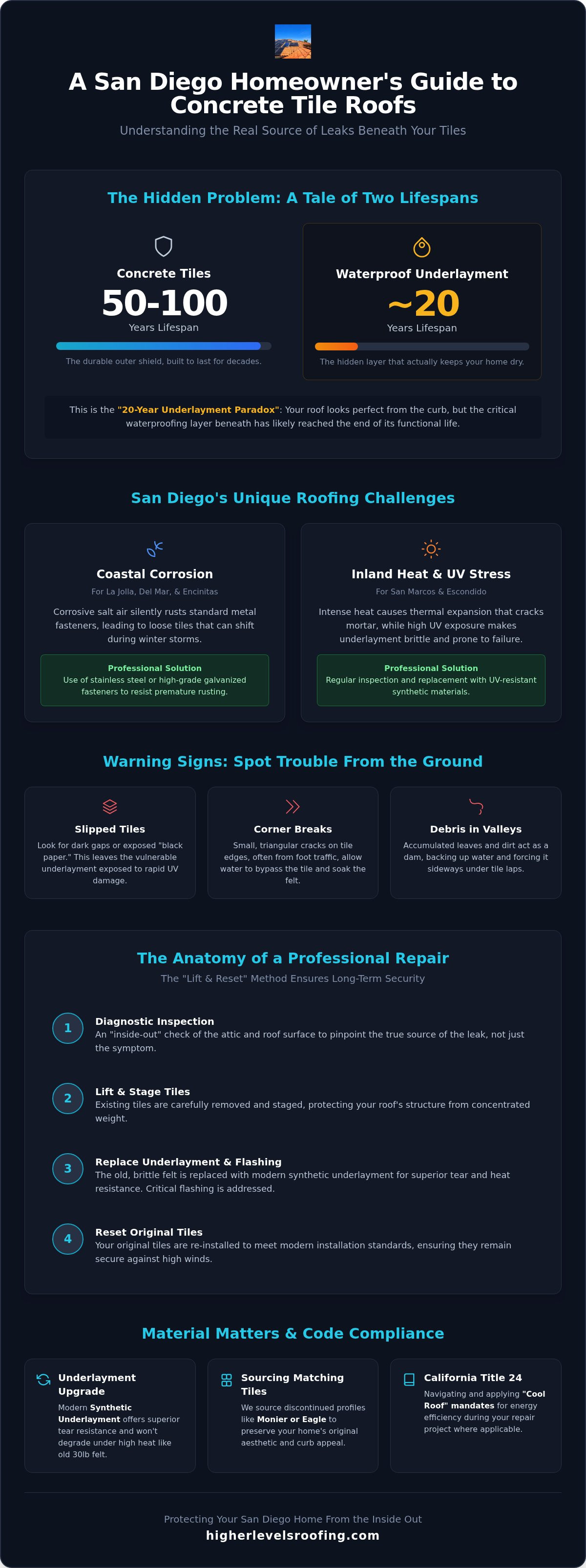
Concrete tiles have a reputation for being nearly indestructible. While the history and types of roof tiles shows that these materials can last up to a century, the components hidden beneath them are far more vulnerable. In San Diego, homeowners often face the "20-year underlayment" paradox. Your tiles might look brand new from the curb, but the waterproof felt layer underneath has likely reached the end of its functional life. This discrepancy is the primary reason why concrete tile roof repair San Diego is so critical for maintaining your home's long-term value.
San Diego architecture typically features two main profiles: Concrete S-Tile and Flat Concrete Tile. S-Tile mimics the curved look of traditional Mediterranean clay, while Flat Tile provides a cleaner, more modern aesthetic. Both are exceptionally heavy and fire-resistant, yet they rely entirely on the integrity of the fasteners and underlayment to keep your attic dry. When these secondary systems fail, even the strongest tile cannot stop a leak from entering your living space.
Coastal vs. Inland Roofing Challenges
Your specific neighborhood dictates the type of wear your roof endures. In coastal communities like La Jolla, Del Mar, Encinitas, and Carlsbad, salt air corrosion is the silent killer of roof systems. Standard galvanized fasteners can rust prematurely, leading to loose tiles that shift during winter storms. We prioritize stainless steel or high-grade galvanized fasteners in these zones to ensure your roof stays put. Meanwhile, inland areas like San Marcos and Escondido face intense thermal expansion. The daily cycle of heat causes the roof deck to swell and shrink, which can eventually crack mortar or loosen tiles. High UV exposure in these zones also degrades any underlayment that becomes exposed, making it brittle and prone to failure.
Common Signs Your Tile Roof Needs Professional Repair
You don't always need to climb a ladder to spot trouble. Keep an eye out for these specific warning signs that indicate your roof's internal layers are at risk:
Corner Breaks: Small, triangular cracks at the edges of tiles are often caused by heavy foot traffic or fallen branches. These allow water to bypass the tile's shedding system and soak the felt underneath.
Slipped Tiles: If you see dark gaps or exposed "black paper," your tiles have shifted. This is common after intense Santa Ana winds and leaves your underlayment vulnerable to rapid UV damage.
Debris in Valleys: When leaves and dirt accumulate in the roof's valleys, they act as a dam. Water backs up, flows sideways, and penetrates the underlayment laps where it doesn't belong.
The Anatomy of Professional Tile Repair: Beyond the Surface
A successful concrete tile roof repair San Diego project requires looking past the visible surface. While the tiles act as a durable shield, the real waterproofing happens underneath. Our team approaches every repair as a meticulous five-step process to ensure long-term security for your home. We begin with a comprehensive diagnostic inspection, checking both the attic for moisture intrusion and the roof surface for structural anomalies. Finding the source of a leak often requires this "inside-out" perspective.
Once we identify the trouble zones, we move to the careful removal and staging of existing tiles. Because concrete is remarkably heavy, we never stack them in a way that compromises your roof's structural integrity. With the tiles out of the way, we evaluate the waterproofing underlayment. We also inspect the flashing, batten strips, and bird stops. These small components are essential for airflow and water diversion. Finally, we re-install the tiles using tile roofing installation standards to guarantee they stay secure against San Diego's occasional high winds. This level of detail is what sets a professional concrete tile roof repair San Diego service apart from a quick patch job.
The Role of Underlayment and Flashing
In many older San Diego neighborhoods, builders used traditional 30lb felt. It's a reliable material, but it often becomes brittle and fails decades before the concrete tiles do. We often recommend synthetic underlayment for modern repairs because it offers superior tear resistance and doesn't degrade as quickly under high heat. Proper flashing is equally vital, especially in "dead valleys" where water tends to pool. If your roof has complex angles, specialized flashing is the only way to prevent water from backing up under the tile laps. If you've noticed damp spots on your ceiling, our team can provide a professional roof assessment to determine if your underlayment is still doing its job.
Identifying Cracked and Slipped Tiles
Most tile damage is actually man-made. Walking on tiles incorrectly is the leading cause of "spiderweb" cracks, which eventually turn into full breaks. A single slipped tile might seem minor, but it exposes the vulnerable underlayment to direct UV rays and heavy rain. This exposure accelerates the failure of the waterproofing layer. You might also notice a white, chalky substance on your tiles; efflorescence is a natural salt deposit that is an aesthetic issue rather than a structural one. While it might look concerning, it doesn't mean your tiles are failing. However, broken or shifted tiles are a different story and require immediate attention to prevent interior water damage.
Repair vs. Lift and Reset: Choosing the Right Solution
Homeowners often feel trapped between two extremes: a temporary patch or a massive bill for a brand new roof. In reality, the most effective concrete tile roof repair San Diego projects often fall into a highly effective middle ground. If your roof has suffered isolated impact damage, such as a fallen branch or a stray baseball, a simple tile replacement is usually sufficient. We carefully swap the damaged units and inspect the immediate area to ensure the underlayment remains intact. This keeps costs low while maintaining the integrity of your roof's surface.
However, if your roof is 20 to 30 years old and experiencing multiple leaks, a "Lift and Reset" is often the most professional recommendation. This process addresses the underlying issue without the expense of purchasing entirely new tiles. Since concrete tiles are designed to last for half a century or more, it's often the "guts" of the roof that fail first. A reset allows us to preserve your existing tiles while completely restoring the waterproofing system that actually keeps your home dry. It's a strategic investment that offers longevity comparable to a new roof at a fraction of the total cost.
What is a Lift and Reset?
The technical process involves "harvesting" your existing Flat or S-Tiles by carefully removing them and staging them on the roof. We then strip away the old, brittle underlayment to reveal the wooden deck. After performing any necessary minor repairs to the wood, we install a high-quality, modern secondary water barrier. The original tiles are then re-installed over the new "guts." Beyond the cost savings, this approach has significant environmental benefits. By reusing your existing materials, we keep tons of heavy concrete out of San Diego landfills, making it a sustainable choice for eco-conscious homeowners.
When is a Full Replacement Necessary?
There are specific scenarios where a reset isn't enough. If our diagnostic inspection reveals widespread structural deck rot or moisture damage that has compromised the home's framing, a full tear-off is required to ensure safety. Additionally, if the tiles are exceptionally brittle and breakage exceeds 20% to 30% during the harvesting process, it becomes more cost-effective to start fresh. Some homeowners also choose a full replacement when they want a complete aesthetic change. If you're considering a transition to different types of roofing materials to update your home's style, a full replacement is the only way to achieve that transformation while ensuring your new system meets current San Diego building codes.
Navigating San Diego Building Codes and Material Matching
San Diego's architectural beauty relies on visual consistency. When you need a concrete tile roof repair San Diego project for a home in La Jolla or Del Mar, a "close enough" match simply won't suffice. Luxury properties demand meticulous attention to detail because a mismatched patch can significantly devalue your home's curb appeal. The challenge lies in the fact that many popular tile brands from the 1980s and 1990s, such as Monier, Lifetile, or certain Eagle profiles, have been discontinued. Finding these specific shapes and sizes requires a contractor with deep roots in the local industry.
Beyond the aesthetics, there's the complex world of local regulations. Significant repairs often require navigating San Diego County building permits, which typically range from $450 to $700 depending on your specific jurisdiction. We handle the technical compliance so you don't have to worry about red tape. Our goal is to ensure your repair is both structurally sound and fully compliant with the latest safety standards. If you're concerned about how these regulations apply to your home, schedule a professional consultation with our team today.
Sourcing Discontinued Concrete Tiles
We maintain relationships with local "bone yards" across Southern California to track down vintage tiles that are no longer in production. Sourcing these originals is the only way to guarantee a perfect fit. However, even with the right profile, color matching concrete is notoriously difficult because pigments fade differently than natural clay. To solve this, we use a technique called "blending." We harvest original tiles from inconspicuous areas of your roof, like back slopes or valleys, to use for the highly visible repair. We then place the newer, slightly different tiles in those hidden spots. This meticulous craftsmanship ensures the front of your home looks untouched and original.
San Diego Title 24 Compliance
California's Title 24 energy standards are a major factor in modern roofing. As of 2026, the "50% rule" is a critical threshold for homeowners to understand. If a repair or alteration affects more than 50% of your roof area, or exceeds 2,000 square feet, it triggers the "Cool Roof" mandate. This requires materials to meet specific Solar Reflectance Index (SRI) values to reduce heat absorption. Additionally, the "25% rule" states that if more than a quarter of the roof is replaced within a 12-month period, the entire system must be brought up to current building codes. Modern concrete tiles are excellent for meeting these energy efficiency standards, helping you stay compliant while potentially lowering your cooling costs during San Diego's warm inland summers.
Why Higher Levels Roofing is San Diego’s Tile Repair Specialist
Higher Levels Roofing isn't just another contractor; it's a team led by Carlos, a craftsman who views every project as a contribution to our community's landscape. We understand that your home is likely your most significant investment. That's why we prioritize local accountability and meticulous attention to detail in every concrete tile roof repair San Diego project we undertake. Whether you own a Mediterranean-style home in the hills or manage a commercial complex with a massive Flat Tile system, we bring the same level of steady, expert care to the job. We don't believe in high-pressure sales or temporary patches that fail during the next winter storm. Instead, we focus on providing a service-oriented experience that emphasizes safety, aesthetic pride, and long-term security.
Our Detailed Inspection and Estimation Process
Transparency is the foundation of our neighborly warmth approach. We know that roofing issues cause anxiety, so we aim to alleviate that stress through clear communication. We provide free roofing estimates in San Diego county to help you understand your options without any initial financial commitment. During our diagnostic phase, we use digital photos to show you exactly what's happening. You'll see the "hidden" problems, such as deteriorated underlayment or rusted fasteners, without ever having to climb a ladder yourself. This allows us to build a customized repair plan that respects both your budget and your property's value.
Local Craftsmanship and Long-Term Security
Our deep roots in communities like San Diego, San Marcos, and Carlsbad define our personality as a dedicated local advocate. We take genuine pride in the finished product because we live and work in the same neighborhoods as our customers. Our repairs aren't designed to just look good for a season; they're engineered to outlast the intense Santa Ana winds and coastal salt air we've discussed. We view ourselves as your steady, expert hand in home maintenance. By choosing a specialist who understands the unique intersection of functional necessity and visual appeal, you're ensuring your roof remains a source of pride rather than a source of worry. Ready to protect your home? Contact Higher Levels Roofing for a Tile Roof Inspection Today.
Secure Your Home for the Seasons Ahead
You now understand that a beautiful tile roof is only as strong as the underlayment and fasteners hidden beneath it. Whether you are dealing with salt air corrosion or shifted tiles from Santa Ana winds, choosing the right path between a simple patch and a strategic "Lift and Reset" can save you thousands while preserving your home's curb appeal. Expert concrete tile roof repair San Diego isn't just about stopping a leak; it's about restoring the long-term integrity of your property through meticulous craftsmanship.
As a locally owned and operated contractor, Higher Levels Roofing brings a steady hand and neighborly warmth to every project. Carlos and his team are licensed, insured, and deeply experienced in both Flat and S-Tile concrete profiles common throughout the county. We focus on transparent communication and solutions that respect your budget. Don't wait for the next rainy season to discover a problem. Get Your Free Concrete Tile Roof Repair Estimate today and gain the peace of mind that comes from a roof built to last. Your home is your sanctuary, and we're here to help you keep it dry and secure for years to come.
Frequently Asked Questions
Can I walk on my concrete tile roof to check for damage?
No, you should avoid walking on your roof whenever possible. Concrete tiles are exceptionally brittle and prone to "spiderweb" cracks when weight isn't distributed across specialized walk boards. These hairline fractures eventually grow into full breaks that cause leaks. It's also a significant safety risk given the steep pitches common in San Diego. Instead, use binoculars from the ground or hire a professional to perform a drone inspection to spot shifted tiles safely.
How much does concrete tile roof repair cost in San Diego?
The total for a concrete tile roof repair San Diego project depends on several local factors. We look at the roof's pitch, the height of the home, and whether we're performing a localized patch or a comprehensive "Lift and Reset." Sourcing discontinued tile profiles can also influence the complexity of the job. Because every home is unique, we provide customized estimates that reflect the specific needs of your property and long-term protection goals.
How long does a concrete tile roof typically last in Southern California?
While the concrete tiles themselves are often rated to last 50 years or more, the internal components have a shorter lifespan. In Southern California, the intense UV radiation and coastal salt air typically degrade the waterproofing underlayment within 20 to 30 years. Regular maintenance and early repairs can help you reach the maximum potential of your tile system. It's common to replace the "guts" of the roof while keeping the original tiles for several decades.
What is a "slip and slide" failure in tile roofing?
A "slip and slide" failure occurs when tiles physically shift out of their original position and slide down the roof deck. This is often caused by fastener corrosion in coastal areas like La Jolla or intense Santa Ana wind gusts. When a tile slips, it leaves the dark underlayment exposed to direct sunlight and rain. This exposure causes the waterproofing layer to fail rapidly, leading to major leaks that can damage your home's interior framing and insulation.
Do I need a permit for tile roof repair in San Diego County?
Yes, most significant roofing projects in San Diego County require a permit to ensure the work meets current California Building Codes. For example, if you replace more than 25% of the roof or trigger Title 24 "Cool Roof" requirements, a permit is mandatory. Permit fees typically range from $450 to $700 depending on your jurisdiction. We handle the paperwork for your concrete tile roof repair San Diego to ensure every detail is fully compliant with local regulations.
Why is my tile roof leaking if none of the tiles are broken?
Your roof is likely leaking because the secondary water barrier, known as the underlayment, has failed. Tiles are designed to shed the bulk of the water, but the felt or synthetic layer underneath provides the actual waterproofing. Over time, this layer becomes brittle and cracks. Even if your tiles look perfect from the street, water can seep through the laps or around rusted flashings, causing damp spots on your ceiling during the rainy season.
What is the difference between concrete and clay tile repairs?
Concrete tiles are generally heavier and more porous than their clay counterparts. While clay tiles are known for their fragile nature and permanent color, concrete tiles can absorb more moisture and may experience pigment fading over several decades. Repairing concrete systems often involves more weight-load considerations for the roof deck. Additionally, matching the specific texture and color of aged concrete requires a different blending technique than working with the natural earthen tones of traditional clay tiles.
How do you match tiles that are no longer manufactured?
We use a combination of local "bone yards" and strategic harvesting to match discontinued tiles. Since brands like Monier or Lifetile are no longer in production, we often take original tiles from less visible areas of your roof, such as the back slopes or valleys. We then install new, similar tiles in those hidden spots and use the vintage matches for the visible repairs. This meticulous approach ensures your home's aesthetic remains consistent and professional across the entire roofline.


Comments