


Commercial Roof Leak Repair in San Diego: Expert Solutions for Local Businesses

A single drip in your warehouse shouldn't automatically trigger a six-figure invoice for a total roof tear-off. Many localized failures in our coastal climate are perfectly suited for targeted restoration rather than a full overhaul. You've likely felt the frustration of watching a small leak disrupt operations while wondering if a contractor's quote for a full replacement is truly necessary. It's a common skepticism when you're trying to protect your facility's bottom line. Finding a specialized team for commercial roof leak repair San Diego businesses can rely on is about more than just stopping water; it's about receiving an honest assessment of your asset's remaining life.
We'll show you how to identify vulnerabilities in TPO and torch down systems under the Southern California sun. This guide explains how to navigate the 2026 Title 24 energy codes, including new "cool roof" Solar Reflectance Index standards and Class A fire-rating requirements for local fire hazard zones. You'll discover how to achieve a watertight building with minimal downtime while maximizing potential tax benefits under IRS Section 179. We're diving into the technical details of modern repairs to ensure your facility remains compliant, energy-efficient, and secure for years to come.
Table of Contents
Common Causes of Commercial Roof Leaks in San Diego
San Diego business owners face a unique set of environmental challenges that aren't found in inland regions. While our weather is generally mild, the combination of constant salt spray, intense solar radiation, and extreme temperature fluctuations creates a punishing environment for industrial structures. Identifying these specific local stressors early is the first step toward effective commercial roof leak repair San Diego facilities require to stay operational. Understanding why these failures happen helps you move from reactive patching to proactive asset management.
Coastal Corrosion and Salt Air Damage
For properties in La Jolla, Carlsbad, or near the San Diego Bay, the Pacific Ocean is a constant threat to roof integrity. Salt air is highly corrosive; it often causes metal flashing and fasteners to fail years before the actual roofing membrane reaches its end of life. When fasteners rust, they lose their grip on the substrate. This allows wind uplift to create gaps where water enters during our sudden winter downpours. We frequently see oxidation on HVAC curbs and vent pipes that goes unnoticed until a ceiling tile in the office starts to sag.
A specific concern for coastal buildings is galvanic corrosion. Galvanic corrosion occurs when two dissimilar metals come into contact in the presence of an electrolyte, such as salt-laden coastal moisture, causing the more active metal to corrode at an accelerated rate. This reaction can quickly compromise the structural seals around roof penetrations, leading to difficult-to-trace leaks that bypass traditional waterproofing layers.
UV Exposure and Membrane Failures
The Southern California sun is a powerful force that degrades even the most durable Membrane Roofing Systems over time. High-energy UV rays penetrate the surface of TPO and asphalt materials, breaking down the polymer chains that provide flexibility. As these materials lose their plasticizers, they become brittle and prone to cracking under pressure. In TPO systems, this often manifests as micro-cracking around the seams where heat is most concentrated.
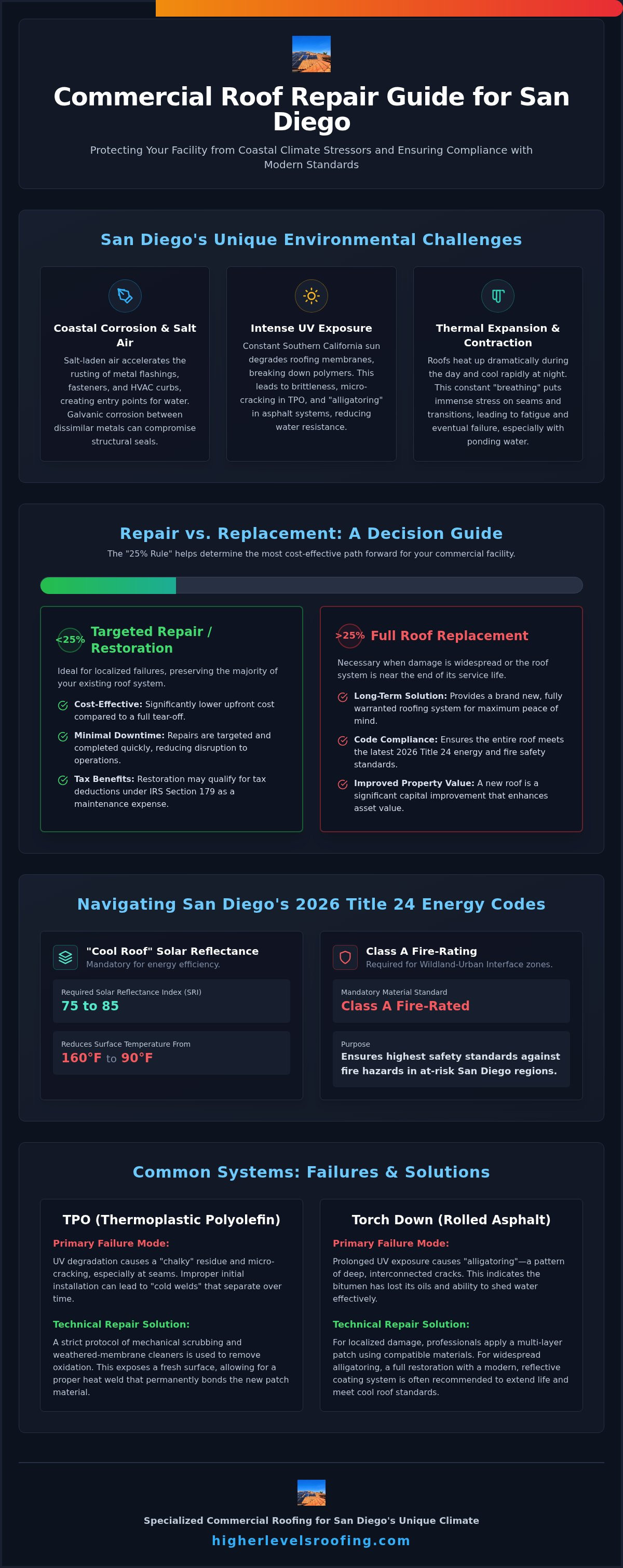
For buildings using rolled asphalt torch down roofing, UV damage often results in "alligatoring." This is a pattern of deep, interconnected cracks that resemble the skin of a reptile. Once this texture appears, the bitumen has lost its ability to shed water effectively. To combat this, modern 2026 Title 24 standards mandate "cool roof" surfaces with a Solar Reflectance Index (SRI) of 75 to 85. These reflective surfaces can lower roof surface temperatures from 160°F to 90°F. Additionally, the updated California Wildland-Urban Interface Code now requires Class A fire-rated materials for many San Diego re-roofing projects, ensuring repairs meet the highest safety standards for our region.
Beyond chemical breakdown, thermal expansion and contraction play a major role in San Diego. Our roofs can bake in 90-degree heat all day and then cool rapidly as the marine layer rolls in at night. This constant "breathing" puts immense stress on seams and transitions. If your building has older, inadequate drainage, this stress is compounded by ponding water. Standing water acts like a magnifying glass for UV rays while adding dead weight that can cause the roof deck to deflect, creating a cycle of damage that eventually leads to a breach.
Repairing TPO and Torch Down Commercial Systems
Successful commercial roof leak repair San Diego projects depend on technical precision and a deep understanding of material chemistry. You can't simply apply a generic patch to a specialized membrane and expect it to withstand the coastal elements. A watertight repair requires a steady, expert hand to ensure that new materials bond permanently with the existing structure. Whether your facility utilizes modern thermoplastics or traditional bitumen, the goal is to restore the original integrity of the system with minimal disruption to your daily operations.
TPO Membrane Repair Protocols
Thermoplastic Polyolefin (TPO) is highly effective at reflecting heat, but aged surfaces present unique challenges during repair. Over time, the top layer of the membrane oxidizes due to intense UV exposure, creating a "chalky" residue that prevents new patches from adhering. To fix this, we follow a strict cleaning and priming protocol. We use mechanical scrubbing and specific weathered-membrane cleaners to expose a fresh layer of TPO before attempting a heat weld.
Identifying Cold Welds: A common failure point in TPO systems occurs when the welding temperature is too low. The seam looks sealed but lacks a structural bond. We pressure-test every seam to ensure a true molecular fuse.
Patching vs. Sealants: While TPO-specific sealants work for minor pinholes, structural breaches require a heat-welded patch that extends at least two inches beyond the damaged area.
Rolled Torch Down and Asphalt Patching
Repairing rolled asphalt torch down roofing requires a careful balance of heat and pressure. When seams begin to lift, we re-torch the area to liquefy the modified bitumen and create a new seal. It's a delicate process; applying too much heat can damage the underlying roof deck or insulation, while too little heat results in a temporary fix that will fail during the next San Diego rainstorm. Understanding how different types of roofing materials respond to thermal stress is essential for a long-lasting result.
We also pay close attention to the aesthetic finish. For visible roof sections, we embed matching ceramic granules into the hot bitumen of the patch. This protects the repair from UV degradation and ensures it blends seamlessly with the rest of the roof. If you're noticing water entry near HVAC units or skylights, these transitions often require new metal flashing and reinforced membrane stripping to stop the leak at its source. If you're concerned about a recurring leak, a professional evaluation can determine if a targeted repair is the right path forward for your building.
Ensuring compatibility between old and new materials is the final step. We never use solvent-based cements on TPO, as they can cause the membrane to swell and deteriorate. By using only manufacturer-approved materials, we maintain the warranty and the structural security of your facility.
Commercial Roof Repair vs. Replacement: A Decision Guide
Deciding between a targeted patch and a total overhaul is a high-stakes choice for any facility manager. You need a watertight building, but you also need to justify the expense to stakeholders. In many cases, a strategic commercial roof leak repair San Diego businesses can rely on is the most fiscally responsible move. However, there is a clear threshold where continuing to patch becomes a case of diminishing returns. Understanding this balance helps you protect your property value without overextending your maintenance budget.
The "25% rule" is a standard industry benchmark used to guide this decision. If the cost of a repair exceeds 25% of the cost of a total replacement, a full system update is usually the better long-term investment. This financial logic is reinforced by San Diego building codes. A building permit is generally required for any roof repair that covers more than 25% of the total roof area. Under the 2026 Title 24 standards, projects affecting over 2,000 square feet or 50% of the roof area must comply with rigorous "cool roof" and insulation requirements. If your repairs trigger these mandates, the cost gap between a major fix and a full replacement narrows significantly.
The condition of the underlying roof deck and insulation is the ultimate deciding factor. We perform core samples to check for moisture infiltration. If the insulation is saturated, it loses its R-value and can lead to structural rot. Patching a membrane over wet insulation is a temporary fix at best; the trapped moisture will eventually cause the new patch to fail from the underneath. A dry, sound deck is a prerequisite for any successful repair strategy.
When to Choose Professional Leak Repair
Targeted repairs are ideal when the overall membrane is still flexible and the leaks are isolated to specific failure points, such as a single HVAC curb or a punctured section of TPO. This approach is a smart way to extend the life of your roof by 2 to 5 years while you plan for a future capital expenditure. It’s important to remember that a shingle roofing company often lacks the specialized heat-welding equipment and technical certifications required to bond patches to commercial TPO or torch down systems correctly.
Signs a Full Replacement is Unavoidable
You may need to move toward a replacement if you're dealing with multiple active leaks across more than 30% of the roof surface. Widespread failure suggests the material has reached the end of its functional life due to the UV degradation discussed earlier. When the cost of constant service calls begins to rival a monthly financing payment for a new system, it's time to look at the bigger picture. For a comprehensive look at modern system options, you can refer to our guide on roof replacement San Diego for full system overviews and 2026 compliance standards.
Preventive Maintenance for San Diego Commercial Roofs
A proactive approach is the most effective way to avoid the high costs of emergency commercial roof leak repair San Diego facilities often encounter during peak storm seasons. While many managers wait for a visible drip to call a professional, the most successful property owners view their roof as a critical asset that requires routine care. Investing in bi-annual inspections provides a high return on investment by identifying minor vulnerabilities before they escalate into structural failures or interior property damage.
The goal of maintenance isn't just to find leaks; it's to ensure the entire system functions as designed. This includes maintaining the reflective properties of your Title 24 compliant cool roof and ensuring that drainage paths remain unobstructed. In our region, the transition between the dry summer and the winter rainy season is the most critical window for these assessments.
Rainy Season Preparation Checklist
San Diego's "first rain" often brings a surge of service calls due to debris that has accumulated over the dry months. A simple blockage in a scupper or drain can lead to thousands of pounds of standing water on your roof deck, causing it to deflect and leak. We recommend a thorough clearing of all drainage systems every October to prepare for the winter months.
Inspect Scuppers and Drains: Remove leaves, dirt, and nesting materials that can clog outlets during a heavy downpour.
Monitor Ponding Water: Check the roof surface 48 hours after a rain event; if water remains, your drainage slope or drains may need adjustment.
Evaluate Sealants: Solar heat can dry out caulking around HVAC units and vents. Ensure these transitions remain pliable and bonded to the membrane before moisture arrives.
Addressing Santa Ana Wind Damage
Our local Santa Ana wind events present a different kind of threat. High-velocity winds can create a vacuum effect, pulling on the edges of your roof. If your perimeter flashing or coping is loose, the wind can get underneath the membrane and cause "billowing." This is particularly common in TPO systems that aren't properly secured at the edges. Billowing stretches the material and stresses the seams, making it much more likely to fail during the next storm.
Regularly checking the mechanical fasteners and edge metal ensures your roof stays pinned down when the winds pick up. When choosing a partner for these inspections, you can use our roofing contractor San Diego county guide to ensure they have the technical expertise to spot these specific regional issues. If you haven't had your facility inspected this year, schedule a professional maintenance walkthrough to secure your building before the next weather event.
Why Choose a Local San Diego Commercial Roofing Specialist?
National roofing conglomerates often prioritize volume and standardized checklists, but commercial properties in Southern California require a more nuanced approach. When you're managing a facility in San Marcos or La Jolla, you're dealing with specific microclimates that national firms frequently overlook. Choosing a specialist for commercial roof leak repair San Diego businesses can trust means opting for direct accountability. You won't be dealing with a distant call center or a rotating cast of subcontractors. Instead, you get the "Carlos" difference; personalized oversight on every project to ensure that every seam and seal meets our high internal standards.
Working with a local team also means faster response times. When a sudden storm hits, a local crew is already in your neighborhood, familiar with the local traffic patterns and building layouts. This proximity allows for quicker stabilization of leaks, which minimizes business interruption and prevents secondary damage to your inventory or electronics. We view every project as a contribution to our community's landscape, which drives us to deliver a higher level of craftsmanship than a volume-based national chain.
Localized Expertise and Compliance
San Diego's building codes are among the most stringent in the country, especially with the 2026 updates to Title 24. A local contractor understands the exact Solar Reflectance Index (SRI) requirements and insulation R-values needed to pass inspection the first time. We don't just guess at compliance; we live it. This local knowledge extends to material selection. A roof in a high-salt coastal zone requires different fastener specifications than one in the dry heat of North County. For a deeper look at how these local factors influence project outcomes, review our TPO commercial roofing case study for local results.
Meticulous Craftsmanship Over Corporate Volume
Large corporations often push for full replacements because it's easier to manage on a spreadsheet. As a locally owned business, we take pride in our identity as meticulous craftsmen. We focus on high-quality repairs that extend the functional life of your existing roof, saving you capital for other business improvements. Our reputation in neighborhoods like San Marcos and La Jolla is built on honesty and transparency. We provide a clear assessment of whether a repair is viable or if a replacement is a technical necessity. This level of dedication ensures your building remains a secure, aesthetic contribution to our local landscape.
Protecting your commercial investment starts with a partner who understands the local environment. If you're ready for an honest evaluation of your roof's condition, contact Higher Levels Roofing for a professional commercial assessment today. We'll help you find a solution that balances functional necessity with long-term security.
Secure Your Commercial Asset for the Long Term
Protecting your facility's integrity doesn't have to be a source of stress or a drain on your capital. By understanding the specific impact of our coastal climate and the technical requirements of modern roofing membranes, you can make informed decisions that extend the life of your asset. Whether you're addressing a minor breach or navigating the complexities of 2026 Title 24 compliance, the right strategy balances immediate security with long-term financial health.
As a locally owned and operated business, we provide the direct accountability and meticulous craftsmanship that national chains often lack. Every project receives the personalized oversight of a licensed San Diego roofing contractor with deep expertise in TPO and torch down systems. Choosing a specialist for commercial roof leak repair San Diego businesses can trust ensures your building remains watertight, efficient, and compliant with all local standards. Don't wait for the next winter storm to test your roof's vulnerabilities; a proactive assessment today can save you from costly interruptions tomorrow.
Schedule Your Professional Commercial Roof Assessment with Higher Levels Roofing and gain the peace of mind that comes from working with a dedicated local expert. We look forward to helping you protect what you've built.
Frequently Asked Questions
How much does commercial roof leak repair cost in San Diego?
Costs depend on the damage extent and material type. Industry averages in Southern California for minor leak repairs often range from $1,200 to $6,000 depending on the complexity and height of the building. Factors like the age of the membrane and the condition of the underlying insulation play a significant role. We recommend a professional assessment to receive an accurate scope of work tailored to your facility's specific coastal or inland location.
How long does a typical commercial roof repair take to complete?
Most targeted repairs for TPO or torch down systems are completed within one to three business days. The exact timeline depends on the size of the affected area and the weather conditions. Our team prioritizes minimizing business interruption by staging materials efficiently and working during low-traffic hours. Larger restoration projects or those requiring structural deck repairs may extend the schedule; however, we provide a clear timeline before starting any work.
Can you repair a TPO roof that is over 15 years old?
Yes, a 15-year-old TPO roof can often be repaired if the membrane remains flexible and hasn't suffered extensive UV degradation. We use specialized cleaning agents to remove years of oxidation before heat-welding new patches to the surface. If the material has become too brittle to accept a weld, we may suggest a restoration coating or a partial replacement. An honest assessment helps determine if the repair provides a reliable, long-term seal for your building.
What are the most common signs of a commercial roof leak if I can't see the ceiling?
Look for external indicators like ponding water that remains 48 hours after a rain event or visible "alligatoring" on asphalt surfaces. Inside the facility, musty odors or unexplained spikes in humidity often signal trapped moisture. In some cases, you might notice bubbling in the TPO membrane, known as billowing, which indicates that wind has compromised the perimeter seal. Regular inspections help catch these subtle signs before they cause structural rot or inventory damage.
Does San Diego's Title 24 affect how I repair my commercial roof?
Yes, the 2026 Title 24 standards mandate specific "cool roof" requirements for repairs affecting a significant portion of your roof. For projects covering over 2,000 square feet, you must use materials with a Solar Reflectance Index (SRI) between 75 and 85. These regulations aim to reduce urban heat islands and lower HVAC energy consumption. Our team ensures every commercial roof leak repair San Diego project remains fully compliant with these updated energy and building codes.
Is a roof coating considered a repair or a restoration?
A roof coating is generally classified as a restoration because it covers the entire surface to extend the system's life. While localized repairs fix specific holes, a silicone or elastomeric coating provides a seamless barrier across the whole roof. This distinction is important for tax purposes; under IRS Section 179, restorations are often deductible as a maintenance expense in the first year. This differs from a full replacement, which is a capital expense depreciated over 39 years.
How do I know if my commercial roof leak is an emergency?
A leak is a high priority if water enters near electrical panels, critical machinery, or inventory storage areas. Structural signs like sagging roof decks or large areas of falling debris also require immediate attention during business hours. While we don't offer 24/7 after-hours care, we prioritize scheduling urgent repairs for local businesses to stabilize the building and prevent further operational downtime. Check your facility's safety protocols if structural integrity is ever in question.
What kind of warranty comes with a commercial roof repair?
Warranties for commercial repairs typically cover the specific workmanship and materials used for the patch or seal. While a repair doesn't usually extend the original manufacturer's system warranty, it provides a dedicated guarantee for the integrity of the fixed area. The length of coverage depends on the material type and the condition of the surrounding roof. We provide clear documentation on all repair work to ensure you have a professional record for your facility's maintenance history.


Comments